

No, not across the Kissimmee and St. Cloud corridor where most new Osceola County homes go up. The adopted Eighth Edition Florida Building Code does not place that ground inside a windborne debris region, so impact glass and shutters sit in the upgrade column on your option sheet. What the code does demand is a Florida product approval on every window, door and garage door, rated for the wind pressures at your specific lot.
The eastern end of the county is the exception. The statewide rule also came close to changing in a way that would have pulled in parts of both cities, which is why builders, lenders and insurance agents still give buyers different answers to the same question. Here is where the line falls today.
What the code requires, and what triggers it
The requirement itself is short. Section R301.2.1.2 of the 2023 Florida Building Code, Residential says exterior glazed openings in buildings located in windborne debris regions shall be protected from windborne debris, and the protection has to pass the Large Missile Test of ASTM E1996 and ASTM E1886, or TAS 201, 202 and 203, or AAMA 506. Garage door glazed opening protection has to meet an approved impact-resisting standard or ANSI/DASMA 115. The commercial volume carries the same rule at Section 1609.1.2.
Everything turns on four words: located in windborne debris regions. The definition in Chapter 2 gives two ways to qualify, and a home needs only one of them:
- Within 1 mile of the mean high water line where an Exposure D condition exists upwind at the waterline and the ultimate design wind speed, Vult, is 130 mph or greater.
- In areas where the ultimate design wind speed, Vult, is 140 mph or greater.
The Building volume definition matches, and adds the instruction that decides which map applies to your house: for Risk Category II buildings, which is what a single-family home is, the windborne debris region is based on Figure 1609.3(1).
That first trigger is the one people misread. A mean high-water line is a tidal feature. Florida defines it in section 177.27(15) as the intersection of the tidal plane of mean high water with the shore, mean high water being the average height of the high waters over a 19-year period. Osceola County has no coastline and no tidal plane, so no lake here produces a mean high-water line, and the first trigger has nothing to attach to. That leaves the 140 mph test.
Where Osceola County sits on the wind map
The county publishes the maps itself. Its GIS portal hosts Ultimate Design Wind Speed layers by risk category, the Risk Category II layer attributed in its own records to the 700-year ASCE 7-22 contours, plus a Windborne Debris Region layer clipped to the county line.
Read against the county boundary, those contours put the whole county at 130 mph or above. The 130 mph contour for Risk Category II never enters Osceola; it crosses northern Florida, roughly 48 miles north of the county line at its closest approach. The 140 mph contour does cut through, running north and south through the eastern side of the county. Sample points in far eastern and southeastern Osceola fall inside the county’s windborne debris layer, while points in the central and western county, including the ground between the two Tohopekaliga lakes, fall outside it.
| Where the lot is | Risk Category II design wind speed | Opening protection required by code |
|---|---|---|
| Kissimmee, St. Cloud and the central and western unincorporated county | 130 mph to 139 mph | No |
| Eastern and southeastern unincorporated county, past the 140 mph contour | 140 mph or greater | Yes |
Two practical notes on that table. The eastern block is rural: tested against the county’s municipal boundary layer, it touches no city limits at all. And a contour is a line on a statewide map rather than a parcel line, so a lot near the boundary is a question for the Osceola County building office rather than a map reading. Wind speed drives the plans either way. Under Section R301.2.1.1, any region at 115 mph or above has to be designed for wind loads by one of the listed methods, so every new Osceola home is engineered for wind whether or not its glass is impact rated.
The lake rule that was adopted, then pulled back
ASCE 7-22 rewrote the 130 to 139 mph trigger. It removed the reference to the coast and extended the designation to within one mile of any body of water where an Exposure D condition exists upwind of the waterline, meaning open water with at least 5,000 feet of fetch. Large inland lakes clear that threshold easily.
Florida adopted that version into the Eighth Edition code, then reversed course. The Florida Building Commission’s own research report, Investigation of the Wind-borne Debris Regions in ASCE 7-22, finalized June 15, 2025 by the University of Florida for the Department of Business and Professional Regulation, records it plainly: the updated definition was initially adopted in the Eighth Edition, and the current version of the Eighth Edition has reverted to the ASCE 7-16 definition, which designates coastal locations only in the 130 to 139 mph band. The code text quoted above is that reverted text.
The county’s Windborne Debris Region layer is a snapshot of the version that did not survive. Its records point to a draft 2023 ASCE 7-22 figure, and every polygon carries a buffer distance of 1,609.35 meters, which is one mile to the foot. Checked against the county’s own water layer, that band overlaps Lake Tohopekaliga and East Lake Tohopekaliga, the two largest at 19,417 and 12,542 acres, along with Alligator Lake, Lake Gentry, Lake Lizzie and Lake Russell. Checked against the municipal layer, it reaches inside the city limits of both Kissimmee and St. Cloud.
The state’s study measured those lakes directly. In its table of Central Florida neighborhoods inside the 130 to 139 mph band and within a mile of large water, Lake Tohopekaliga is listed with a fetch of 43,270 feet and Lake Kissimmee with 61,062 feet, against the 5,000-foot threshold that creates an Exposure D condition. Lake Tohopekaliga is flagged as potential new development, Lake Kissimmee as uninhabited wildlife reserve.
The report did not recommend leaving the question alone. Its modeling found that neighborhoods within 3,000 feet of a large body of water at 130 to 139 mph carry debris risk comparable to or greater than homes sitting at the 140 mph contour in suburban terrain, with risk dropping below that benchmark past 3,000 feet. It recommends adding inland windborne debris regions while cutting the boundary from one mile to 3,000 feet, a change it calculates would reduce the land area designated under ASCE 7-22 by 43 to 56 percent. On price, it puts impact-resistant windows at 1.7 to 2.7 percent of a Florida home’s total new construction cost, and finds the benefit-cost ratio for a home at 130 mph in Exposure C higher than for homes already inside the 140 mph regions.
A recommendation in a research report is not a code change, and nothing in it is enforceable today. It does show which way the next code cycle is likely to lean, which matters if you are picking options on a lakefront homesite you plan to hold for a decade.
Exposure category, the setting that does change your lot
Opening protection is one requirement. Exposure category is a separate one, it applies everywhere in the county, and it is the number most likely to differ between your lot and the model you toured.
Section R301.2.1.4.2 sorts ground into surface roughness categories: B is urban and suburban areas, wooded areas, or terrain with numerous closely spaced obstructions the size of single-family dwellings or larger; C is open terrain with scattered obstructions generally under 30 feet, including flat open country and grasslands; D is flat, unobstructed areas and water surfaces. Section R301.2.1.4.3 assigns the exposure from there. Exposure B needs Roughness B prevailing upwind for at least 1,500 feet on a house with a mean roof height of 30 feet or less. Exposure D applies where Roughness D prevails upwind for at least 5,000 feet, and also where the site sits within 600 feet of an Exposure D condition. Exposure C covers every case where B and D do not apply.
The difference is not academic. Table R301.2(3) adjusts design wind loads by height and exposure, and at a 15-foot mean roof height the coefficient is 0.82 in Exposure B, 1.21 in Exposure C and 1.47 in Exposure D. The same plan on a pasture-facing perimeter lot or a lot fronting open water carries meaningfully higher design pressures than the interior lot it was drawn for.
One wrinkle favors the builder, and it is in the code. Section R301.2.1.4 lets a home in a subdivision or master-planned community be evaluated on the site conditions that will exist once all adjacent structures are built, so an early-phase lot standing in open pasture today can be designed as the suburban lot it will become.
What to ask before you sign
Osceola County requires the paperwork that answers most of this. The county’s product approval page states that applicants must include copies of product approvals, manufacturer’s data and installation instructions for any covered product in the permit application package, and its frequent omissions list names that same documentation for windows, exterior doors, skylights, roofing, panel walls and structural components as a common gap. Under section 553.842(4) and (5), those products must be approved before use in construction in this state.
- The exposure category printed on the plans, and whether it matches your lot rather than the phase average.
- The product approval numbers for the windows, exterior doors and garage door, with the design pressures each is approved for, set against the pressures the plans require.
- The garage door. It is the largest opening on the house and carries its own standard. Confirm it is rated.
- The impact glass option and its real price, in writing, before the structural option deadline. Window packages are hard to change once the order is placed.
- Anything specific to your lot. A lakefront or pasture-fronting homesite, or one in the eastern county, is worth a direct question to the building office rather than the sales office.
Common questions
Can a builder advertise windows as hurricane protection if they are not approved?
No. Section 553.842(5) says a product may not be advertised, sold, offered, provided, distributed or marketed as hurricane, windstorm or impact protection from windborne debris from a hurricane or windstorm unless it is approved under that section or section 553.8425. Anyone who does so without approval is subject to the Florida Deceptive and Unfair Trade Practices Act. Ask for the approval number, which is the whole point of the statewide system.
Will impact windows lower my insurance even though the code does not require them?
Section 627.0629(1) requires a residential property insurance rate filing to include actuarially reasonable discounts, credits or other rate differentials for construction techniques demonstrated to reduce windstorm loss, and it names opening protection and window, door and skylight strength on that list. Since October 1, 2023 each insurer must publish its hurricane mitigation discounts on its website. The size of the credit varies by carrier and by how the protection is verified, so price the option against a real quote. That credit is separate from the hurricane deductible you select.
My lot is in eastern Osceola. What changes?
Every glazed opening has to be protected to the standards in R301.2.1.2. The code allows a low-cost route: wood structural panels at least 7/16 inch thick with a span between fastener lines of no more than 44 inches are permitted for opening protection on a building with a mean roof height of 33 feet or less where Vult is 180 mph or less, provided the panels are precut, predrilled and secured with corrosion-resistant hardware permanently installed on the building. Storage sheds of 720 square feet or less that are not designed for human habitation are exempt from the impact standard.
Where to go from here
Opening protection is one line in a longer list of Osceola-specific costs and conditions that land between contract and closing. For the utility charge on the same build, see our breakdown of the Toho Water system development charge on a new Osceola home, and for the rule governing the roof over those windows later, see Florida’s 25 percent roof replacement rule.
If you are choosing a homesite in Orange, Lake, Osceola, Seminole or Polk County, send us the lot and the builder before your option deadline and we will check the exposure assumption and the wind map against the parcel. Book a strategy session with our team at mvphomegroup.com/nelsoncruz. This is general information about building code and statutory requirements rather than engineering, legal or insurance advice; the building official in your jurisdiction and your design professional control the outcome, and published maps and code editions change.
Nelson Cruz, P.A.
Founder & CEO
MVP Home Group, Real Broker LLC
Nelson brings nearly two decades in law enforcement to his work in real estate. View Nelson’s profile or contact our team at 407-901-9939 or [email protected].
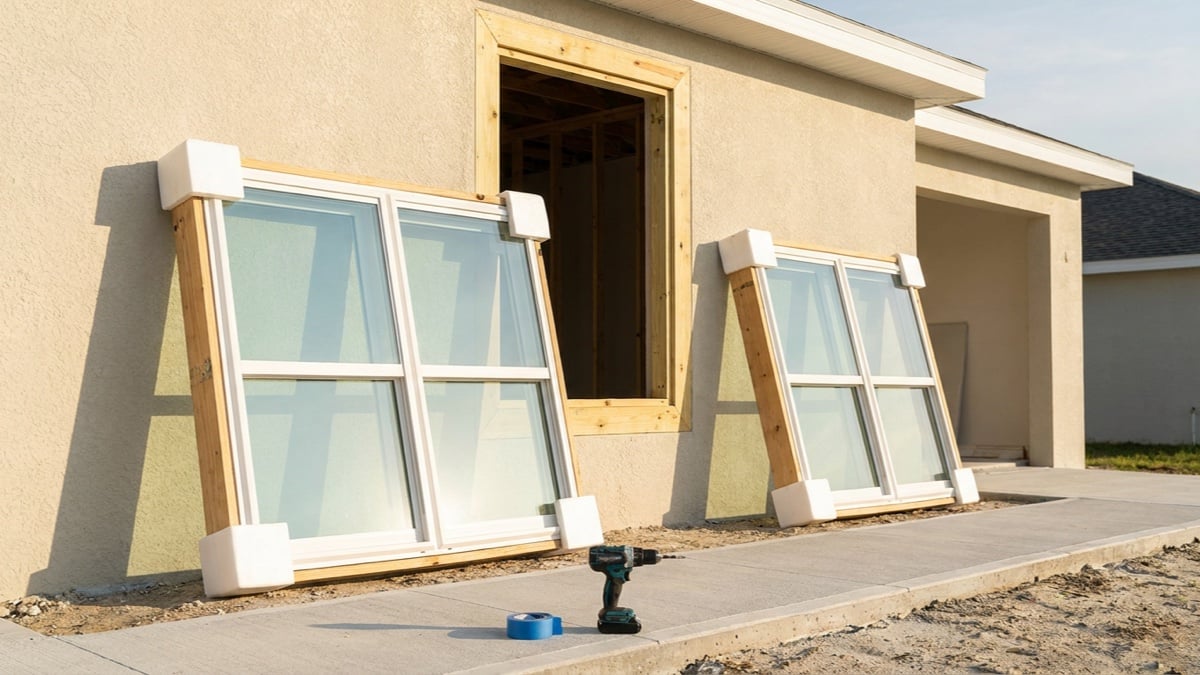
Featured image: AI-generated editorial illustration of two new residential window units in shipping frames with foam corner blocks leaning against the stucco wall of a house under construction, beside an empty framed window opening. Not a particular home, product or property.