

If roof work touches 25 percent or more of a roof area in any 12-month period, Florida’s building code requires replacing the covering on that entire roof system, with one exception that decides most deals: a roof already built to the 2007 Florida Building Code or later only has to fix the damaged portion. The question that moves money is not how old the roof looks. It is which code edition the last permitted roof work was done under, and that answer sits in the building department’s permit record.
What the code counts, and over what period
The rule is in the Florida Building Code, Existing Building, Eighth Edition (2023), Section 706.1.1: not more than 25 percent of the total roof area or roof section of an existing building may be repaired, replaced or recovered in any 12-month period unless the roof covering on the entire existing roof system or roof section is replaced or recovered to conform to the code.
Three phrases in that sentence do the work. “In any 12-month period” makes the threshold cumulative, so two separate 400-square-foot repairs eight months apart on a 2,400-square-foot roof are not two 17 percent repairs. They are 800 square feet, or 33.3 percent, and the second permit crosses the line.
“Total roof area or roof section” sets the denominator, and the code allows either. Whether a detached garage, a porch roof or a separate plane counts as its own roof section changes the percentage sharply, and that call belongs to the building official reviewing the permit rather than the roofer writing the estimate. “The roof covering” limits what gets triggered: crossing 25 percent requires replacing or recovering the covering, not reframing the structure.
The exception that decides most transactions
Section 706.1.1 carries an exception drawn from section 553.844(5), Florida Statutes (2026): if an existing roofing system or roof section was built, repaired or replaced in compliance with the requirements of the 2007 Florida Building Code or any subsequent edition, and 25 percent or more of it is being repaired, replaced or recovered, only the repaired, replaced or recovered portion must meet the code in effect.
Note what the statute asks: which code edition the roofing system was built, repaired or replaced in compliance with. A roof installed under the 2004 code does not qualify merely because the work happened after 2007, and a roof that looks tired still qualifies if its last permitted replacement met a qualifying edition.
The same subsection closes a door most people do not know exists. Notwithstanding section 553.73(4), a local government may not adopt by ordinance an administrative or technical amendment to this exception. The Florida Building Commission adopted the code by Rule 61G20-1.001, effective March 18, 2026, which implements section 553.844(5). No county or city in Florida can make this exception stricter or looser, so the rule reads identically in Orange County, in Lake County and statewide. What varies locally is the permit process and the records, not the rule.
How the percentage works on a real roof
| Scenario on a 2,400 sq ft roof | Math | Roof built to 2004 code or earlier | Roof built to 2007 code or later |
|---|---|---|---|
| One damaged slope, 500 sq ft | 500 / 2,400 = 20.8 percent | Repair the damaged portion only. Under the threshold. | Repair the damaged portion only. Under the threshold. |
| Larger damaged area, 700 sq ft | 700 / 2,400 = 29.2 percent | Replace or recover the covering on the entire roof system or section to current code. | Repair the 700 sq ft only. Exception applies. |
| Two repairs, 400 sq ft each, eight months apart | 800 / 2,400 = 33.3 percent in 12 months | The second permit triggers the entire roof system or section. | Repair the second 400 sq ft only. Exception applies. |
The gap between the two right-hand columns is the whole negotiation. On the 29.2 percent case, one roof gets a patch and an identical roof next door gets a complete tear-off, and the only difference between them is a permit record.
What a triggered replacement adds beyond shingles
Section 553.844(3)(a) requires that a roof replacement on a site-built single-family home incorporate secondary water barriers and corrected or strengthened roof-decking attachments and fasteners. Those are line items, and they are why a triggered replacement does not price out like a simple reroof.
Subsection (3)(b) adds roof-to-wall connection retrofits, but only for a building in the wind-borne debris region as defined in section 1609.2 of the International Building Code (2006) with an insured value, or a just valuation of the structure for ad valorem purposes, of $300,000 or more. The Legislature capped that cost: under subsection (2)(b)3, roof-to-wall connections are not required unless evaluation and installation at gable ends or all corners can be completed for 15 percent of the cost of roof replacement. On an $18,000 replacement the ceiling is $2,700, and if the retrofit cannot be done for that, it is not required. Have the roofer state in writing whether the address sits inside that region.
Verify the roof’s code vintage before you negotiate
Since the exception turns on the permit record, pull the record first. Both of our core counties publish one online.
In unincorporated Orange County, the Division of Building Safety issues roofing permits, and the Fast Track permit search is open without an account, searchable by address, file number or parcel. The county also states plainly that a replacement roof needs a roof permit, that re-roofs require an in-progress inspection as well as a final inspection, and that roof-overs require a permit and final inspection only. That in-progress inspection matters to a buyer, because it is where deck attachment and secondary water barrier work is examined. A re-roof permit with a final but no in-progress inspection record is worth a question.
In unincorporated Lake County, Building Services publishes a records search with lookups by address, alternate key, permit number, owner name, contractor and issue date. Read the county’s own caveat before relying on it: the permit data is provided for informational purposes only, and permit activity reports are not official records of open or expired permits. Confirm with the department at [email protected] rather than resting on a screenshot.
Check jurisdiction first in either county. If the address sits inside a municipality rather than the unincorporated county, the county search will not hold the permit. Lake County directs residents to the Property Appraiser’s record to read the millage group and city fields, and states that if a city is listed you contact that city’s building department directly. A permit that appears to be missing is often a permit filed one jurisdiction over.
Who pays when the code forces the bigger job
When the 25 percent rule converts a patch into a full replacement, the extra cost is a code-upgrade cost, which is a specific coverage question under section 627.7011, Florida Statutes (2026) rather than a general claim question.
Under subsection (2), unless the insurer obtains the policyholder’s written refusal, a policy covering the dwelling is deemed to include law and ordinance coverage limited to 25 percent of the dwelling limit. On a $400,000 dwelling limit that is $100,000 for costs necessary to meet applicable laws and ordinances, and policyholders may select 50 percent instead, which on the same limit is $200,000.
The limit is not the whole story. Subsection (1)(b) provides that the coverage applies only to repairs of the damaged portion of the structure unless total damage to the structure exceeds 50 percent of the replacement cost of the structure. A wind event that damages 29 percent of a roof has not damaged half the house, so a code-driven requirement to replace the undamaged 71 percent of the covering can fall outside what that coverage reaches even when the dollar limit looks ample. Get the carrier’s position in writing, citing the policy’s law and ordinance endorsement, before assuming insurance absorbs the difference.
One interaction is worth knowing. Section 627.7011(5)(d) calculates a roof’s age for insurance purposes from the last date 100 percent of the roof’s surface area was built or replaced in accordance with the building code in effect at that time, or from the initial date of a partial replacement where later partials brought the surface to 100 percent. A 29 percent patch does not reset the roof’s insurance age. It can solve the building-code problem and leave the underwriting problem where it was, which we covered separately in what a 4-point inspection reports about a Florida roof.
How to use this during the inspection period
Order matters. Pull the permit record before pricing the repair, because the vintage determines which of two very different jobs you are negotiating.
- Pull the permit history for the address in the correct jurisdiction and find the last permitted roof replacement, its issue date and its final inspection.
- Ask the building department which code edition governed that permit. That single answer decides whether the exception applies.
- Have the roofer measure the damaged area and state the denominator in writing, total roof area or a specific roof section.
- Add up any roof permits in the trailing 12 months, because prior patches count toward the threshold.
- If the threshold triggers, get the replacement quoted with secondary water barrier and deck-fastener work included, not as a shingle-only number.
- Get the carrier’s written position on law and ordinance coverage before treating the upgrade cost as covered.
On the negotiation, the room to ask comes from the gap between where the home is positioned and where homes like it actually trade. A seller-paid credit at closing usually serves a buyer better than a seller-managed repair, because the credit protects the comp and you keep control of the contractor and the scope. That works only if the home still appraises with the credit in place, so size it against the price rather than against the estimate. If the code forces a full replacement, make the ask with the permit record and the code section attached, because a documented requirement carries more weight than an inspector’s opinion.
Sellers get leverage from the same record. If your last replacement was permitted under a qualifying code edition, that is a documented answer to a buyer asking for a new roof, and it is worth pulling before you list. For the disclosure side, see what Florida sellers must disclose on an AS IS sale.
Common questions
Does the 25 percent rule apply to a repair, or only to a replacement?
Both. Section 706.1.1 counts area that is repaired, replaced or recovered, so a large repair reaches the threshold the same way a partial replacement does. The label on the roofer’s invoice does not control it. Area within a 12-month period does.
My roof is 18 years old. Does that mean the exception cannot apply?
Not necessarily, and this is the most common mix-up. The building-code exception in section 553.844(5) turns on the code edition the roofing system was built, repaired or replaced in compliance with, not on elapsed years. Insurance is where age itself carries legal weight, under a different statute and a different test. Treat them as two questions with two answers.
The sellers never pulled a permit for their reroof. What does that do to us?
It removes the evidence the exception depends on. With no permit record showing the work met a qualifying code edition, you cannot establish that only the damaged portion needs attention, and unpermitted work carries its own problems at closing and at renewal. We walk through that exposure in selling a Florida home with open or expired permits.
A roof question is always about one specific address and one specific permit record, so settle it on the property rather than in the abstract. If you are weighing a repair-or-replace ask inside an inspection period in Orange or Lake County, book a strategy session at mvphomegroup.com/nelsoncruz.
Nelson Cruz, P.A.
Founder & CEO
MVP Home Group, Real Broker LLC
Nelson brings nearly two decades in law enforcement to his work in real estate. View Nelson’s profile or contact our team at 407-901-9939 or [email protected].
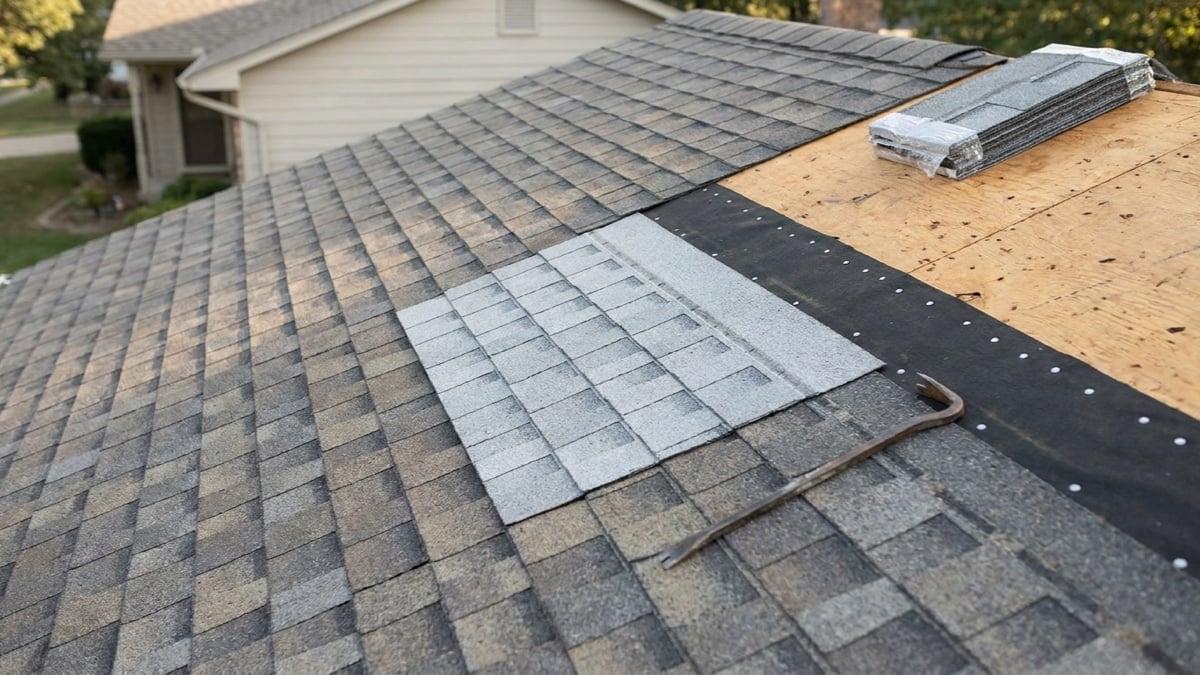
Featured image: AI-generated editorial illustration of a residential asphalt shingle roof where a rectangular section of new light-gray shingles meets older sun-faded charcoal shingles, beside a small area of exposed roof deck and a bundle of new shingles. No people and no readable text. Not a particular property, street or neighborhood.