

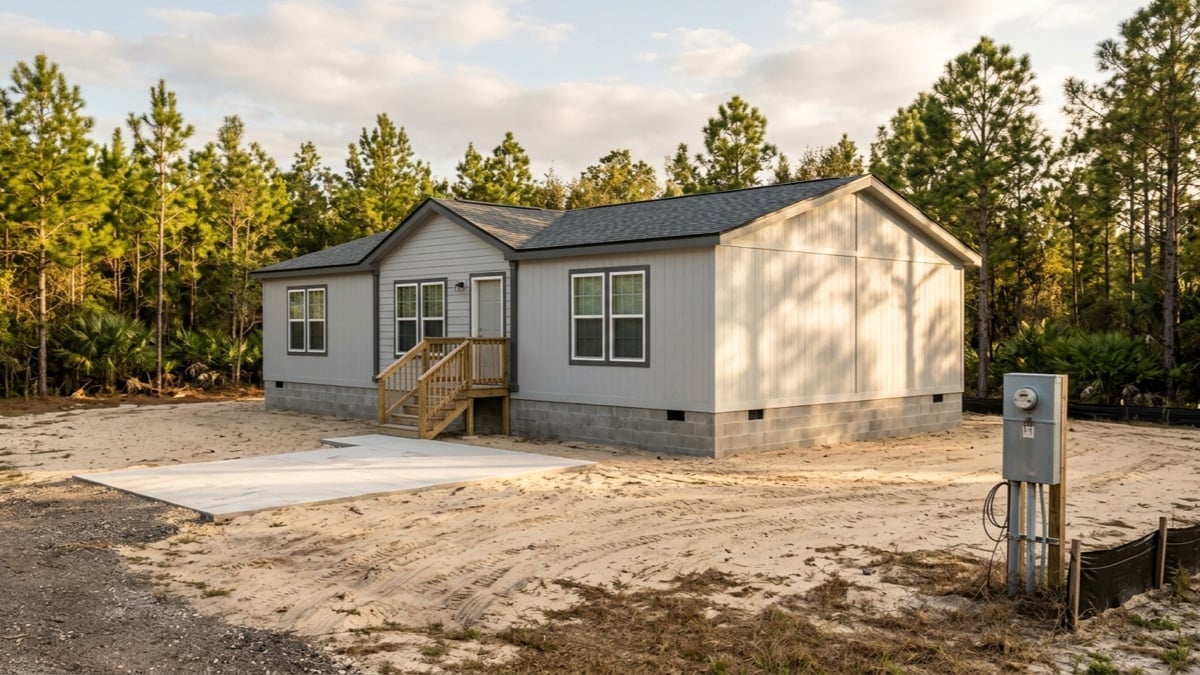
Since July 1, 2026, Florida law has required every county and city to permit a manufactured home as of right in any zoning district that allows single-family detached houses, as long as the home is treated as real property. Zoning is no longer the question on most lots. What decides your purchase is whether the lot itself can take a septic system, legal access and a flood-compliant foundation.
We get this question from buyers pricing cheap vacant land with a plan to set a new double-wide on a permanent foundation. The law moved in your favor this year. The dirt did not change at all, and the dirt is where these deals fail.
The 2026 statute that changed the zoning answer
Section 553.385, Florida Statutes, was created twice in the 2026 session, so check the date behind any answer you are given. Chapter 2026-63, Laws of Florida (CS/CS/HB 803), created the section in its section 6 with no delayed date and took effect July 1, 2026 under its own section 12, having been approved by the Governor on May 6, 2026. Chapter 2026-7 (CS/CS/CS/HB 399) created a second version of the same section number in its section 8, effective January 1, 2027. Both carry the identical operative command, quoted from s. 553.385(2)(a): an off-site constructed residential dwelling “must be permitted as of right in any zoning district where single-family detached dwellings are allowed.”
The definition decides whether your home qualifies. Section 553.385(1)(b) reaches a manufactured building under s. 553.36 and, separately, a manufactured home as defined in s. 320.01(2)(b) that is constructed in whole or in part off site and is treated as real property. Section 320.01(2)(b) defines a manufactured home as a mobile home fabricated on or after June 15, 1976 in an offsite manufacturing facility, each section bearing a seal certifying compliance with the federal Manufactured Home Construction and Safety Standards Act. A new HUD-labeled double-wide sits squarely inside that definition.
Treated as real property is the condition buyers skip
The parity right attaches to the home’s legal character rather than to its size or price, and Florida gives you two ways to establish it.
The tax route runs through s. 193.075(1). A mobile home is taxed as real property when the owner of the home is also the owner of the land on which it is permanently affixed, and that subsection defines permanently affixed as tied down and connected to the normal and usual utilities. A home taxed that way is issued an “RP” series sticker under s. 320.0815.
The stronger route is s. 319.261, which retires the state title altogether once you record the title, the legal description and a sworn statement that the home is permanently affixed in accordance with state law. From that point the home conveys by deed, transfers only with the property it is affixed to, and can no longer carry a separate security interest, because s. 319.261(7) leaves the mortgage on the real property as the only way to secure it.
Both paths require that you own the ground. A leased lot, or a home you keep on a motor vehicle title, puts you outside the parity statute and back in front of whatever your local code says about mobile homes.
What the parity law does not override
Section 553.38 reserves setbacks, side and rear yard requirements, site development requirements, property line requirements, subdivision control, onsite installation requirements and architectural review to local authorities, and the 2026 statute leaves that list standing. Each reserved item must be applied without distinction as to whether a building is conventionally constructed or manufactured, and permit fees for installation inspections have to equal what the jurisdiction charges for similar inspections on conventionally built housing.
| Question about your lot | Who decides it | Can the county apply it to you? |
|---|---|---|
| Is a manufactured home allowed in this district at all? | State law, s. 553.385(2)(a) | No. If detached single-family is allowed, your home is allowed as of right. |
| Roof pitch, exterior finish, foundation enclosure, minimum livable square footage | Local compatibility standards, s. 553.385(2)(c) and (d) | Yes, if the same standard applies to site-built houses in that district. |
| Setbacks, lot dimensions, orientation on the lot | Local code, s. 553.38 and s. 553.385(2)(d) | Yes, applied uniformly. |
| Septic permit and lot capacity | Florida DEP, s. 381.0065 | Yes. The parity statute says nothing about sewage. |
| Legal road access to the lot | Local site development rules and ss. 704.01 to 704.04 | Yes. |
| Flood elevation and anchoring | Federal minimums at 44 CFR 60.3, enforced locally | Yes. |
| Denial because neighboring houses are site-built | Nobody. Void under s. 553.385(3) | No. |
Can the lot take a septic system?
This is the gate that disqualifies most inexpensive lots, and state rule decides it rather than the seller. Under s. 381.0065(4) nobody may construct an onsite sewage treatment and disposal system without first obtaining a permit approved by the department, and s. 381.0065(2)(d) now defines that department as the Florida Department of Environmental Protection. Regulation of the Onsite Sewage Program moved out of the Department of Health under the Clean Waterways Act, chapter 2020-150, on a phased county-by-county schedule set out in chapter 2024-180, so confirm which agency currently runs the program in your county before filing anything.
Two numbers in that statute tell you quickly whether a small lot works.
- Well plus septic: s. 381.0065(4)(c) allows a lot with a minimum area of at least one-half acre, which is 21,780 square feet, and either a minimum dimension of 100 feet or a mean of at least 100 feet along the street side, provided projected daily sewage flow stays at or under an average of 1,500 gallons per acre per day and the setback, soil condition and water table requirements can all be met.
- Public water plus septic: s. 381.0065(4)(d) allows septic where there are no more than four lots per acre, which works out to 10,890 square feet per lot, with projected flow at or under 2,500 gallons per acre per day.
Septic also closes off entirely when public sewer is legally available. Under s. 381.0065(1)(a)1., sewer counts as available to a single-family residence when a gravity line, or an approved low pressure or vacuum collection line, exists in a public easement or right-of-way that abuts the property line of the lot. A line that abuts your boundary converts your plan from a drainfield into a connection, with the connection cost attached.
Setbacks then eat the usable area on a narrow lot. The statute’s distance list includes 75 feet from a private potable well, 50 feet from any nonpotable well, and 75 feet from the mean annual flood line of a permanent nontidal surface water body. Lay those circles on a quarter-acre rectangle before you write an offer.
Legal access, and what a landlocked lot actually costs
A dirt track to a lot is a different thing from a recorded right to use it. Florida recognizes an implied grant of a way of necessity under s. 704.01(1), though only where a unity of title exists from a common source other than the original grant from the state or the United States. Section 704.01(2) adds a statutory way of necessity for land desired to be used for a dwelling that is shut off or hemmed in with no practicable route to the nearest practicable public or private road in which the owner holds vested easement rights, and that route covers utility service including water, wastewater, natural gas, electricity and telephone.
Read the price tag in s. 704.04 before treating that as a solution. If the neighbor objects or wants to be paid, either party or the board of county commissioners files suit in circuit court, and the court determines the type, duration, extent and location of the easement along with the compensation and any attorney’s fees. That section closes with the line that matters to a buyer: the easement dates from the time the award is paid. A lawsuit and a payment stand between you and the driveway, and your lender will want the easement recorded first. Our breakdown of who pays for private road repairs covers the maintenance side once access exists.
Flood zone: a single lot gets the strict rule
Federal minimum standards at 44 CFR 60.3(c)(6) treat your situation differently from a home going into a park. A manufactured home placed in Zones A1-30, AH or AE on a site outside a manufactured home park or subdivision has to be elevated on a permanent foundation so that the lowest floor sits at or above the base flood elevation, and securely anchored to an adequately anchored foundation system to resist flotation, collapse and lateral movement. Homes going onto lots inside an existing park get the softer alternative at 44 CFR 60.3(c)(12), where reinforced piers supporting the chassis can satisfy the rule. Buying your own lot forfeits that alternative.
In an unnumbered Zone A with no published elevation data, 44 CFR 60.3(b)(8) still requires the home to be elevated and anchored, on top of state and local anchoring requirements for wind. Pull the flood zone before the appraisal, because fill, a stem wall and an engineered foundation can cost more than the lot. If the mapping looks wrong, see how a map amendment works.
What to settle before your inspection period ends
- Request a written zoning verification letter naming the district and confirming detached single-family dwellings are permitted in it.
- Ask the building department which compatibility standards from s. 553.385(2)(d) it has adopted, and get the roof pitch and minimum square footage figures in writing.
- Order a boundary survey, then overlay the setbacks and the septic distance requirements on it.
- Apply for a septic site evaluation yourself rather than relying on a seller’s claim, and ask whether a sewer line abuts the parcel.
- Get a utility availability letter from the water provider and a service estimate from the electric utility, measured to your proposed stake.
- Have the title agent confirm recorded legal access and read every easement and recorded restriction.
- Pull the FEMA zone and the base flood elevation, and price the foundation to that elevation.
Private deed restrictions deserve their own line. The parity statute binds counties and municipalities, and it does not rewrite a recorded covenant on a platted subdivision that bans manufactured housing. A title search finds those; a zoning letter will not.
Frequently asked questions
Can a county deny my permit because every other house on the street is site-built?
No. Section 553.385(2)(b) forbids any zoning, land use or development regulation that treats an off-site constructed residential dwelling more restrictively than a site-built dwelling allowed in the same district, s. 553.385(2)(e) bars regulation based solely on the method of construction, the location of construction or the presence of components constructed off site, and s. 553.385(3) declares any conflicting ordinance void and unenforceable as applied. Neighborhood character is not a lawful ground for that denial.
Can the county make me improve or pave the road before it issues a permit?
Possibly, and the parity statute does not exempt you. Section 553.38 expressly reserves site development requirements and subdivision control to local authorities. What the statute forbids is applying a tougher access or site standard to you because the home is factory-built. Ask for the written standard and the code citation, then compare it against what a site-built house on the same lot would face.
Do I have to retire the title before closing on the land?
No, and the sequence runs the other way. Section 193.075(1) and s. 319.261 both depend on the home already being permanently affixed to land you own, which cannot happen until you close, permit the installation and set the home. Plan on buying the lot, installing the home, then converting it to real property. Tell your lender that timeline early, because loan products on a lot and a new manufactured home work differently from a conventional purchase. Our guide to financing a Florida manufactured home covers that side.
If you are weighing a vacant lot in Orange, Lake, Osceola, Seminole or Polk County for a manufactured home, send us the parcel number before you write the offer and we will pull the zoning district, the flood zone, the sewer situation and the recorded access. Book a strategy session with our team at mvphomegroup.com/nelsoncruz. Related reading: when a septic and well property has to connect to city utilities. This is general information about Florida statutes and federal regulations rather than legal advice; the current code in your jurisdiction and a Florida attorney control the outcome.
Nelson Cruz, P.A.
Founder & CEO
MVP Home Group, Real Broker LLC
Nelson brings nearly two decades in law enforcement to his work in real estate. View Nelson’s profile or contact our team at 407-901-9939 or [email protected].
Featured image: AI-generated editorial illustration of a new double-wide manufactured home set on a finished block foundation on a cleared sandy lot, with a concrete driveway apron and young pines behind it. Not a particular home, lot or community.