

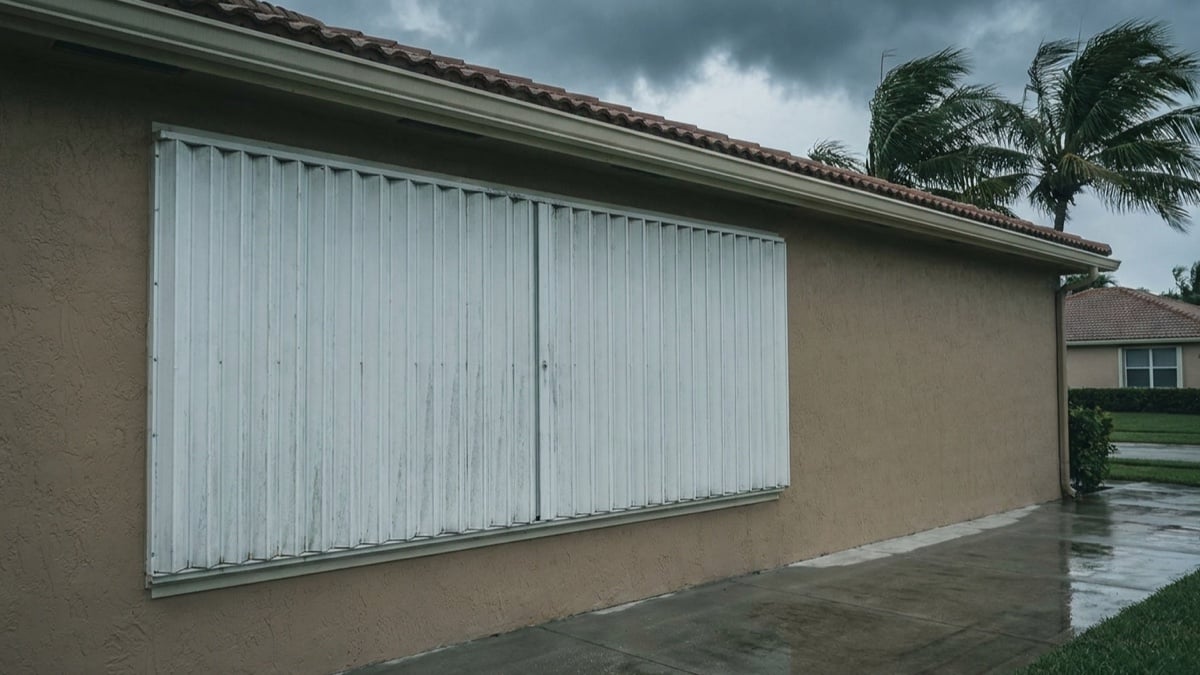
Your hurricane deductible is a percentage of the dwelling limit shown on your policy rather than a percentage of the purchase price, and Florida law applies it once per calendar year instead of once per storm. On a $430,000 dwelling limit, the 2 percent option comes to $8,600. Every hurricane loss during that year draws against the same $8,600 until it is used up.
Section 627.701(4)(b), Florida Statutes (2026), requires the insurer to compute that dollar value and display it prominently on the declarations page when the policy is issued. Read it during your inspection period, while changing the answer is still free.
What the percentage is measured against
Section 627.701(3)(a) states the deductible options as percentages “of the policy dwelling limits.” That limit is the figure your insurer sets for the structure. Your contract price is the figure you negotiated.
On a declarations page showing a $430,000 dwelling limit for a home bought at $575,000, the 2 percent hurricane deductible is $8,600. Running 2 percent against the purchase price returns $11,500 and overstates your exposure by $2,900.
Section 627.701(4)(a) requires a policy carrying a separate hurricane deductible to say so on its face in boldfaced type no smaller than 18 points, warning that it may result in high out of pocket expenses. Section 627.701(4)(c) requires a further warning where an inflation guard rider is attached, because the rider moves the limit the percentage runs against.
The choices your insurer has to put in front of you
Before issuing a personal lines residential policy, section 627.701(3)(a) requires an offer of hurricane deductibles equal to $500, 2 percent, 5 percent and 10 percent of the policy dwelling limits, dropping any percentage that computes below $500. The menu narrows as the limit rises.
| Dwelling limit | What the insurer must offer | Statute |
|---|---|---|
| Under $100,000 | $500, 2, 5 and 10 percent | 627.701(3)(a) |
| $100,000 to under $250,000 | May replace the $500 option with a policy carrying up to 2 percent, guaranteed against nonrenewal for hurricane loss reduction reasons for one renewal period | 627.701(3)(c) |
| $250,000 or more | Need not offer $500; the other amounts still apply | 627.701(3)(d)1 |
| $1 million to under $3 million | May offer 3 percent in place of 2 percent | 627.701(3)(d)2 |
| $3 million or more | Need not offer 2 percent; the other amounts still apply | 627.701(3)(d)3 |
The written offer must specify which deductible applies if you never affirmatively choose one. A policy bound quickly inside a short closing window can default you into a percentage nobody discussed.
Electing more than 10 percent is deliberately difficult. On a risk valued below $500,000, section 627.701(4)(d)1 requires a statement you personally write or type acknowledging that your insurance will not pay the first stated dollar value of hurricane damage, signed and dated by every named insured, plus written lienholder approval where there is a mortgage. Section 627.701(7) separately requires an offer of a $500 deductible for perils other than hurricane.
One deductible, a whole calendar year of storms
Section 627.701(5)(a)1 applies the hurricane deductible on an annual basis to all covered hurricane losses occurring during the calendar year under one or more policies issued by the same insurer or an insurer in the same insurer group. For a later hurricane that year, section 627.701(5)(a)3 lets the insurer apply the greater of your remaining hurricane deductible or your deductible for other perils. On the $8,600 figure, with a $1,000 deductible for all other perils:
- A first hurricane causes $6,000 of covered damage. That falls below $8,600, so you absorb all $6,000.
- Your remaining hurricane deductible for the rest of that calendar year is $2,600.
- A second hurricane causes $30,000 of covered damage. The deductible applied is the greater of $2,600 and $1,000, so the insurer pays $27,400.
- Across both storms you paid $8,600. Charged per storm, the second claim alone would have paid $21,400, a $6,000 difference.
That credit depends on documentation. Section 627.701(5)(a)3 permits insurers to require policyholders to report hurricane losses falling below the deductible, or to keep receipts for them, before applying those losses to a later claim. Report the small storm and keep the invoices even when the insurer owes you nothing for it.
When the hurricane clock starts and stops
Section 627.4025(2)(c) defines a hurricane as a storm system declared to be a hurricane by the National Hurricane Center, and fixes its duration in Florida as beginning when a hurricane warning is issued for any part of Florida and ending 72 hours after the last hurricane watch or warning for any part of Florida is terminated. Read “any part of Florida” literally: the window can stay open over your roof while your own county sits under clear sky.
Section 627.4025(2)(a) reaches ensuing interior damage from rain, hail, sand or dust only where the direct force of the windstorm first damaged the building and created the opening the water came through. Water arriving by another route is a separate question, which is why flood coverage sits alongside this policy rather than inside it.
The separate roof deductible, and where it stops
Section 627.701(10) lets an insurer write a separate roof deductible, capped at the lesser of 2 percent of the Coverage A limit or 50 percent of the cost to replace the roof. On that $430,000 limit with a $15,000 roof replacement cost, the cap is the lesser of $8,600 and $7,500, so $7,500. It reaches only claims adjusted on a replacement cost basis.
The carve outs decide most real claims. Under section 627.701(10)(a)5 it does not apply to a total loss under the valued policy law at section 627.702, to a roof loss resulting from a hurricane as defined in section 627.4025(2)(c), to a tree fall or other hazard puncturing the roof deck, or to a roof loss requiring repair of less than 50 percent of the roof. A hurricane that takes your roof is charged against the hurricane deductible instead.
You can decline it at issuance by signing an office approved rejection form. At renewal an insurer may add one through a notice of change in policy terms under section 627.43141, and must still carry the opt out. See also how Florida’s 25 percent roof rule decides patch versus full replacement.
Trading a mitigation discount for a lower deductible
Mitigation credits are usually presented as a premium discount. Section 627.701(9) gives you a second route: where the policyholder has taken appropriate hurricane mitigation measures, the insurer shall provide the option of selecting either an appropriate reduction in the policy’s hurricane deductible or the discount or credit under section 627.0629, with notice of both options on a form approved by the office. Section 627.711(1) requires that notice at issuance and at each renewal, covering the range of each discount, credit, rate differential or reduction in deductibles.
Comparing the two routes is straightforward because section 627.0629(4) requires the premium notice to state the hurricane premium separately from the premium for all other coverages. The inspection documenting those features is covered in our guide to wind mitigation inspections and the discounts they support.
What to settle before you close
- Get the declarations page rather than a quote summary, and read the printed dollar value required by section 627.701(4)(b).
- Confirm which deductible the written offer applies if nobody affirmatively selects one.
- Check whether an inflation guard rider is attached.
- Ask whether a separate roof deductible is on the policy, what figure it carries, and whether you were offered the rejection form.
- Request the section 627.711 mitigation form and ask whether a deductible reduction is available in place of the premium credit.
- Hold the hurricane deductible as cash outside your closing funds.
Frequently asked questions
Is my hurricane deductible based on what I paid for the house?
No. Section 627.701(3)(a) measures the percentage against the policy dwelling limits, the figure your insurer sets for the structure rather than the price you negotiated. Section 627.701(4)(b) requires the insurer to compute that dollar amount and display it prominently on the declarations page at issuance, so you should never need to calculate it yourself.
If two hurricanes hit in the same year, do I pay the deductible twice?
Generally no. Section 627.701(5)(a)1 applies the deductible on an annual basis to all covered hurricane losses during the calendar year under policies from the same insurer or group, and section 627.701(5)(a)3 lets the insurer charge the greater of your remaining hurricane deductible or your deductible for other perils. That subsection also allows insurers to require you to report below deductible losses or keep receipts, so document the small storm.
Can I lower my hurricane deductible in the middle of hurricane season?
Not with immediate effect after a hurricane loss that year. Under section 627.701(5)(a)4, a policyholder who had a hurricane loss under a prior policy and is then offered a lower hurricane deductible must be notified in writing that the lower figure will not apply until January 1 of the following calendar year.
Where to go from here
Whether a carrier will write the house at all gets settled before the deductible question; see when a four point inspection is required to insure a Florida home, and whether your Florida insurer can cancel after you close.
If you are under contract now and want the insurance questions sequenced against your inspection deadline, book a strategy session with our team at mvphomegroup.com/nelsoncruz. We read the declarations page with you before the inspection period closes. This is general information about Florida insurance statutes rather than insurance advice; your policy terms control, and a licensed insurance agent should confirm what applies to your policy.
Nelson Cruz, P.A.
Founder & CEO
MVP Home Group, Real Broker LLC
Nelson brings nearly two decades in law enforcement to his work in real estate. View Nelson’s profile or contact our team at 407-901-9939 or [email protected].