

Toho Water Authority charges a one-time system development charge to connect a new home to its water and sewer system. On the standard three-quarter-inch residential meter that charge is $9,943 through December 31, 2026. It becomes $10,629 on January 1, 2027 and $11,315 on January 1, 2028.
The increase is already adopted: Toho’s Board of Supervisors approved the step schedule by resolution at a public hearing on January 22, 2025. Holding the current rate takes an active municipal building permit, a Toho Utility Permit with approved construction plans, and payment in full before January 1, 2027.
What the charge is and who collects it
Toho describes system development charges in its own materials as charges “formally known as impact fees,” imposed on all new development because development requires the utility system to be extended and expanded. The authority to impose them comes from the Toho Special Act, Chapter 2003-368, Laws of Florida, as amended. The charge is not a deposit, is not credited against your monthly bill, and is assessed on the lot rather than on the buyer.
Toho is the largest provider of water, wastewater and reclaimed water service in Osceola County, serving more than 160,000 customers in St. Cloud, Kissimmee, Poinciana and unincorporated areas of Osceola, Polk and Orange counties. Toho combined utility systems with the City of St. Cloud on October 1, 2022, so a St. Cloud address now runs through the same schedule as a Kissimmee one. A lot outside the service area is served and priced by somebody else entirely.
How Toho arrives at $9,943
Meter size drives the number, and the three-quarter-inch meter is the standard single-family size. Underneath the meter size sits a level of service expressed in gallons per day. Toho assigns a home 200 gallons per day of typical indoor use at a peak day factor of 1.2, which is 240 gallons, plus 50 gallons of irrigation at a factor of 2.0, which is 100 gallons. Those add to a water level of service of 340 gallons per day. The wastewater level of service is 221 gallons per day, consistent with the indoor peaking factor alone.
Each of those daily gallons carries a price: $19.55 for water and $14.90 for wastewater in the current schedule. Multiply 340 by $19.55 and you land within a few dollars of the $6,650 water charge on the published table, and 221 at $14.90 reconciles the same way to the $3,293 wastewater charge. The reason this matters to a buyer is that the charge scales with meter size rather than with home price. A lot specified for a one-inch meter carries $16,605 today instead of $9,943, and nothing about the house changes that.
One detail is easy to miss in the 2027 step: the wastewater side does not move. The water charge goes from $6,650 to $7,336 and then to $8,022, while wastewater stays at $3,293 through 2028. Every dollar of the increase is on the water system.
| Meter size | Total through Dec 31, 2026 | Total from Jan 1, 2027 | Difference |
|---|---|---|---|
| 3/4 inch (standard single-family) | $9,943 | $10,629 | $686 |
| 1 inch | $16,605 | $17,750 | $1,145 |
| 1.5 inch | $33,111 | $35,395 | $2,284 |
| 2 inch | $52,997 | $56,653 | $3,656 |
The two conditions that hold the 2026 rate
Toho publishes the test plainly. A project qualifies for the 2026 rates only if it has an active municipal building permit and a Toho Utility Permit with approved construction plans, and only if the charges are paid in full before January 1, 2027. An issued invoice does not hold the price. Where an invoice went out before January 1, 2027 and the charges were not paid in full by that date, a new assessment is required and the 2027 rates apply.
Two situations have their own published answers. If the building permit has expired, the fix is to obtain an updated permit and pay in full before January 1, 2027. If system development charge credits are being applied, the credits have to be applied in full before that same date or a new assessment follows. Forty-seven days separate today from the step, and Toho processes payments received after 3 p.m. on the following business day, which is worth knowing if anyone is planning to settle this during the last week of December.
What the charge does not cover
The system development charge buys capacity in the system. Physical connection work and hardware sit on a separate fee schedule. Toho’s posted development fees include $500 for a three-quarter-inch potable meter with dual check, $2,250 for a tap, $4,800 for a sanitary lateral and $150 for a sanitary connection. Those are assessed against the project rather than billed to a buyer at closing, and they are why a quoted hookup cost rarely matches the published system development charge on its own.
Where this sits among the other charges on a new Osceola home
Osceola County collects its own impact and mobility fees at permit, and they are considerably larger. Under the countywide residential schedule effective June 20, 2025, a single-family home carries $21,710.14 in mobility fees, $12,923.00 in school fees, $2,304.72 in park fees and $780.00 in fire fees, a total of $37,717.86 before a $60.00 administrative charge. Three areas inside the county, East of Lake Toho, South Lake Toho and the Alligator Chain of Lakes, carry lower mobility components, between $20,013.76 and $21,347.00 for a single-family home. Add Toho’s $9,943 and the government and utility charges on one new single-family house reach $47,660.86 today, rising to $48,346.86 in January.
All of that is paid at the permit stage, long before a closing statement exists. It is separate from the recurring charges that begin once the home is finished: the fire rescue and solid waste assessments that start at your certificate of occupancy, and the community development district assessments that arrive on the tax bill in districts that have them.
What to do with this before you sign
On a finished or nearly finished production home the permit was pulled months ago and these charges were settled then. The date matters if you are building on your own lot, or if you have contracted for a home whose permit has not been issued yet.
- Ask the builder, in writing, whether the Toho Utility Permit has been issued for your lot and whether the system development charges have been paid.
- Read your contract’s provision on increases in government and utility fees between contract and permit. Builder contracts differ on who absorbs them, and this is a dated, published increase rather than a speculative one.
- Confirm the specified meter size. Three-quarter-inch is standard; a one-inch meter adds $6,662 at current rates.
- Check the address on Toho’s service area map rather than assuming by city, since Toho also serves unincorporated parts of Polk and Orange counties and does not serve every Osceola address.
Frequently asked questions
Will the Toho connection charge appear on my closing statement?
Not on a builder-built home. Toho’s published timing allows payment upon issuance of the municipal building permit or the Toho Utility Permit with approved construction plans, both of which come before a production home is completed and sold. The charge is handled by whoever pulled the permit. A custom build on your own lot is the case where you pay it directly.
Is this the same thing as Osceola County impact fees?
No. The county’s impact and mobility fees are adopted by Osceola County and collected at permit for roads, schools, parks and fire. Toho’s system development charge is adopted by the Toho Water Authority Board of Supervisors under the Toho Special Act and funds expansion of the water and wastewater system. A new home inside Toho’s service area in unincorporated Osceola is assessed both.
Does the January 1, 2027 increase reach a home already under construction?
It reaches any project whose charges are not paid in full by December 31, 2026. An active building permit and an approved Toho Utility Permit are the qualifying conditions, and payment in full before January 1, 2027 is what locks the current rate. Toho’s published answer is explicit that an unpaid invoice issued before that date does not hold it.
About this guide
Sources read on November 15, 2026: Toho Water Authority’s system development charges page for the current schedule, level of service and payment timing; Toho’s published schedule of new system development charges effective January 1, 2027; Toho’s development fees page for meter, tap and lateral charges; Toho’s service area page; the January 22, 2025 Board of Supervisors public hearing item adopting the resolution, read in Toho’s own posted document; and Osceola County’s residential impact and mobility fee rate tables effective June 20, 2025. Published schedules change, so confirm current figures with Toho and with Osceola County before relying on them. Nothing here is legal or tax advice, and MVP Home Group has no affiliation with Toho Water Authority or any builder.
If you are buying new construction in Kissimmee, St. Cloud or anywhere in Osceola County, we read the builder’s contract and the district and utility charges with you before you sign, not after. Book a strategy session at mvphomegroup.com/nelsoncruz. If you want the governance side of a district community, start with who actually runs the two boards in your community.
Nelson Cruz, P.A.
Founder & CEO, MVP Home Group, Real Broker LLC
Nelson brings nearly two decades in law enforcement to his work in real estate. View Nelson’s profile or contact our team at 407-901-9939 or [email protected].
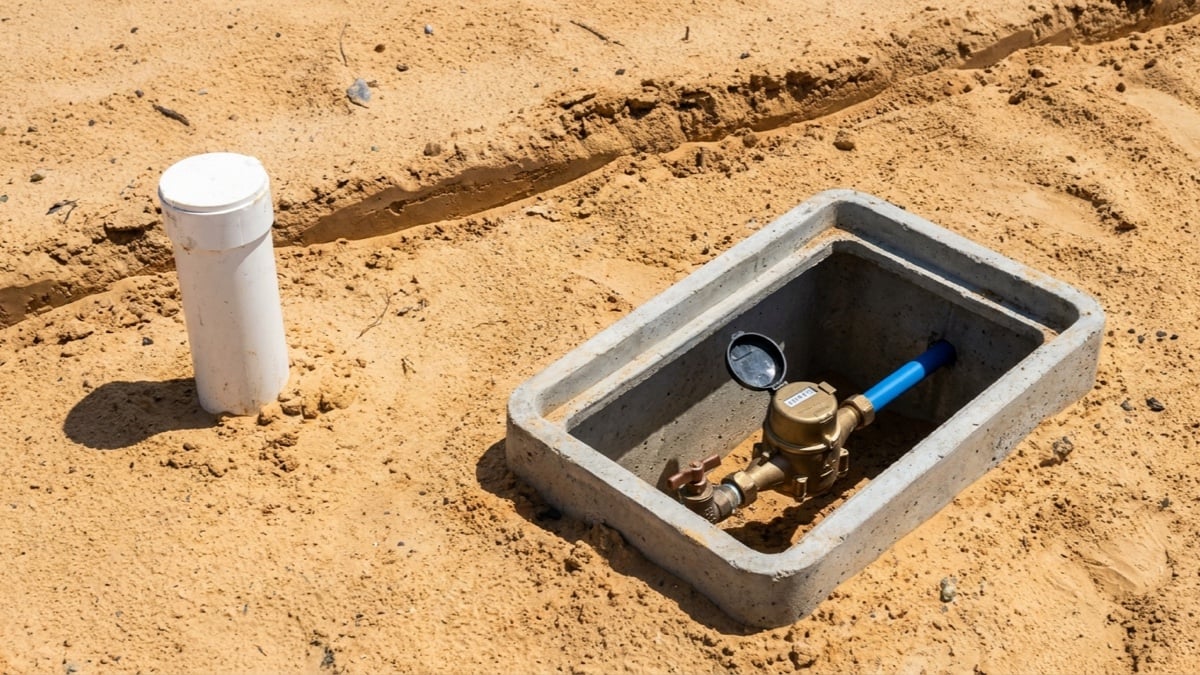
Featured image: AI-generated editorial illustration of a newly installed residential water meter in an open in-ground meter box at the edge of a graded sandy construction lot, with a blue service line, a brass shutoff valve and a capped PVC sewer cleanout nearby. It does not depict a particular property or a real utility installation.