

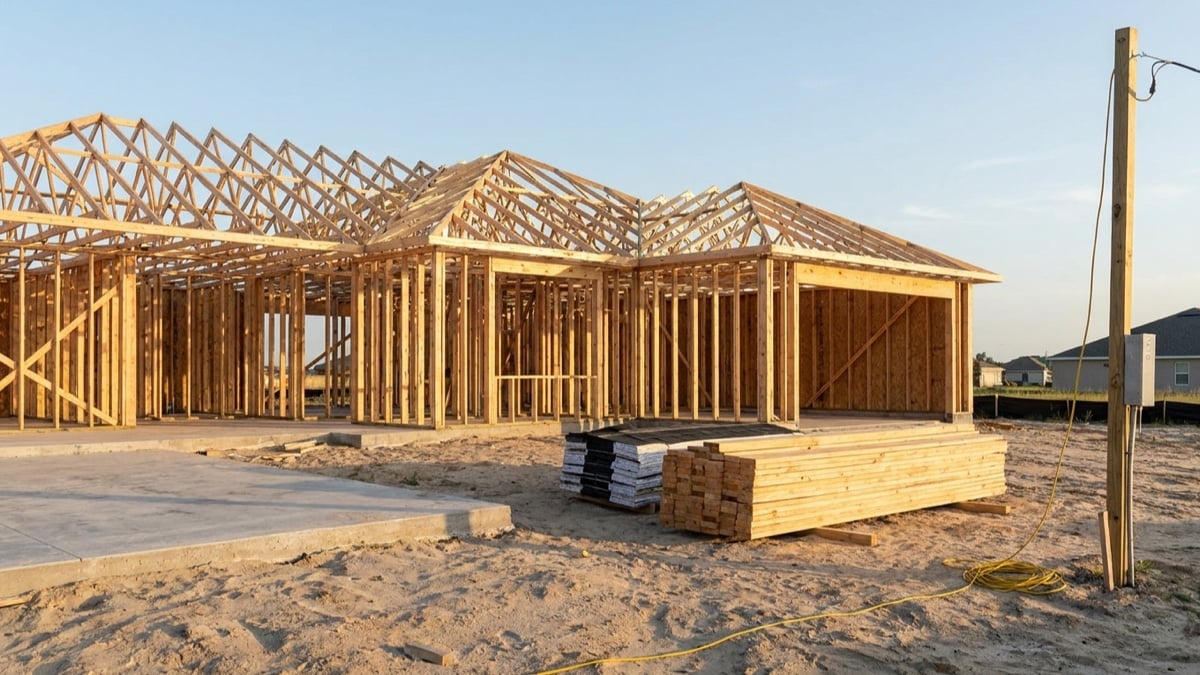
On a Sumter County home that is not finished yet, the appraisal is written against plans and specifications, and the file does not clear until someone certifies the house is actually complete. The paperwork chain decides your down payment. FHA caps a house that is under construction, or finished less than a year, at 90 percent loan to value unless the permit was pulled before construction started and your lender collects the right forms.
What gets appraised when there is no house yet
Fannie Mae’s Selling Guide topic B4-1.2-05, dated December 10, 2025, requires an appraisal on new or proposed construction to be based on plans and specifications, an existing model home, or other information sufficient to identify the quality and character of the proposed improvements. The lender then has to confirm that what got built matches the drawings, on the Appraisal Update and/or Completion Report, Form 1004D, or on a borrower and builder attestation letter certifying conformity with the plans, specifications, amendments and change orders. Verification of completion is required before the loan is sold.
A minor item can stay open at closing only if it is in the sales contract, cannot affect the occupancy permit, costs no more than 10 percent of the “as completed” appraised value, and finishes within 180 days of the note date. The lender withholds 120 percent of the estimated cost, so a $6,000 punch list means a $7,200 escrow.
The appraisal also ages. Under Selling Guide topic B4-1.2-04, dated June 4, 2025, the property must be appraised within the 12 months before the note date, and once the original effective date is more than four months out, the appraiser must perform an update on Form 1004D that inspects the exterior and reviews current market data, within four months before the note date. That rule applies whether the property was appraised as proposed or as existing construction, and a reported decline forces a new appraisal, which is where a slipped build meets the low-appraisal problem on a house nobody has ever sold before.
The FHA rule that can turn 3.5 percent down into 10 percent
FHA Handbook 4000.1 Section II.A.8 sorts new construction into three states. Proposed Construction means no concrete or permanent material has been placed, and digging a footing does not count. Under Construction runs from the first placement of permanent material to 100 percent completion with no certificate of occupancy. Existing Less Than One Year means the house is complete, the certificate issued under a year ago, and nobody has ever lived in it; once someone occupies it inside that first year, FHA treats the sale as an existing property.
A property Under Construction or Existing Less Than One Year is limited to 90 percent loan to value unless it meets the Pre-Approval requirements and the Required Documentation for Maximum Financing. FHA’s minimum required investment is at least 3.5 percent of the adjusted value under Section 203(b)(9) of the National Housing Act. On a $400,000 adjusted value that is a $386,000 base loan with $14,000 down, against a $360,000 base loan with $40,000 down at the 90 percent cap, a $26,000 swing that turns on paperwork rather than on credit. Those figures are an illustration, not a quote.
| Status when the appraisal is ordered | What the lender must obtain for maximum financing | Effect |
|---|---|---|
| Proposed Construction, no permanent material placed | Any one of: permit plus certificate of occupancy; footing, framing and final inspections by an ICC-certified inspector on form HUD-92051; or those three inspections by the local authority | Outside the 90 percent cap |
| Under Construction | Permit plus certificate of occupancy, or a final inspection from the local authority or an ICC-certified inspector | 90 percent cap without the pre-approval and maximum-financing documents |
| Existing Less Than One Year | The certificate of occupancy, or a final inspection from the local authority or an ICC-certified inspector | 90 percent cap without the pre-approval and maximum-financing documents |
Pre-Approval has three routes: the property was appraised and the lender issued form HUD-92800.5B before construction started; a local jurisdiction issued a building permit or its equivalent; or the lender issued an Early Start Letter, available once that permit exists and a case number has been assigned. The file also needs form HUD-92541, the builder’s certification of plans, specifications and site, signed no more than 30 days before the appraisal was ordered, form HUD-92544, the warranty of completion of construction, and a wood infestation report with form NPMA-99-A, the termite protection builder’s guarantee required on all new construction.
Where the Sumter County paperwork comes from
Two of those routes run through a local building department, which here means Sumter County Building Services. Applications go in online or at 7375 Powell Road in Wildwood, and the county’s guidance says a certificate of occupancy on a residential single-family permit is requested by email, with “Request for CO” and the permit number in the subject line, only after every required inspection has passed and five documents are uploaded to the permit record: City of Wildwood utility approval where applicable, final septic approval from the Health Department where applicable, a blower door test, final termite treatment and an insulation certificate.
Read that list beside the FHA list and the overlap is the point. The final termite treatment the certificate waits on is the same work behind the NPMA-99-A guarantee in the loan file. A missing city utility sign-off holds the certificate, the certificate holds the FHA documentation route, and that route holds your down payment.
Sumter County says a building permit is valid until 180 days past the issue date or the last approved inspection, and that a county-issued permit for a single-family dwelling expires one year after issuance or on the effective date of the next edition of the Florida Building Code, whichever is later. Inspections are booked at 352-569-1529 or online. For how a permit record reads from the outside, see our guide to a new home’s inspection and permit history. One county figure to carry while you shop: HUD’s CY2026 forward mortgage limit file lists Sumter County, inside the Wildwood-The Villages metropolitan area, at a one-unit FHA limit of $541,287, a standard limit at the national floor, effective January 1, 2026.
Your Loan Estimate can be reset on a new build
Under 12 CFR 1026.19(e)(3)(iv)(F), in transactions involving new construction where the creditor reasonably expects settlement more than 60 days after the original Loan Estimate, the creditor may issue revised disclosures if that original Loan Estimate stated clearly and conspicuously that at any time prior to 60 days before consummation it could do so. Without that statement, revised disclosures are available only on the other grounds in the same paragraph. The fine print on the first Loan Estimate of an eight-month build decides whether its cost estimates are a baseline or a draft.
Two limits protect the back end. Under 1026.19(e)(4)(ii), no revised Loan Estimate may be issued on or after the date the Closing Disclosure is provided, and you must receive any revised version at least four business days before consummation. Once the Closing Disclosure is out, 1026.19(f)(2)(ii) triggers a fresh three-business-day waiting period for only three changes: the annual percentage rate becomes inaccurate, the loan product changes, or a prepayment penalty is added.
What to settle before you sign the builder contract
- Ask in writing which construction status the home will be in on the day the appraisal is ordered, and which FHA documentation route your lender intends to use.
- Get the permit number, and confirm the permit was issued before construction started if you need the pre-approval route.
- Confirm form HUD-92541 will be signed within 30 days of the appraisal order, and budget the 90 percent scenario as fallback cash rather than expected cash.
- Put the punch list in the contract so an unfinished item can be escrowed instead of delaying closing.
- Review the deposit and escrow terms and the incentive terms together, because both move your cash to close.
Frequently asked questions
Can I close before the certificate of occupancy is issued?
For FHA maximum financing the file needs the certificate of occupancy or a final inspection, and the lender certifies on form HUD-92900-A that the property is 100 percent complete. On a conventional loan, verification of completion is required before the loan is sold, and the postponed items exception excludes anything affecting the occupancy permit. In unincorporated Sumter County that certificate waits on the five uploaded documents.
My build slipped six months. Do I need a new appraisal?
Usually an update rather than a new report. Once the original effective date is more than four months before the note date, Fannie Mae requires an update on Form 1004D performed within four months of that note date. Past 12 months you need a new appraisal, and a reported decline in value also forces one, with your loan to value recalculated on the new number.
Can the appraiser use only sales inside my new community?
Not under FHA. Handbook 4000.1 directs that for properties in new subdivisions the comparable sales must include at least one sale outside the subdivision or project and at least one from within it. For a home between 90 and 100 percent complete, the lender must also give the appraiser a list of the components still to be installed or completed after the inspection date.
About these sources
Read on November 17, 2026: Fannie Mae Selling Guide topics B4-1.2-05 (12/10/2025) and B4-1.2-04 (06/04/2025); FHA Handbook 4000.1, Section II.A.8 and its required investment section; 12 CFR 1026.19 via the eCFR, Title 12 current through the November 12, 2026 issue date; HUD’s CY2026 FHA forward mortgage limits file; and the Sumter County Building Services and Inspections pages. Confirm each item against the current version for your own file.
Buying a to-be-built home in Lake, Orange or a surrounding county and want the financing sequence mapped against the builder’s schedule? Book a strategy session at mvphomegroup.com/nelsoncruz and we will work the documentation chain, the appraisal timing and your fallback cash backward from the delivery window.
Nelson Cruz, P.A.
Founder & CEO, MVP Home Group, Real Broker LLC
Nelson brings nearly two decades in law enforcement to his work in real estate. View Nelson’s profile or contact our team at 407-901-9939.
Featured image: AI-generated editorial illustration of a single-family house at the framing stage on a cleared lot. It does not depict a particular property.