

Only part of it is protected, and the protected part is the first 10 percent. Section 501.1375, Florida Statutes, gives the buyer of a one-family or two-family dwelling the right to have deposit funds up to 10 percent of the purchase price held in escrow by a bank or trust company, a Florida Bar member attorney, a licensed Florida real estate broker or a title insurer. That right is waivable in writing. Money above 10 percent falls outside the section. A separate statute, s. 489.126, puts a clock on any initial payment over 10 percent: 30 days to apply for permits, 90 days from permit issuance to start work. Both deadlines are checkable against Sumter County public records.
The 10 percent line decides which statute protects you
Section 501.1375(2) requires a building contractor or developer to notify the buyer that any deposit up to 10 percent of the purchase price goes into escrow unless the buyer waives that right in writing, and to print the waiver notice in conspicuous type in the contract.
Run the arithmetic before signing. On a $400,000 contract, 10 percent is $40,000. A buyer who puts down $60,000 has $40,000 inside the escrow right and $20,000 that s. 501.1375 says nothing about. The section is narrower still in one respect: s. 501.1375(1)(a) excludes a person who sells or constructs fewer than 10 units per year statewide, so a builder putting up six houses a year is outside it entirely.
What a builder may legally do with escrowed money
Escrow does not mean frozen. Section 501.1375(3) requires both signatures for withdrawals, then subsection (4) supplies the exception: after notifying the buyer, the builder acquires a surety bond payable to the buyer in the amount of the deposit, and the funds are released for construction purposes only. If no bond is available, the builder may instead borrow an equal amount, and the interest the builder pays on that loan, for a period not to exceed 12 months, is paid by the buyer at closing, with credit for interest accrued on the escrow account. Subsection (5) offers a master surety bond, with the buyer debited at closing for the premium. Each route moves a cost onto your closing statement, so ask which the contract uses.
Subsection (7) lists the only exits without both signatures. A buyer who properly terminates under the contract terms gets the funds plus accrued interest. On a buyer default, which s. 501.1375(1)(d) defines as failing to close after the certificate of occupancy issues or failing to meet any buyer obligation under the contract, the builder may withdraw after certified mail notice at least 72 hours beforehand plus an affidavit of default. One clause is better known before closing than after: under s. 501.1375(8)(b), once closing occurs the buyer has no right to claim escrowed funds for breach of contract, and problems found later run through the builder’s written warranty.
The clocks that run on money above 10 percent
Section 489.126 covers the ground s. 501.1375 leaves open, and subsection (1) extends the term contractor to any person performing or promising to perform the work, without regard to licensure. Under s. 489.126(2)(a), a contractor who receives an initial payment totaling more than 10 percent of the contract price must apply for the necessary permits within 30 days after the payment date, and must start work within 90 days after all permits are issued. Both duties yield to just cause or to a written agreement to a longer period.
When a deadline passes, the next move is yours. Section 489.126(2)(b)1. requires written demand by certified mail, return receipt requested, to the address in the contract, or to the address on file with the department if the contract has none. It may then be inferred that the contractor lacks just cause if nothing happens within 30 days of that demand. Penalties under s. 489.126(5) scale with the money received, from a first degree misdemeanor below $1,000 to a first degree felony at $200,000 or more; a $60,000 deposit falls in the second degree felony band. Intending to return the money is not a defense.
Checking the Sumter County record yourself
Confirm the jurisdiction first. Sumter County has joint planning agreements with the City of Wildwood and the City of Bushnell, and directs property owners to Sumter GIS to determine whether a parcel sits inside a JPA. Property inside one may face additional development standards, including annexation into Wildwood or Bushnell, with the county listing Wildwood at 352-330-1330 and Bushnell at 352-793-2591. Wildwood’s Code of Ordinances, chapter 7, defines its building official as the chief officer of the city’s own building services department, so an annexed parcel is a different conversation.
County permits run through Sumter County Building Services at 7375 Powell Road, Suite 115 in Wildwood, with records online at citizenserve.com/sumtercounty covering permit information since September 2003 and a system changeover for applications submitted after September 23, 2024. A Sumter County permit stays valid until 180 days past the issue date or the last approved inspection, so the record shows both whether a permit was pulled and whether anything was ever inspected.
The second record is the notice of commencement. Section 713.13(1)(a) requires the owner, before actually commencing to improve real property, to record it with the clerk and post a certified copy at the site. It names the contractor, the lender and any payment bond surety, and item 9 of the statutory form sets expiration at one year after recording unless a different date is specified. On a production home the builder owns the lot and records it; on a build on your own lot, you are the owner and recording it is your job. Search it at the Sumter County Clerk’s portal, myfloridacounty.com/orisearch/60. Recording runs $10.00 for the first page and $8.50 for each additional page, so a two-page notice costs $18.50.
| Record | Where it lives | What it proves |
|---|---|---|
| Permit and inspection history | Sumter County Citizenserve portal, or the city if the parcel was annexed | Whether permits were applied for within 30 days of your payment, and whether any inspection has been approved |
| Notice of commencement | Sumter County Clerk official records | That the owner recorded before work began, who the contractor and lender are, and the expiration date |
| Contractor license | Sumter County Building Services, or the state at myfloridalicense.com | Whether the builder held a valid license when you signed, which the recovery fund later requires |
| Escrow confirmation | The escrow holder named in your contract | That the deposit reached a bank, attorney, broker or title insurer rather than an operating account |
A complaint is not how you get the money back
Sumter County routes complaints about building contractors to the Department of Business and Professional Regulation. DBPR states that the discipline it may impose is administrative in nature, including fine, probation, license suspension or revocation, and that it cannot represent you in civil matters to recover fees paid. It lists some fee and price disputes, disagreements over contract terms and some workmanship issues as matters that may fall outside its authority.
Money runs on a different track. Section 501.1375(10) entitles the prevailing party in civil litigation under that section to attorney fees and costs. The Florida Homeowners’ Construction Recovery Fund sits behind a judgment rather than in front of one: s. 489.141(1) makes a claimant eligible only after exhausting any available bond, surety, warranty or insurance, and only with a final judgment, arbitration award or licensing board restitution order against a licensee. Section 489.141(2)(d) disqualifies the claim entirely if the contractor did not hold a valid and current license when the contract was signed, which is the reason to verify licensure before handing over money rather than after. Payment is capped twice over: s. 489.143(2) measures it against the judgment or $25,000, whichever is less, and only up to the maximum for the division, which s. 489.143(3) sets at $100,000 per claim for Division I contracts entered into on or after July 1, 2024. A home builder is Division I under s. 489.105(3).
Before you write the deposit check
- Find the conspicuous escrow legend in the contract and read whether you are being asked to waive it. A waiver counts only in writing.
- Calculate 10 percent of the contract price against the deposit requested, so you know which dollars sit outside s. 501.1375.
- Ask who will hold the funds, and whether the builder intends to use the subsection (4) bond or the subsection (5) master bond, since both land on your closing statement.
- Confirm whether the lot is in unincorporated Sumter County or inside a Wildwood or Bushnell joint planning area, and verify the builder’s license before signing.
- Calendar 30 days from payment for the permit application and 90 days from permit issuance for work to start, then pull the records yourself.
Frequently asked questions
Can a builder refuse to place my deposit in escrow?
Not if the builder is covered by s. 501.1375 and you have not waived the right in writing. Section 501.1375(9) makes a willful failure to establish the account, deposit the funds or follow the withdrawal rules a third degree felony, and treats failure to place funds in escrow within 10 days after receipt as prima facie evidence of a violation. The section does not reach a builder who sells or constructs fewer than 10 units per year statewide.
My Sumter County builder took my money months ago and nothing has been built. What is the first step?
Check the permit record, because the statute turns on permit dates. Sumter County permit information is online through the Citizenserve portal, and a parcel inside a Wildwood or Bushnell joint planning area means calling the city instead. If no permit application appears past 30 days from your payment, or work did not start within 90 days of permit issuance, s. 489.126(2)(b) requires written demand by certified mail before the inference of no just cause arises 30 days later. Keep the receipt.
Does the notice of commencement protect my deposit?
No. It is a lien law document, not a deposit document. What it gives a buyer is timing evidence and a short list of who else holds a financial interest in the job. The statutory form warns that payments made after its expiration are improper payments under chapter 713. Separately, s. 501.1375(8)(a) keeps an escrow deposit or surety bond under that section free of any chapter 713 part I lien.
A to-be-built contract leaves a trail in two Sumter County public records and one private one: the permit file, the clerk’s official records, and the escrow account named in your contract. Ask for the third in writing and check the first two yourself. To weigh that contract against the district assessments on a Wildwood home, book a strategy session at mvphomegroup.com/nelsoncruz.
Nelson Cruz, P.A.
Founder & CEO
MVP Home Group, Real Broker LLC
Nelson brings nearly two decades in law enforcement to his work in real estate. View Nelson’s profile or contact our team at 407-901-9939 or [email protected].
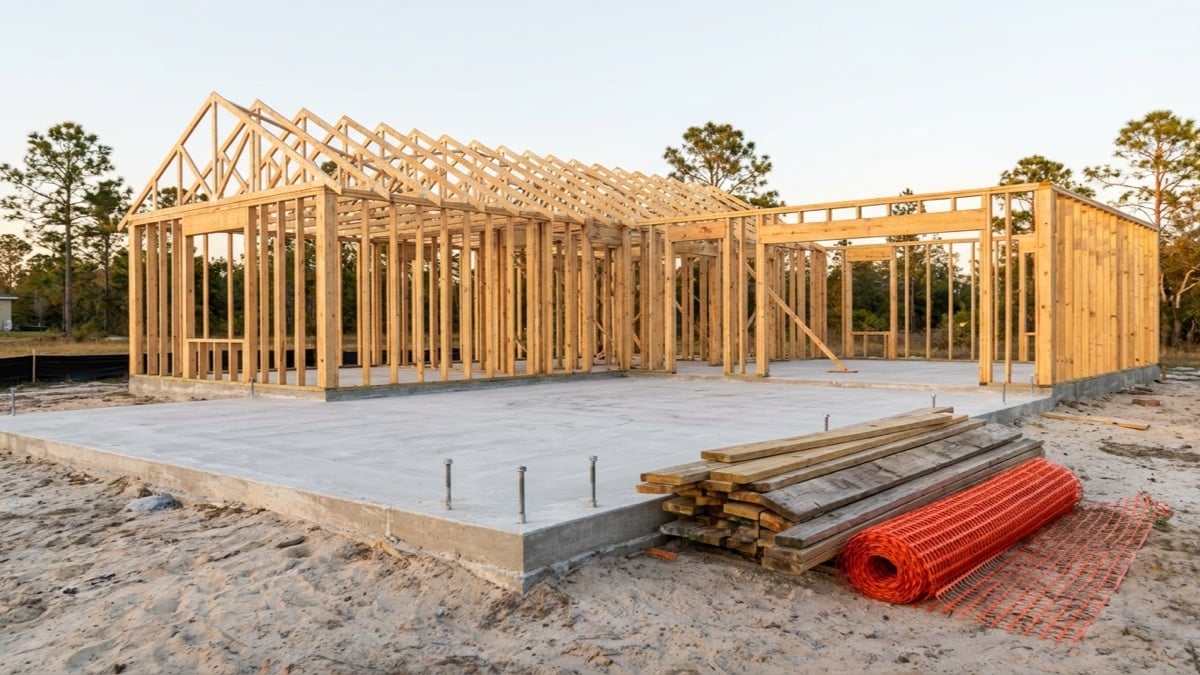
Featured image: AI-generated editorial illustration of an early-stage house under construction, a poured concrete slab foundation with bare wood wall framing rising from it. Not a particular property. No people and no readable text.