

Two events decide whether your new house in unincorporated Orange County is finished in the county’s eyes, and neither is the builder’s walkthrough. The permit reaches complete status only when a passed inspection coded 290 Final Inspection is on the record, and the house cannot be occupied until the building official issues a certificate of occupancy. Orange County states that scheduling every required inspection is the permit customer’s job rather than the county’s, and those inspections may be performed by a private provider the builder hired instead of by a county inspector. All of it is searchable before you close.
Who signs off, and who picked them
Fla. Stat. s. 553.791(2)(a) lets the owner of a building, or the owner’s contractor with written authorization, choose at any time to use a private provider for plans review, for required inspections, or for both. On a to-be-built home the builder holds title until your closing, so the builder makes that election and signs the acknowledgment in s. 553.791(5)(c): “I understand that the local building official may not review the plans submitted or perform the required building inspections to determine compliance with the applicable codes, except to the extent specified in said law.” The same form has the signer attest that they inquired into the provider’s competence and indemnify the local government against claims arising from the choice.
After that election the county’s role narrows by statute. Section 553.791(8)(a) bars the building official from reviewing plans a private provider found compliant, except on local ordinances, floodplain management, site review and life safety matters unrelated to code compliance. Section 553.791(16)(a) lets the official inspect approved work only when the official has knowledge that required inspections were not performed, and the provider gets written notice of the basis first.
What the county’s own numbers show
Fla. Stat. s. 553.80(7)(b) makes a local government that charges permit fees publish a building permit and inspection utilization report. Orange County’s, read on November 2, 2026, covers fiscal year 2024.
| Line item as the report labels it | FY2024 (Oct 1, 2023 to Sep 30, 2024) |
|---|---|
| Building permit applications submitted | 81,492 |
| Building permits issued or approved | 75,824 |
| Building inspections and reinspections requested | 339,257 |
| Building inspections and reinspections conducted | 270,163 |
| Private Provider inspection notifications | 36,258 |
| Private Provider audits conducted | 27 |
Read the fifth line carefully. The statute asks for inspections conducted by a private provider, and the county fills that line with notifications, which s. 553.791(5) files per permit rather than per inspection. Against the audit line that is one audit for every 1,343 notifications, consistent with the county’s manual: audits are as-needed, capped at four per provider or firm per year, with five business days of notice. The third and fourth lines matter too. That year 69,094 requested inspections were not conducted, 20.4 percent of requests, so a scheduled inspection is not a completed one.
Three inspection codes worth knowing by name
Orange County publishes no single list of required inspections for a new house. Its New Residential Structure Permit page and its Private Provider Manual point to the same two places: the inspection record issued with the permit, which carries the list on its back, and the permit’s details page inside Fast Track. Three codes appear by number in county documents.
- 135 is the elevation inspection, which the county describes as applying to properties with active construction in an area identified as a flood plain and calls the FEMA Elevation Certificate. The manual puts the requirement with the Stormwater Management Division and has the private provider schedule it.
- 190 is the framing inspection, and it carries extra weight in the private provider process because the manual requires finished floor elevation to be verified at it.
- 290 is the final, and a passed 290 is what moves the permit to complete status. The county warns that failing to pass it within the allowed time results in the permit expiring, with added expense to reinstate or replace it. How long you have is worth asking in writing, because the county’s FAQ says 180 days from issuance or from the last passed inspection, while Fla. Stat. s. 553.79(1)(c) sets one year from issuance for a single-family dwelling, or the effective date of the next Florida Building Code edition if later.
What Orange County demands on top of the state code
The Private Provider Manual, document ADM 112 with an effective date of July 1, 2026, tells private providers their inspections must meet or exceed Section 110 of the Florida Building Code, Building, and chapter 9 of the Orange County Code. It then adds the most concrete site conditions the county puts in writing for a new lot:
- A final survey inspection covering building setbacks, sidewalk locations and grading elevations.
- Sidewalks on all lots within unincorporated Orange County, unless Public Works has waived the requirement in writing for that specific permit. They belong in the right-of-way as designed, with 2 to 3 inches of encroachment into the private lot tolerated and anything beyond that needing Public Works approval before the final compliance package clears.
- Grading elevations within plus or minus two tenths of a foot, 2.4 inches, of the approved design, with swales and water flow as designed.
- Finished floor elevation no more than one tenth of a foot, 1.2 inches, below the approved design elevation and no more than half a foot, 6 inches, above it.
The manual is equally direct about shortcuts. Work covered before its inspection must be uncovered unless the county exempts it, under county policy BI-125, and affidavits, photographs and engineers’ letters are not accepted in place of required inspections unless the county asked for them. All of this governs unincorporated territory. Inside a city, that city’s building department runs the process, so start by sorting out which side of the line an address falls on, an exercise we worked through in city limits versus unincorporated Orange County.
Reading the permit record yourself
Orange County’s Fast Track site states that its search tools “are available to anyone, without a member services account,” listing permit search for all types, properties by address or parcel, inspections and licensed contractors. The county’s instruction for checking status is to open Permits, All Types, then Building Permits, enter the permit number, address or parcel ID, click the permit number when it appears, and follow the items shown in blue. The property search takes a street number, name and type, or a section, township, range, subdivision, block and lot, and the county warns that fewer criteria often work better than more. It also asks you to read a human verification image, so this is a lookup you do by hand.
For the certificate itself, email [email protected] with the building permit number in the subject line. It matters because Orange County Code chapter 9, article II, section 111.1 says a building “shall not be occupied or a change made in the occupancy, nature, or use of a building or part of a building until after the building official has issued a certificate of occupancy in the name of the occupant or tenant.” That provision carves out one and two-family dwellings inside its clause about an existing building. Its clause about a new building carries no exception, which is why a brand-new house gets one.
Where a private provider ran the inspections, the clock on that certificate is short. Section 553.791(16)(a) gives the building official two business days after a complete request on a one or two-family dwelling, the county’s manual commits to the same two days, and s. 553.791(16)(b) grants the certificate automatically the next business day if that window passes without notice of incomplete documents.
Closing while a permit is still open
This happens, usually on a pool, a fence, a driveway or a final grade rather than the house. Under s. 553.79(16)(a) a property owner may close a permit whether or not they are named on the application, by retaining the original contractor, hiring a different Florida-licensed contractor, or acting as owner-builder. The protection that matters at the closing table is s. 553.79(17)(a): a local enforcement agency may not deny a permit to, issue a notice of violation to, or fine, penalize, sanction or assess fees against an arms-length purchaser of a property for value solely because a permit applied for by a previous owner was not closed. Its remedies against the owner and contractor named on the permit survive, and that is the builder.
What to ask for, and when
| When | What to get |
|---|---|
| Before you sign | The permit number and the parcel ID, so you can search Fast Track yourself instead of relying on a status update |
| Before you sign | Whether a private provider is performing the inspections, and the provider firm’s name |
| At framing | Confirmation that 190 passed, and on a floodplain lot, that the 135 elevation inspection is scheduled |
| Before the walkthrough | The list of required inspections from the permit details page, with the pass or fail result on each |
| Before closing | The final survey, and confirmation that the sidewalk and grading items cleared Public Works |
| At closing | The certificate of occupancy, plus a list of every permit on the parcel still showing open |
Frequently asked questions
Can I bring my own inspector to a pre-drywall walkthrough?
Nothing in Florida’s inspection statutes or Orange County’s published procedures gives a buyer a right of entry to a house the builder still owns, so that access is a term of your purchase contract and has to be negotiated before you sign. The record gives you the required inspection list on the permit details page and the result on each one. Under s. 553.791(14) a private provider posts each completed inspection record showing pass or fail and delivers it to the building official within four business days, and the county requires that notification to name the inspector, describe the inspection and state the result.
Does a private provider inspection mean the county never looks at my house?
No. Orange County still issues the permit, reviews the final compliance package against s. 553.791, verifies that plan review comments are satisfied and that every child permit is complete, and issues or denies the certificate. It also reserves the right to audit, up to four times a year per provider or firm with five business days of notice, and to follow up on structural or life safety complaints with or without notice. Audit findings go on a county form the manual says is made available on the county website for the preceding two quarters.
Where to go from here
The pattern across new construction in this county is that the obligations are recorded somewhere public before anyone signs. Assessments work the same way, which is what we found on the Orange County side of the Sunbridge stewardship district. The right-of-way work in front of your lot has its own review path, laid out in which driveway permit review applies in Orange County.
If you are weighing a standing inventory home against a to-be-built one in Horizon West, Lake Nona, Apopka or anywhere else in unincorporated Orange County, book a strategy session with our Central Florida team at mvphomegroup.com/nelsoncruz. Pulling the permit record takes one search and costs nothing. Learning after closing that the final survey never cleared Public Works costs considerably more.
Nelson Cruz, P.A.
Founder & CEO
MVP Home Group, Real Broker LLC
Nelson brings nearly two decades in law enforcement to his work in real estate. View Nelson’s profile or contact our team at 407-901-9939 or [email protected].
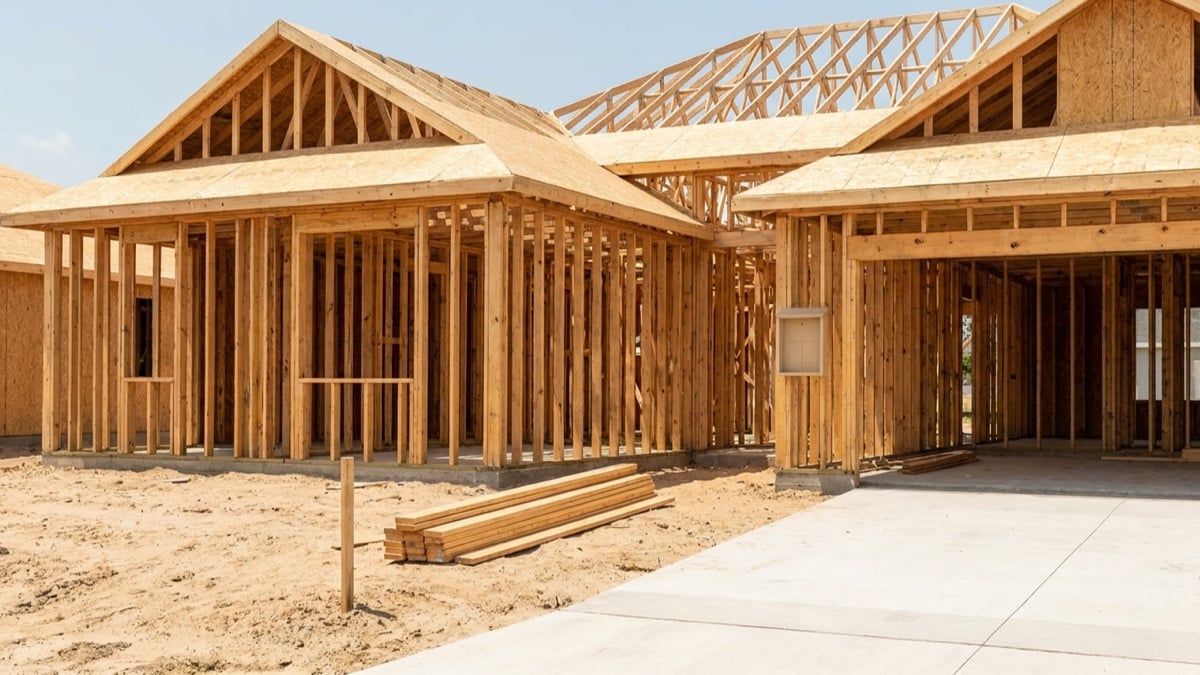
Featured image: AI-generated editorial illustration of a new single-family house at the wood framing stage on a bare sand lot, with open roof trusses, partly installed roof sheathing, a fresh concrete driveway slab, a blank permit card holder on a corner stud and a stack of lumber. Not a particular property or project.