

The document that decides what may legally be built on the land around a new home in unincorporated Orange County is Destination 2030, the county’s 2010 to 2030 Comprehensive Plan, effective March 4, 2023. Vision 2050, the replacement the Board adopted in June 2025, is not in force. The Florida Department of Commerce ruled it null and void under Senate Bill 180, and county planning staff now project an effective date of December 21, 2026 that depends on a state notice going unchallenged. Pull your lot and its neighbors on the county zoning map before you sign, then register for the county emails that report new development within one mile of your address.
Two growth documents, only one of them operative
Orange County steers growth with two instruments. A comprehensive plan assigns every parcel a future land use designation, which sets the ceiling on what that land may become; the development code then fixes the zoning district, the density and the form of the buildings. Your builder answers to both, and so does whoever owns the field behind your back fence.
Destination 2030 is the plan in force. The Planning Division publishes its rezoning policies under the heading of the Comprehensive Plan 2010 to 2030, effective as of March 4, 2023. Vision 2050 is the proposed successor, paired with a new development code called Orange Code that sorts land by transect zone rather than by separated use. The Board adopted Vision 2050 on June 3, 2025 through Ordinance No. 2025-15.
Why a state hurricane law froze a county growth plan
Senate Bill 180 became chapter 2025-190, Laws of Florida, when the Governor approved it on June 26, 2025. Section 28 of that chapter is the provision that reached Orange County. It bars any county listed in the federal disaster declaration for Hurricane Debby, Hurricane Helene or Hurricane Milton from proposing or adopting a more restrictive or burdensome amendment to its comprehensive plan or land development regulations before October 1, 2027. Any such amendment is declared null and void ab initio, the subsection applies retroactively to August 1, 2024, and the whole section expires June 30, 2028.
Orange County is inside two of those three declarations. FEMA lists Orange County as a designated area under DR-4806 for Hurricane Debby, declared August 10, 2024, and under DR-4834 for Hurricane Milton, declared October 11, 2024. Vision 2050 was adopted inside the retroactive window, and on July 28, 2025 the state issued its null and void determination. Orange County and twenty-four other Florida jurisdictions filed suit challenging SB 180 on September 29, 2025, according to the Planning Division’s own presentation to the Board.
Section 28 carries a carve-out that kept builders moving throughout. A plan amendment, site plan, development permit or development order may still be enforced where a private party other than the county initiated the application and owns the property.
What the September 2026 ordinance set in motion
On September 29, 2026 the Board of County Commissioners adopted Ordinance 2026-18, amending Ordinance No. 2025-15. The county’s legislative record shows the motion made by Commissioner Wilson, seconded by Commissioner Scott, and carried. That ordinance clarifies when Vision 2050 takes effect, confirms that Destination 2030 applies until that date, and creates a temporary review procedure that lets certain privately initiated applications be judged against the property’s Destination 2030 designation as fixed immediately before the changeover.
Planning Division staff laid the schedule out for the Board. A certified copy of the ordinance went to the Florida Department of Commerce on October 6, 2026 as a supplement to Comprehensive Plan Amendment No. 23-07ER. Staff projected a state Notice of Intent on November 20, 2026 and a Vision 2050 effective date of December 21, 2026, and marked both dates as projections that assume an in-compliance notice is not timely challenged. September 30, 2027 is the last day to file an election under the temporary procedure.
The election is worth understanding before a builder mentions it. Staff described it as voluntary, filed at no fee, with no discretionary approval required, available for a privately initiated site plan, development plan, development permit or development order. It does not create new entitlements, change zoning or switch off any land development regulation. A project running under an election cannot seek a comprehensive plan amendment or a rezoning at all; variances and special exceptions are the only relief available, through the Board of Zoning Adjustment. No election exists before the Vision 2050 effective date.
Four county tools that answer the question for your specific lot
Every item below is free, public and specific to unincorporated Orange County. None of them requires an account.
| Tool | What it tells you | Where it lives |
|---|---|---|
| Find My Parcel zoning map | The existing zoning district on your lot and on every parcel around it, searchable by address or parcel ID. Linked from the county Rezoning Process page and labeled the existing code | map.gridics.com/us/fl/orange-county |
| OCFL Atlas | Proposed development projects in the pipeline, plotted across the county. The county describes it as an interactive map of projects in the pipeline and carries it under the line “see what’s developing in your community” | The current OCFL Atlas |
| Atlas email alerts | Emails about upcoming development in unincorporated Orange County, covering new development located within one mile of the address you register | netapps.ocfl.net/Atlas/SignUp.aspx |
| Community Meetings Hub | Upcoming and past community meetings on proposed development projects, each with a public input tool for written comment | engageorange.ocfl.net/community-meetings |
Three cautions come from the county itself. Its Atlas disclaimer states that the information is provided for general information only and is not to be used for any legal, engineering or surveying purpose. Registering for the alerts puts your contact information into the public record under chapter 119, Florida Statutes, where it may be released on request. A separate Gridics map at the orange-county-orange-code address displays the proposed Orange Code transect zones, so read the existing code map when you want the rules a reviewer applies today.
How a project actually becomes something next door
Orange County runs proposals through a sequence a buyer can watch. A community meeting comes first, and the county calls it the first opportunity for residents to comment publicly: the applicant presents the request and answers questions alongside the District Commissioner and county staff, and no vote is taken. The proposal then goes to the Development Review Committee for land use plans, preliminary subdivision plans and development plans, to the Planning and Zoning Commission for rezonings and Future Land Use Map amendments, or to the Board of Zoning Adjustment for variances and special exceptions. That recommendation travels to the Board of County Commissioners for the final vote.
The Development Review Committee meets on two Wednesdays of each month, and the county posts a current agenda on its calendar each Friday preceding the meeting. Notice reaches neighbors two ways. The county’s own application form requires the applicant to place one or more posters on the property for land use plan, land use plan amendment and preliminary subdivision plan applications, and states that for certain application types surrounding property owners are notified by mail, with county staff coordinating the mailer.
Timing favors an attentive buyer. The Planning Division lists a conventional rezoning at four to six months of review and a large scale land use amendment at eight months or more. A proposal that will change the field behind your lot is usually visible for most of a year before anyone votes on it.
What to ask before you sign the builder contract
- Is the home in unincorporated Orange County or inside a city? Every process above is the county’s. A home inside Orlando, Winter Garden, Ocoee, Apopka or Windermere runs through that city’s planning department instead.
- What is the Destination 2030 future land use designation on the vacant parcels touching this subdivision, and what is their current zoning? Pull both on the parcel map rather than asking the sales office.
- Is any part of this community still awaiting approval, and under which plan will it be reviewed? Ask whether the developer intends to file an election to stay under Destination 2030.
- Does the Atlas map show a pending case within a mile, and has a community meeting already been held on it?
- If a neighboring approval already happened, what did the Board actually approve, and what conditions came with it?
- Are there posters on any nearby parcel right now? Drive the perimeter of the subdivision before the inspection period closes.
Register the address for Atlas alerts on the day you close. The emails cost nothing and they arrive while a proposal is still at the community meeting stage, which is the only point where written comment is easy to give.
Frequently Asked Questions
Does Vision 2050 change what my builder can build in Orange County?
Not as of today. Vision 2050 is not in effect, and the Florida Department of Commerce ruled it null and void under SB 180 on July 28, 2025. Orange County planning staff project an effective date of December 21, 2026, conditioned on a state Notice of Intent that is not timely challenged. Until a plan takes effect, Destination 2030 and the existing zoning code govern every application the county reviews. Confirm the current status with the Planning Division before relying on either plan for a specific parcel.
Can a developer still build under the old Orange County plan after Vision 2050 takes effect?
For certain privately initiated applications, yes. Ordinance 2026-18 created a voluntary election letting a qualifying site plan, development plan, development permit or development order be reviewed under the property’s Destination 2030 designation as fixed immediately before the effective date. Staff described the election as free of charge and not subject to discretionary approval, with September 30, 2027 as the last filing date. A project under an election cannot pursue a comprehensive plan amendment or a rezoning, which leaves variances and special exceptions through the Board of Zoning Adjustment.
How will I find out that something is proposed next to my new Orange County home?
Three channels run in parallel. Surrounding property owners receive mailed notice for certain application types, and the applicant must post one or more posters on the property for land use plan, land use plan amendment and preliminary subdivision plan applications. The OCFL Atlas signup emails registered addresses about new development within one mile, and Engage Orange County lists upcoming and past community meetings with a tool for written comment. Mailed notice depends on how the county defines surrounding owners for that case, so the email alerts and the meeting list are the two that do not depend on your distance from the parcel.
Buying new construction in Orange County
The land around a new subdivision is the part of the purchase no one hands you paperwork for. We read the parcel map, the pending cases and the approval conditions with our clients during the inspection period, alongside the plat and the builder contract, so the view you are shown matches what the county has on file. For the communities we cover across Orange, Lake, Osceola, Seminole, Polk and Volusia counties, see our community pages. Which inspections a new Orange County home must pass before it can be occupied is a separate record to check, whether an address sits inside a city or in unincorporated county territory changes who regulates it, and the question of whether roads and schools were tested for capacity before a lot was platted is handled county by county. To review a specific Orange County community, book a strategy session at mvphomegroup.com/nelsoncruz. This is general information about adopted ordinances, published county materials and Florida law, not legal advice, and not a determination about any particular parcel.
Nelson Cruz, P.A.
Founder & CEO
MVP Home Group, Real Broker LLC
Nelson brings nearly two decades in law enforcement to his work in real estate. View Nelson’s profile or contact our team at 407-901-9939 or [email protected].
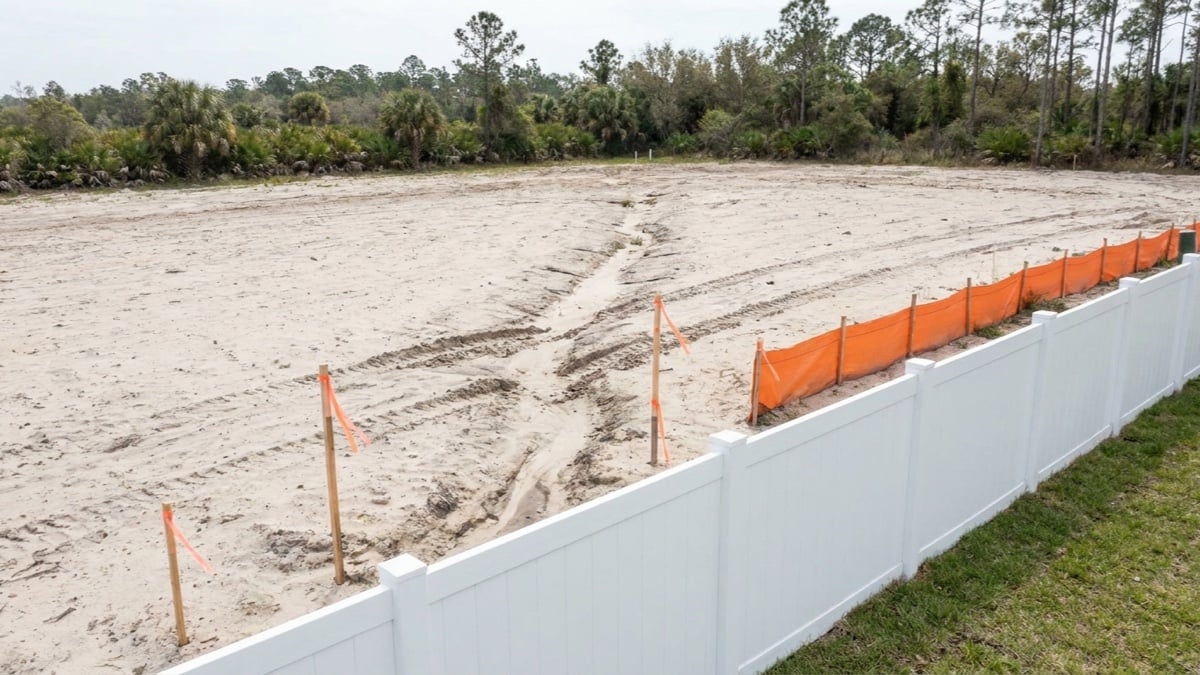
Featured image: AI-generated editorial illustration of a large cleared vacant lot of bare sandy ground beside a finished home’s fence line, with wooden survey stakes, orange flagging and silt fencing along the property line. Not a particular community, project or property.