

Before your lot appeared on a plat, Lake County tested it for capacity in roads, schools, parks, potable water, sanitary sewer, solid waste and stormwater. The document that proves the test passed is a Capacity Encumbrance Letter, and it holds that capacity for only 120 days. Four-year certainty costs extra and comes from a separate Capacity Reservation Certificate. Ask your builder which of the two the project holds, ask for the Lake County School District concurrency determination behind it, and check the dates, because both expire.
What concurrency actually tests in Lake County
Concurrency is the rule that public facilities have to be available at the same time as the development that loads them. Under Section 163.3180(1), Florida Statutes, only four facilities carry that requirement statewide: sanitary sewer, solid waste, drainage and potable water. The same subsection lets any local government extend concurrency to more facilities, and Lake County has.
Policy II-1.1.2 of the 2030 Lake County Comprehensive Plan, updated October 16, 2026, sorts facilities into three categories. Category A, the concurrency list, holds roadways, sanitary sewer, stormwater, potable water, solid waste, public schools, and parks and recreation facilities in the county’s unincorporated jurisdictional area. Category C, which the plan labels non-mandatory, is the one worth reading twice: it includes fire protection, law enforcement, emergency medical service, library services, public buildings and jail facilities. No capacity test stands between a new Lake County subdivision and a fire station or a sheriff’s patrol zone.
Three letters, and only two of them hold anything
Lake County’s Office of Planning and Zoning issues three capacity documents. They sit side by side on a builder’s paperwork list and do very different jobs.
| Document | What it does | How long capacity is held | County application fee |
|---|---|---|---|
| Non-Binding Capacity Information Letter | A snapshot in time of available capacity. Optional, and not a prerequisite for anything | Nothing is held | $170, non-refundable (form dated 10/10/2025) |
| Capacity Encumbrance Letter | Triggers a full concurrency review. Required during the development application process for all non-exempt development, and a prerequisite to the reservation certificate | 120 days from issuance | $1,380 without a traffic study, $3,660 with one (form dated 10/1/2026) |
| Capacity Reservation Certificate | Reserves the capacity the encumbrance letter found. Requires a copy of a valid Capacity Encumbrance Letter | Four years | $300 non-refundable, plus the capacity reservation fee (form dated 10/1/2026) |
The 120-day window is the number that surprises people. A builder can hold a valid encumbrance letter, let four months pass while engineering or financing moves, and land behind whoever filed next. Policy II-3.1.7 of the comprehensive plan sets the other end of the range: a capacity determination attached to a development order with no expiration date stays valid for a period not to exceed four years, or for whatever term an enforceable development agreement specifies.
The encumbrance letter application is also where the school district enters. For residential subdivisions it requires a school concurrency capacity report form from the Lake County School Board, alongside a utility availability letter from the water provider.
The school determination behind your subdivision
The School District runs its own review on its own form, the School Concurrency Application and Service Provider Form, revised March 5, 2025. The form promises a determination within 30 working days of a complete application. The determination is not transferable and is valid for one year from the date of issuance. Once the development order is issued, it holds for the life of that order on verification of a final development order.
Part 3 of the form gives the district exactly three ways to answer. It can verify that the project complies with the adopted level of service for schools. It can verify compliance subject to attached conditions. It can state that it cannot verify compliance. Those are different outcomes for a buyer, and the middle one is the one worth asking about, because the conditions are where mitigation agreements live.
The arithmetic that drives the answer is published. Table SCHOOL-1 of the comprehensive plan adopts student generation rates per dwelling unit of 0.186 for elementary, 0.100 for middle and 0.124 for high school, and requires the rates to be reviewed every two years. A 100-lot subdivision is therefore counted as 18.6 elementary, 10 middle and 12.4 high school students, 41 in all.
Why a subdivision gets approved next to a school that is already full
Policy IX-6.1.1 sets the level of service for every school type in the district at 100 percent of permanent capacity under the Florida Inventory of School Houses. Then it adds a second tier. Where core dining capacity exists beyond the FISH number, school capacity is increased up to 125 percent of FISH capacity by counting seats in temporary student stations, so long as the total stays within what the cafeteria can serve. A school at 100 percent of its permanent classroom capacity can still show room on paper if its cafeteria is large enough and portables are added.
Three further routes keep a plat moving even when the level of service is missed. Under Policy IX-7.2.1, and under Section 163.3180(6)(h)2., Florida Statutes, the county cannot deny a subdivision plat or site plan on school capacity alone where adequate facilities will be in place or under actual construction within three years after approval, where capacity sits in an adjacent concurrency service area and the impacts can be shifted there, or where the developer signs a legally binding commitment to proportionate-share mitigation. The statute treats school concurrency as satisfied once that commitment is tendered, and gives the school board 30 days to confirm capacity.
Mitigation has its own limit. Policy IX-7.3.2 directs it toward permanent capacity on the School Board’s five-year capital improvement program and states plainly that portable classrooms will not be accepted as mitigation, even though portables count toward measured capacity under the 125 percent rule. Where the district will not issue a determination and mitigation is not acceptable, Policy IX-7.2.2 says the county will not accept or process the development application at all.
What the reservation costs, and who gets it back
Lake County publishes the residential rule on its Concurrency Management page: a residential project can reserve capacity for schools, roads and parks, and the fee is 50 percent of the estimated impact fees per lot. Reservation fees are then applied as a credit against assessed impact fees when the building permit is pulled, so the money returns to the project rather than stacking on top of it.
On the county’s residential schedule for October 1, 2026 through January 1, 2027, a single-family detached home of 1,500 to 2,499 square feet in the Central and North Central transportation benefit districts carries $3,928 in road, $12,021 in school and $263 in park impact fees. Those three reservable categories total $16,212, and half of that is $8,106 per lot. Treat that as arithmetic on published rates rather than a quote, since the current reservation certificate form states the fee only as equivalent to estimated impact fees and sends applicants to the county’s impact fee office. Our post on Lake County impact fees on a new home carries the full schedule.
Seven questions before you sign the builder contract
- Does this project hold a Capacity Encumbrance Letter, a Capacity Reservation Certificate, or neither? Ask for the document, not the answer.
- What date was it issued, and has the 120-day or four-year clock run out?
- Which box did the School District check in Part 3 of its form, and if it was the conditional box, what are the attached conditions?
- Was the plat approved on available capacity, on the three-year construction test, on a contiguous service area, or on a proportionate-share mitigation agreement?
- Which utility serves the lot, and did the developer file the water provider’s availability letter? The county’s adopted standard of 100 gallons per capita per day yields to a higher one adopted by the serving utility.
- Is the home in unincorporated Lake County or inside a city? The three capacity letters are the county’s process, so ask a city project which capacity documents it issued. The district’s school form applies either way: it asks for the municipality and whether the parcel was recently annexed.
- Is anything you are counting on in Category C? Fire protection, law enforcement, emergency medical service and libraries sit outside the concurrency test entirely.
Buyers rarely ask for any of this. The ones who do find out early whether the capacity under their lot was bought for four years or borrowed for four months.
Frequently Asked Questions
Does a Capacity Encumbrance Letter mean my new Lake County home is approved?
No. The letter is the result of a full concurrency review and it encumbers available capacity for 120 days from issuance. It is a prerequisite to the Capacity Reservation Certificate, which is what holds capacity for four years. Lake County’s application also states that an encumbrance letter requested as part of a development order application is issued at the same time as the final project approval letter. Check the issue date against today before treating it as current.
My new home is in a Lake County subdivision next to a crowded school. How did it get approved?
The adopted level of service is 100 percent of permanent FISH capacity, raised to as much as 125 percent by counting temporary student stations where core dining capacity allows. Beyond that, the county cannot deny a plat on school capacity alone where adequate facilities will be in place or under actual construction within three years of approval, where capacity exists in a contiguous concurrency service area, or where the developer has signed a binding proportionate-share mitigation commitment. Ask which of those applied, since the three-year test points to a school that does not exist yet.
Can I order a capacity letter myself before I buy a lot in Lake County?
The Non-Binding Capacity Information Letter is the one open to anyone evaluating a site. Lake County describes it as a snapshot in time and states that it is optional and not a prerequisite for further review. The one-page application charges $170 and asks for a warranty deed, a property record card and a site location map with a two-mile radius. It holds no capacity and binds no one, which makes it a research tool rather than a guarantee for a specific lot.
Buying new construction in Lake County
A builder’s approval packet answers questions most buyers never think to ask, and the capacity documents are the part that carries dates. We read them with our clients before the contract is signed, alongside the plat, the development order and the impact fee estimate, so the timeline you are told matches the timeline the county recorded. For the communities we cover across Orange, Lake, Osceola, Seminole, Polk and Volusia counties, see our community pages, and for a worked case of county conditions on a Lake County master plan, see what the county locks in at Wellness Way. Which schools an address actually attends is a separate question from school concurrency. To review a specific Lake County project, book a strategy session at mvphomegroup.com/nelsoncruz. This is general information about adopted plans, published county forms and Florida statutes, not legal advice, and not a determination about any particular project.
Nelson Cruz, P.A.
Founder & CEO
MVP Home Group, Real Broker LLC
Nelson brings nearly two decades in law enforcement to his work in real estate. View Nelson’s profile or contact our team at 407-901-9939 or [email protected].
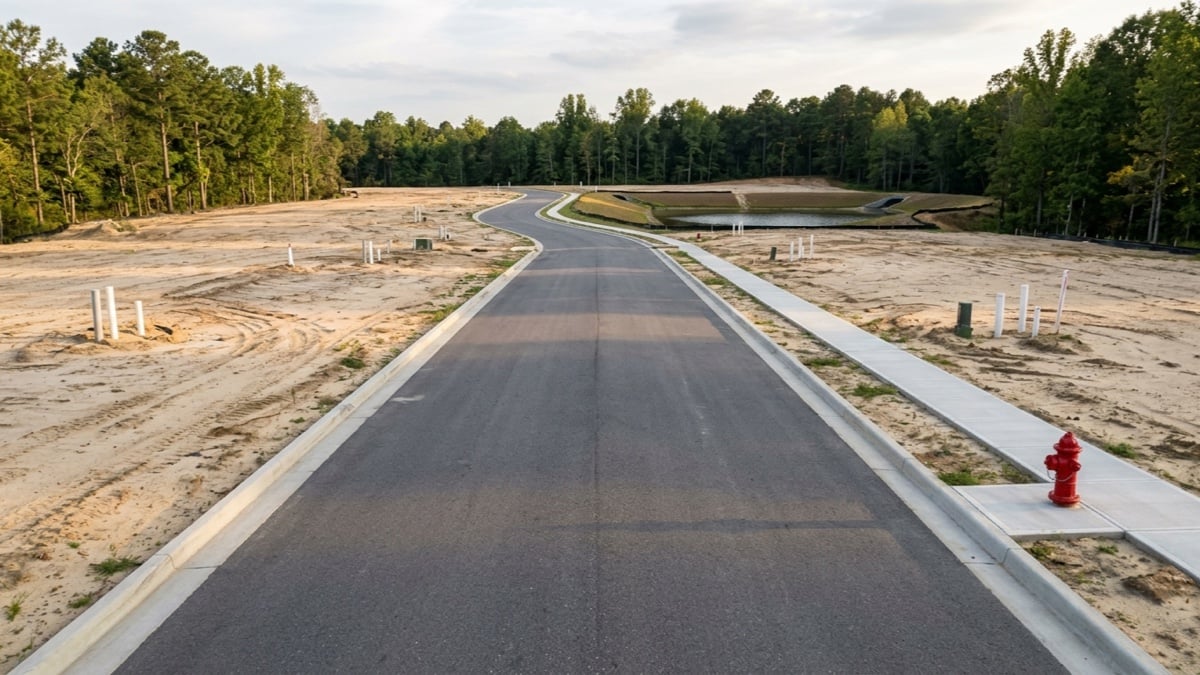
Featured image: AI-generated editorial illustration of a newly built residential subdivision street with fresh curbing, graded empty lots, utility stub-outs and a stormwater pond, before any homes are built. Not a particular community, project or property.