

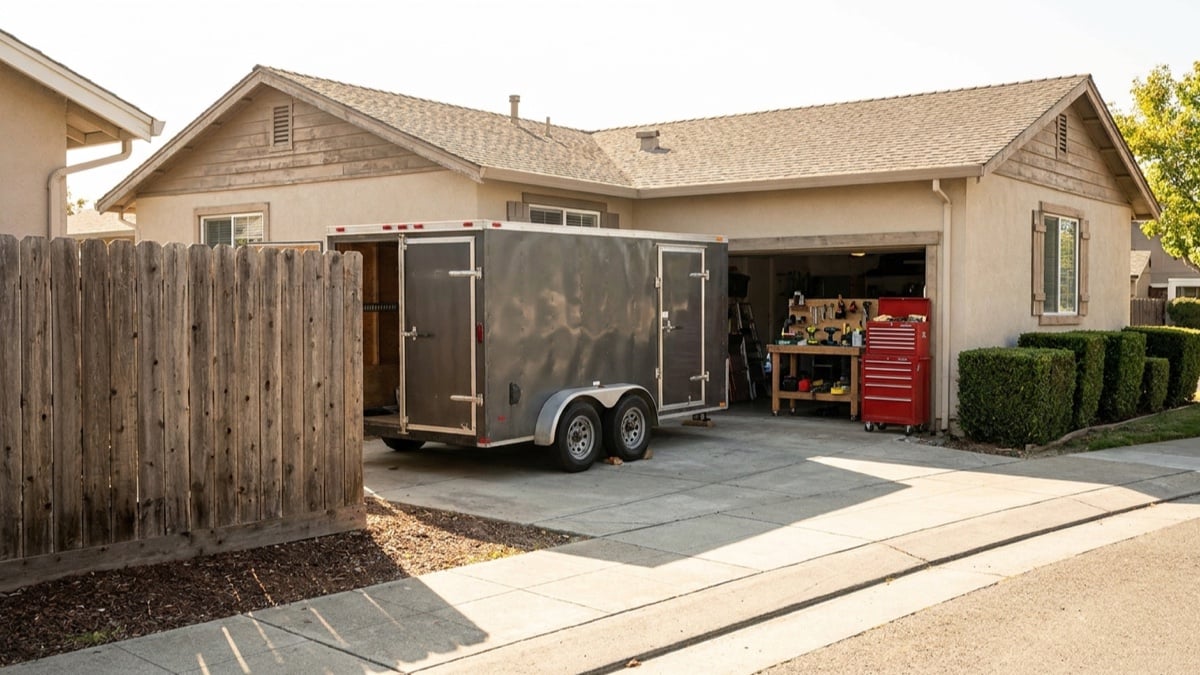
You can run a business out of a house in Ocoee. Florida Statutes section 559.955 bars the city from prohibiting a home-based business in a residential zone, and Ocoee’s own land development code treats a home occupation as an allowed accessory use wherever a home is allowed. The limits that remain are about workers, vehicles, signage and your recorded covenants.
Those limits are what decide whether one specific Ocoee house will carry your work.
What the state settled in 2021 and what it left open
Section 559.955 took effect July 1, 2021 as chapter 2021-202, Laws of Florida. It says local governments “may not enact or enforce any ordinance, regulation, or policy or take any action to license or otherwise regulate a home-based business in violation of this section.” A qualifying home-based business “may operate in an area zoned for residential use,” may not be regulated differently from other businesses in the jurisdiction, and “is only subject to applicable business taxes under chapter 205.”
The statute also gives the business owner teeth. Under subsection (4), an adversely affected current or prospective owner may challenge a local action, and the prevailing party may recover reasonable attorney fees and costs, appellate fees included.
Ocoee’s code now points at the statute directly. Article II of the land development code defines a home occupation as a business operating from residential property “in accordance with Section 559.955, Florida Statutes,” and meeting the criteria in Section 5-17 of Article V. Section 5-13 lists home occupations among the uses accessory to residential uses, allowed “where the principal use is allowed.”
The six limits that decide whether a house fits
Qualifying under the statute requires meeting all of the criteria in subsection (3). Ocoee’s Section 5-17 tracks those criteria and, in two places, uses the room the statute leaves for local rules. The code version read for this article is dated October 23, 2026.
| Issue | Florida Statutes 559.955 | Ocoee land development code Sec. 5-17 |
|---|---|---|
| Workers at the house | Employees working at the dwelling must live there, except up to two employees or independent contractors who do not. Remote staff are unlimited. | Same two-person allowance, stated in subsection A. |
| Where vehicles may sit | Business vehicles and trailers must be in legal parking spaces, not in the right-of-way, on or over a sidewalk, or on unimproved surfaces. | Adds that business parking may not be within the required front yard, and must be provided on-site. |
| Heavy equipment | Local governments may regulate parking or storage visible from the street or neighboring property. | Must be completely screened from the street and adjacent properties by six feet of opaque screening material. |
| Signs | Signage must comply with relevant local or state regulations. | One sign, no larger than one square foot, non-illuminated, flat against the wall within two feet of the main entrance. |
| Retail and accessory buildings | No retail transactions at a structure other than the residential dwelling. Incidental business uses are allowed on the property. | Same rule, and incidental uses in an accessory building must be completely screened from the street and adjacent properties. |
| Nuisance effects | Noise, vibration, heat, smoke, dust, glare, fumes and noxious odors are governed by local rules no stricter than those for a house with no business. | Lists noise, vibration, glare, fumes and odors detectable off the lot, and adds electrical interference with radio or television reception off the premises. |
Sources: section 559.955, Florida Statutes, and City of Ocoee Land Development Code sections 5-17 and 5-13, both read November 19, 2026.
The front-yard clause and the screening clause are the two that change a buying decision. Article II of the Ocoee code defines heavy equipment as “commercial, industrial, or agricultural vehicles, equipment, or machinery,” the same wording the statute uses. If your work involves a skid steer, a mower trailer or a service body truck, the question becomes whether the lot has an improved surface outside the required front yard with room for six feet of opaque screening on the street side and the neighbor side.
Uses Ocoee names, and the four it bars
Section 5-17 names specific uses. Subsection I lists offices of convenience such as attorneys, accounting, professional or office-based functions, telehealth and writing or editing, plus handyman and general household services, and individual instruction including art, photography, music, dance and piano teaching. Subsection J covers fabrication of articles commonly classified as arts and handicrafts, and cottage food operations under section 500.80, Florida Statutes.
Subsection H bars four categories: uses that generate traffic and parking greater than a single-family home without a business, manufacturing or wholesale distribution of goods and services, uses involving harmful or hazardous materials, and uses that change the character and appearance of the dwelling as primarily a residence.
Cottage food is worth reading closely if you plan to bake or can at home. Section 500.80 exempts a cottage food operation from state food permitting while annual gross sales stay at or under $250,000, and allows sales directly to the consumer, to a specific event venue, or by mail, while prohibiting sales at wholesale. Ocoee’s own home-based business tax application, updated March 27, 2023, asks cottage food applicants for a Department of Agriculture license or report and a Cottage Food Law affidavit.
Your covenants outrank the statute
Section 559.955(5)(a) is the subsection that catches buyers. The protection “does not supersede” any current or future declaration of condominium adopted under chapter 718, cooperative document under chapter 719, or declaration of covenant adopted under chapter 720. The statute restrains the city. It leaves a deed restriction untouched.
A declaration can limit the lot to residential use, bar commercial vehicles from driveways, or require architectural approval for the same screening the city code wants. Request the recorded declaration and the current rules during your inspection period; our guide to Florida HOA disclosure, documents and estoppel covers what you are entitled to receive and when.
The business tax receipt is the filing that matters
Subsection K of Section 5-17 subjects a home occupation to all applicable city business taxes under chapter 205, Florida Statutes. The City of Ocoee requires a business tax receipt “for the privilege of engaging in or managing any business, profession, or occupation within the City of Ocoee.” All receipts expire September 30, and the city states that submissions are processed within two business days in most cases.
Two practical notes from the city’s own forms. Renters face an extra step: the home-based application lists a “Requirement for Renters” of an owner’s notarized letter of approval plus proof of residence at the business site address. And subsection L of Section 5-17 gives the Development Services Director authority to revoke a home business tax receipt if the standards are violated, which is how the city enforces a section that issues no separate permit.
Renting rooms to guests is a different use
The home-based business protection stops at the door of transient lodging. Section 559.955(5)(b) preserves local laws on transient public lodging establishments as defined in section 509.013(4)(a)1., to the extent they are not otherwise preempted under chapter 509. Ocoee regulates that use separately as a tourist home under Section 5-15.C of the land development code.
A tourist home in Ocoee may not be rented, offered or advertised for rent without both an active business tax receipt and a no-cost tourist home certificate, both updated annually. The certificate application requires a floor plan identifying the rooms offered to transient guests, capped at four, a survey or site plan showing parking, and a designated responsible party available 24 hours a day, seven days a week. For how a neighboring market handles the same use, see Kissimmee short-term rentals and what the zoning allows.
What to confirm before you write the offer
- Confirm the parcel is inside Ocoee city limits. The rules above are the city’s, and an unincorporated Orange County address follows county code instead.
- Count the people who would work at the house and do not live in it. Two is the ceiling, and remote staff do not count against it.
- Walk the lot with the work vehicle in mind: an improved surface, on-site, outside the right-of-way, off the sidewalk and outside the required front yard.
- If any vehicle, equipment or machinery is commercial, industrial or agricultural, find the six feet of opaque screening on both the street side and the neighbor side before you commit.
- Read the recorded declaration for use restrictions, commercial vehicle language and architectural review, since section 559.955 leaves all of it standing.
- Budget the Ocoee business tax receipt, plus the owner’s notarized letter if you will be renting.
Frequently asked questions
Does Ocoee require a home occupation permit?
Section 5-17 creates no separate home occupation permit. It sets standards, subjects the business to city business taxes under chapter 205 in subsection K, and in subsection L authorizes the Development Services Director to revoke a home business tax receipt or pursue other code remedies if the standards are violated. The business tax receipt is the filing, and the standards ride along with it.
Can a homeowners association ban my home business even though state law allows it?
Yes. Section 559.955(5)(a) states that the section does not supersede a declaration of covenant adopted under chapter 720, a declaration of condominium under chapter 718, or a cooperative document under chapter 719. The preemption reaches local government and stops there, so a declaration that limits the lot to residential use can still be enforced.
May clients come to the house?
Client visits are not prohibited outright, and Section 5-17 names individual instruction such as music, dance and photography as a home occupation. The constraint is volume. Subsection D bars traffic or parking greater than would normally be expected for a residential dwelling without a business, subsection H bars uses generating traffic above that level, and any parking the business creates has to be provided on-site. Retail transactions must happen in the principal dwelling rather than a detached structure.
Where to go from here
For the wider picture on the corridor, the full Ocoee relocation guide lives at Live Move Orlando, which covers price bands, commute times and nearby corridors. For another Ocoee rule that varies lot by lot, see which Ocoee lakes allow ski boats.
If you want a specific Ocoee address checked against city limits, the Section 5-17 standards and the subdivision’s recorded covenants before your inspection period closes, book a strategy session with our team at mvphomegroup.com/nelsoncruz. This is general information about Florida statutes and one city’s current code rather than legal advice; the adopted code and your recorded documents control, and both can change.
Nelson Cruz, P.A.
Founder & CEO
MVP Home Group, Real Broker LLC
Nelson brings nearly two decades in law enforcement to his work in real estate. View Nelson’s profile or contact our team at 407-901-9939 or [email protected].