

A Kissimmee house can be rented to guests for under 30 days only if its zoning district and its overlay both allow it. Inside city limits, the land development code prohibits renting a dwelling for less than 30 days in a residential district, with two exceptions that each require the property to sit in the city’s Short-Term Rental Overlay and to hold a prior approval. Of the 12 residential standard districts in the city use table, 5 list short-term rentals at all, and in all 5 the use is conditional rather than permitted by right. Outside city limits, unincorporated Osceola County allows short-term rental housing only in a Planned Development inside the county’s own overlay. The state license and the 6 percent county tourist tax follow the use once it is allowed; neither creates permission for it.
Three rules, three different clocks
The phrase “short-term” carries a different number in each of the three systems reaching the same house.
| Rule | Where the line falls | Who applies it |
|---|---|---|
| City of Kissimmee zoning, section 14-6-44.B | Rental of a dwelling for less than 30 days in a residential district | City of Kissimmee |
| State lodging license, F.S. 509.013(4)(a)1 | Rented to guests more than three times in a calendar year for periods under 30 consecutive days, or advertised as regularly rented for under 30 days | DBPR Division of Hotels and Restaurants |
| Osceola tourist development tax | Any short-term rental of less than 180 days | Osceola County Tax Collector |
A 60-day furnished lease sits outside the city’s 30-day prohibition and outside the state definition of a transient lodging establishment, and it still owes the county’s 6 percent tourist development tax, because that tax reaches everything under 180 days. Reading one threshold and assuming it covers the other two is the costly mistake here.
Inside city limits, the use table and the overlay decide
Section 14-4-5 of the city land development code sets the rule behind every answer here: uses not expressly listed as permitted (P) or conditional (C) are prohibited. There is no silent permission in this code.
Table 4-1 carries one row for short-term rentals, cross-referenced to section 14-6-44. It shows a C in five districts, RA-4, RB-1, RB-2, RC-1 and RC-2, and nothing in the other seven, which include the Agriculture and Conservation district, the Residential Estate district and both mobile home districts. Table 4-2, the non-residential schedule, carries no short-term rental row at all. A C means an application, a hearing and a decision, so even a correctly zoned address starts with a conditional use request.
Zoning alone is still not enough. Section 14-6-44.B prohibits renting a dwelling for under 30 days in a residential district except in two cases: the dwelling sits in an SRPUD or MUPUD district inside a Short-Term Rental Overlay district and was approved for the use during the planned unit development process, or it was approved as a conditional use under Table 4-1 and sits inside an overlay district. Both exceptions also cover approvals granted before the overlay rules existed, provided the approval remains in effect. Legally established short-term rentals that no longer conform fall under section 14-1-12 as nonconforming uses, a status that can be lost rather than a permission that transfers automatically.
Two standards in section 14-6-44.C reach a resale buyer. Converting existing dwellings to short-term rental or time-share use requires at least 80 percent of owners in the development to demonstrate acceptance, or more if the association documents say so. Sales contracts in these developments must state in bold red type that residential lots may be used for short-term rental or time-share units, so that line should already be in the contract handed to you.
A Kissimmee mailing address is not the City of Kissimmee
The city tells applicants to run the address through its zoning map first to confirm the parcel is inside city limits at all. Outside them, unincorporated Osceola County runs a parallel structure. Sections 3.6.K and 3.12.2 of the county land development code both state that short term rental is permitted in the Planned Development zoning district subject to the standards for a Planned Development, and that proposed developments must fall within the boundaries of the Short-Term Rental Overlay. Both carry the same citation, Ordinance No. 2025-10, section 4, adopted March 17, 2025. A footnote to the county use table limits Commercial Tourist zoning to the overlay boundary shown on Future Land Use Map 2A.
The county publishes its sequence in three steps: verify the zoning allows short-term rental against the overlay, apply for a state vacation rental license, then register a Local Business Tax Receipt with the Osceola County Tax Collector. Its zoning office takes address questions at 407-742-0200 and warns that a subdivision or planned development may add guidelines or use limits of its own. City planners take the equivalent question at 407-518-2140. Our guide to what changes when an address is inside city limits covers that boundary elsewhere in the metro.
What the state preempts, and what it does not
F.S. 509.032(7)(b) states that a local law may not prohibit vacation rentals or regulate the duration or frequency of rental of vacation rentals, then adds that the paragraph does not apply to any local law adopted on or before June 1, 2011. Kissimmee’s short-term rental section carries history notes running back to Code 1995 sections 14-2-73 and 14-2-74 and Ordinance No. 2038 of December 20, 1994, with Ordinance No. 3034 of August 4, 2020 as the later amendment. Whether a specific provision is covered by that 2011 date is a question for a Florida land use attorney. A private covenant is a fourth gate on top of the three public ones, and our article on whether an HOA can block a short-term rental covers that side.
The licenses and the taxes
A single-unit vacation rental license from the DBPR Division of Hotels and Restaurants runs $170 for a full year on the Single and Group fee schedule, or $90 for a half year, plus a $50 application fee on new and change-of-owner applications. That is $220 in the first full-year cycle.
The city collects its own business tax on top. Section 40-172 charges $50 per short term rental unit with the first unit included, against $6.00 for each rental dwelling house after the first, where the first unit is exempt and the tax caps at $60. The same house costs nothing in city business tax as an annual rental and $50 as a short-term rental. Section 40-157(b) requires the city manager to see proof of the DBPR license before issuing that receipt, so the state license comes first.
The county tourist development tax is the larger recurring number, and the county collects it directly. Osceola has charged 6 percent since July 1, 2004, on the total rental amount a guest pays.
| County | Local transient rental tax rate | Collected by |
|---|---|---|
| Osceola | 6% | County |
| Orange | 6% | County |
| Polk | 5% | County |
| Seminole | 5% | County |
| Lake | 4% | County |
On a five-night stay at $200 a night, $1,000 of rent carries $60 of Osceola tourist tax, against $50 in Polk and $40 in Lake. State sales tax and any applicable discretionary sales surtax are reported separately to the Department of Revenue. One detail decides whether that $60 reaches the Tax Collector: Osceola County states it is not contracted with Airbnb, VRBO, Evolve or any other third-party booking platform, so the owner or agent collects and remits the 6 percent directly. An owner who assumes the platform handles it accrues a county liability from the first booking.
Five things to settle before you write the offer
- Confirm the jurisdiction first. Run the address through the city zoning map. A Kissimmee mailing address answers nothing.
- Get the district code and the overlay status in writing. You need both. Neither one answers the question alone.
- Ask what approval already exists. A conditional use or planned development approval attaches to the property and can lapse. Ask for the document and its current status, not a description of it.
- Read the association documents for a second prohibition. A private covenant can bar what zoning allows.
- Price the first year. $220 in state license fees, the city and county business tax receipts, and 6 percent of every night booked.
Frequently asked questions
Can I rent my Kissimmee house for a weekend if the zoning does not list short-term rentals?
No. Section 14-4-5 states that uses not expressly listed as permitted or conditional in the use tables are prohibited, and section 14-6-44.B separately prohibits renting a dwelling for under 30 days in a residential district outside its two listed exceptions. Seven of the 12 residential standard districts carry no short-term rental entry at all. A booking platform listing does not change the zoning category.
Does a state vacation rental license mean the city has approved the use?
No. The DBPR license is a lodging license issued under F.S. ch. 509 and does not decide local land use. The order runs the other way in Kissimmee: section 40-157(b) makes proof of the DBPR license a condition of getting a city business tax receipt, and section 14-6-44.C separately requires that applicable city, county and state licenses all be obtained. Holding one of the three proves nothing about the other two.
Who collects the 6 percent tourist tax if I list on Airbnb or VRBO?
You do. The Osceola County Tax Collector states that the county is not contracted with Airbnb, VRBO, Evolve or any other third-party booking platform, and that property owners and agents are responsible for collecting and remitting the 6 percent tourist tax on all short-term rentals. The person receiving the rent owes the tax regardless of where the payment exchange happens.
Where to go from here
If a purchase turns on short-term rental income, make the zoning answer a contract contingency and settle it inside the inspection period. Our breakdown of what a Florida home really costs each month covers the fixed carrying side, and our guide to HOA disclosure, documents and estoppel explains how to get the association’s rules before your inspection period runs out. For the wider view of the corridor, including St. Cloud and Narcoossee, read the full Kissimmee corridor guide at Live Move Orlando.
When you want a specific address checked against the zoning map, the overlay and the association documents at once, book a strategy session with Nelson.
Nelson Cruz, P.A.
Founder & CEO
MVP Home Group, Real Broker LLC
Nelson brings nearly two decades in law enforcement to his work in real estate. View Nelson’s profile or contact our team at 407-901-9939 or [email protected].
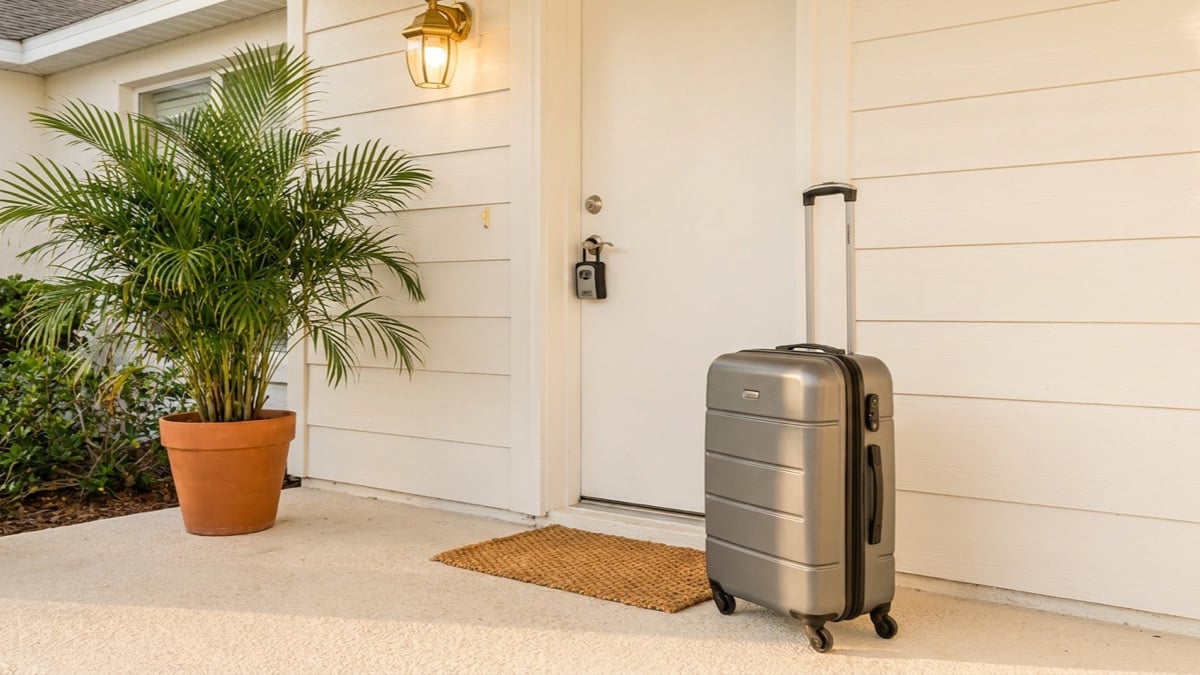
Featured image: AI-generated editorial illustration of a residential front entry, showing a silver wheeled suitcase standing on a pale concrete porch, a black key lockbox hanging from the handle of a white front door, a coir doormat, a potted areca palm in a terracotta pot and a lit brass porch lantern. Not a particular property.