

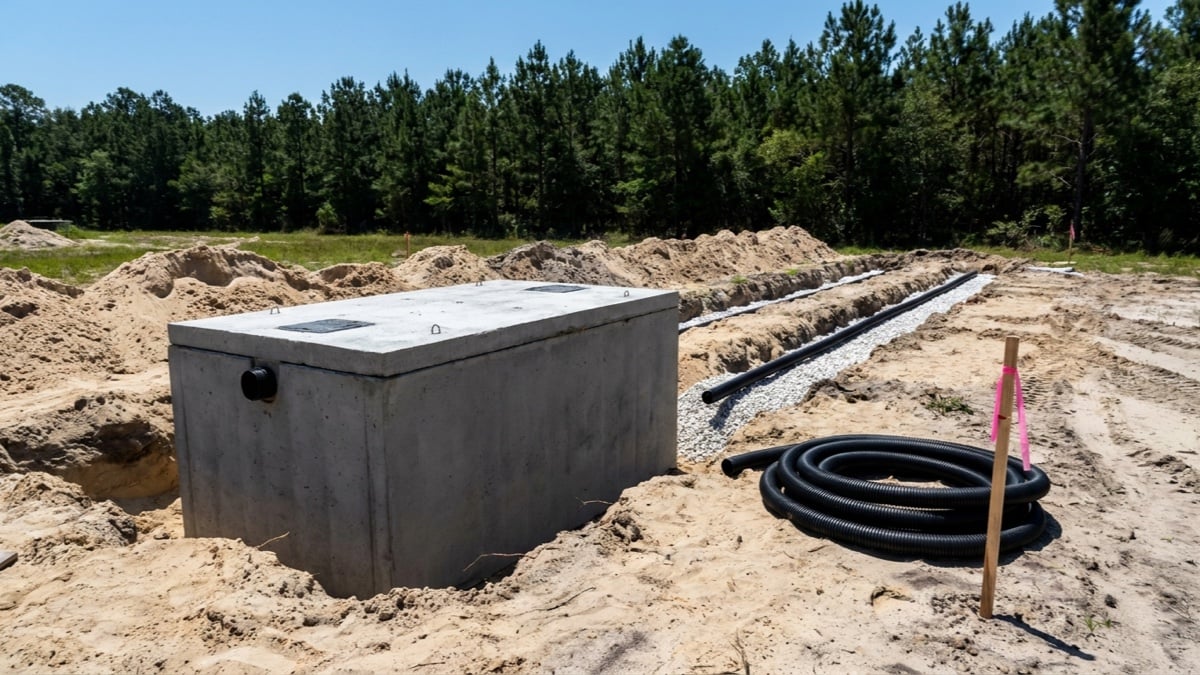
If the new home you are buying in Marion County will sit on a septic system, two things work differently here than in the rest of our service area. Since July 1, 2025, the Florida Department of Environmental Protection issues the septic permit directly instead of the county health department. And because Marion County holds two Outstanding Florida Springs, the parcel may fall inside a springs priority focus area where the state requires a nitrogen-reducing system rather than a conventional tank and drainfield. Both answers turn on where the lot sits, which makes them contract-stage questions.
Who issues the permit changed on July 1, 2025
Florida is moving onsite sewage permitting from the Department of Health to the Department of Environmental Protection one group of counties at a time. DEP’s permitting page lays out the schedule: Phase 1 covered Escambia County through Jefferson County on January 2, 2025, and Marion County followed on July 1, 2025. The remaining counties are listed as undetermined, dependent on legislative approval.
That makes Marion County the outlier in our market. In Lake, Orange, Osceola, Polk and Sumter counties, a septic permit still comes from the Environmental Public Health Program of the local county health department. In Marion County it comes from DEP, through the department’s online permit and service request portal, with paper applications still accepted by mail.
The submittal is short: the application form on page 1 of DEP form 4015, a site plan on page 2, and a copy of the building’s floor plan. What controls your calendar is the site evaluation, which assesses soil, topography and other conditions to decide whether the property can take an onsite system at all. DEP can perform it, or you can hire a qualified private site evaluator. A private evaluation has to be finished before the application goes in and uploaded as part of it.
Two Outstanding Florida Springs change which system is legal
Marion County Utilities states on its springs protection page that the county is home to two Outstanding Florida Springs, Silver Springs and Rainbow Springs, that it adopted one of the first springs protection ordinances in the state in 2009, and that onsite systems in both spring systems meet or exceed the 20 percent share of nitrogen loading that triggers a state-required remediation plan.
The rule that follows from that status sits in section 373.811, Florida Statutes. Inside a basin management action plan in effect for an Outstanding Florida Spring, a new onsite sewage treatment and disposal system is prohibited where connection to a publicly owned or investor-owned sewerage system is available. On lots of one acre or less where such a system is not available, the statute authorizes only enhanced nutrient-reducing systems or other wastewater treatment systems that achieve at least 65 percent nitrogen reduction.
House Bill 1379, chapter 2023-169, Laws of Florida, widened that one-acre rule. DEP’s guidance states that effective July 1, 2023, applicants for new septic systems serving lots of one acre or less anywhere in an impacted area must install a nitrogen-reducing system instead of a conventional one. A 20,000 square foot lot is 0.459 acres, so most platted subdivision lots sit well inside that threshold.
Lot size is not the end of the analysis here. DEP publishes an interactive map of where these requirements apply, drawn from its Springs Priority Focus Areas layer. Read on October 31, 2026, that layer records both the Silver Springs and the Rainbow Springs and Rainbow River priority focus areas as primary protection areas covering new and existing systems, with the requirement stated as nitrogen-reducing systems on all lot sizes.
A system qualifies as enhanced nutrient-reducing when the department has approved it as capable of meeting or exceeding 50 percent total nitrogen reduction before the wastewater reaches the drainfield, or at least 65 percent combined across the tanks and the drainfield. DEP lists three approved routes: in-ground nitrogen-reducing biofilters, Florida-approved aerobic treatment units certified to NSF 245, and Florida-approved nitrogen-reducing performance-based treatment systems.
One detail deserves a line of its own. DEP’s frequently asked questions document on these systems, version 1.1a dated December 19, 2023, states that the usual septic variance process under section 381.0065(4)(h) is not available for the nitrogen-reducing requirement. What remains is a petition for an administrative hearing under sections 120.569 and 120.57, a legal proceeding rather than a waiver counter.
What sewer being available actually means
Because the prohibition on a new septic system turns on sewer being available, the statutory definition matters. Section 381.0065(2)(a) defines available as a system capable of being connected to the plumbing, not under a DEP moratorium, and holding adequate permitted capacity for the sewage the residence will generate. For a residential subdivision lot or single-family residence with an estimated flow of 1,000 gallons per day or less, it adds a physical test: a gravity sewer line able to maintain gravity flow from the property’s drain, or a low pressure or vacuum collection line in areas approved for those, has to exist in a public easement or right-of-way that abuts the property line. A plant two miles away does not satisfy that, and neither does a line that stops one parcel short.
Marion County Utilities publishes a water and sewer availability view inside the county’s interactive mapping system, and that system carries its own disclaimer: the geospatial data are general representations subject to revision, are not used to establish legal descriptions, and should be confirmed with the appropriate department or constitutional office. Use the map to form the question and the utility’s written answer to settle it.
Four positions a Marion County lot can be in
| Where the lot sits | What the state allows | What it means for the build |
|---|---|---|
| Sewer available at the property line under the statutory test | No new onsite system inside a springs basin plan | Utility capacity confirmation replaces the septic permit track |
| No sewer, lot one acre or less, inside an impacted area | Nitrogen-reducing system only, since July 1, 2023 | Advanced system priced into the build, no variance route |
| No sewer, lot over one acre, inside the Silver Springs or Rainbow Springs and Rainbow River priority focus area | DEP’s map records nitrogen-reducing systems on all lot sizes | Acreage does not buy a conventional system |
| No sewer, lot over one acre, outside any impacted area | A conventional system remains possible | Still subject to the site evaluation result |
The permit order Marion County has to enforce
Section 381.0065(4), Florida Statutes, puts the sequence beyond local discretion. A municipality or political subdivision may not issue a building or plumbing permit for any building that requires an onsite sewage system unless the owner or builder has already received a construction permit for that system from the department. The same subsection bars occupancy until the department approves the final installation, so the septic sign-off sits ahead of the certificate of occupancy as well. A construction permit is valid for 18 months and the department may extend it once for 90 days, which is the window a slipped build-on-your-lot schedule has to fit inside.
Marion County Building Safety’s checklist for a new single-family residence or duplex asks for a site plan showing the property dimensions, all streets, the septic and well locations, the distances to the property lines and the driveway location. It also requires an individual stormwater drainage plan at permit application under section 5.5-33(l) of the Marion County Code of Ordinances, and a certified copy of the recorded Notice of Commencement for new construction over $5,000.
What to settle before you sign
- Run the parcel number against both DEP’s requirements map and the county’s water and sewer availability view on the same day, and save what you saw.
- If sewer looks available, ask the utility in writing whether a qualifying line exists in a public easement or right-of-way abutting the property line and whether permitted capacity exists for the home.
- If the home will be on septic, ask the builder in writing which system type the contract price includes and who absorbs the difference if the permit requires a nitrogen-reducing system.
- Confirm who performs the site evaluation and when, since a private evaluator’s report has to be complete before the application is submitted.
- Check that your inspection or financing period covers the evaluation and permit timeline rather than only loan approval.
Frequently asked questions
Does a larger lot in Marion County avoid the nitrogen-reducing requirement?
Not inside the priority focus areas. The statewide one-acre threshold from House Bill 1379 is a floor rather than a ceiling. DEP’s requirements map records the Silver Springs and the Rainbow Springs and Rainbow River priority focus areas as requiring nitrogen-reducing systems on all lot sizes. Check the specific parcel before you treat acreage as the answer.
Can I get a variance if an advanced system does not fit the budget?
DEP’s guidance states that the standard septic variance process under section 381.0065(4)(h) is not available for the nitrogen-reducing requirement. The route that exists is a petition for an administrative hearing under sections 120.569 and 120.57. Treat the system as a cost to negotiate inside the purchase contract rather than one to appeal afterward.
When does the septic permit have to be in hand?
Before the county can issue the building or plumbing permit. The department’s approval of the finished installation then has to be in hand before anyone can authorize occupancy, which puts both milestones on the critical path to your closing date.
Where to go from here
Rural and semi-rural lots carry these checks in a cluster. Worth reading alongside this one: what to verify when a home is on a private well, the difference between a pump-out and a real septic inspection, and how county impact fees are calculated on a new home.
To have the wastewater question, the permit sequence and the price exposure mapped out before you commit to a Marion County lot or a to-be-built contract, book a strategy session with our team.
Nelson Cruz, P.A.
Founder & CEO
MVP Home Group, Real Broker LLC
Nelson brings nearly two decades in law enforcement to his work in real estate. View Nelson’s profile or contact our team at 407-901-9939 or [email protected].
Featured image: AI-generated editorial illustration of a new concrete septic tank set into an open excavation on a cleared sandy building lot, with a gravel drainfield trench and perforated pipe running behind it, a coil of corrugated pipe, a surveyor’s stake with pink flagging and fresh sand spoil piles against a pine treeline. Not a particular property or installation.