

Yes, once the home and the ground under it have both become real estate. That takes four things at once: a federal HUD certification label on the home, a permanent foundation with the hitch, wheels and axles removed, a Florida certificate of title that has been retired, and a county tax roll that assesses the home as real property. Miss one and the purchase becomes a personal-property loan with a shorter maximum term. The two Florida steps are filed with different offices, and neither one triggers the other.
The four tests, and who decides each one
The dividing line is not the age or the width of the home. Fannie Mae’s Selling Guide B5-2-02, updated December 10, 2025, requires the loan to be secured by both the manufactured home and the borrower’s interest in the land, with both “legally classified as real property under applicable state law.” FHA draws it the same way: 24 CFR 203.43f(b) requires the mortgage to cover the home and the site, to constitute a mortgage on a property “classified and taxed as real estate,” and to run no more than 30 years from the start of amortization. One test keys off legal classification and the other off the tax roll. In Florida those are separate filings, so a home can pass one and fail the other.
The HUD label is the first gate, and it is a physical object
Selling Guide B2-3-02, updated February 4, 2026, requires the home to have been built in compliance with the Federal Manufactured Home Construction and Safety Standards established June 15, 1976, as amended and in force when the home was made. For an existing home the lender must obtain photos of either the original HUD Data Plate or the Certification Label, and if neither can be obtained the guide states the loan is not eligible for sale to Fannie Mae. FHA conditions eligibility at 24 CFR 203.43f(a) on a certification label affixed under 24 CFR 3280.8. Those standards have been in force for 50 years, so an older home has no label to verify at all.
Go find both before you write an offer. The certification label (24 CFR 3280.11) is an aluminum plate about 2 inches by 4 inches, riveted on so it cannot be removed without defacing it, one per transportable section, at the taillight end roughly 1 foot up from the floor and 1 foot in from the road side. The Data Plate (24 CFR 3280.5) is a paper document inside the home near the main electrical panel. A missing label is often recoverable, since B2-3-02 accepts a verification letter or duplicate plate from the Institute for Building Technology and Safety or the manufacturer.
The same section sets the physical tests: a permanent foundation system meeting the manufacturer’s requirements for anchoring, support, stability and maintenance, permanent connection to a septic tank or sewage system and the other utilities, the towing hitch, wheels and axles removed, and at least 12 feet of width with at least 400 square feet of above-grade finished area. One condition has no fix. The unit must never have been installed or occupied at any other site, other than arriving from the manufacturer or a dealer’s lot as a new unit, and FHA says the same at 24 CFR 203.43f(d)(iii). A home set up elsewhere, lived in, then moved to its current lot will not finance on either program regardless of the foundation under it today.
Two Data Plate lines that decide Florida deals
The first is the wind zone. Under 24 CFR 3280.305(c)(2) the design wind requirement follows the home’s intended location. Wind Zone II carries a 100 mph design wind speed and covers every Florida county except the fourteen the rule places in Wind Zone III at 110 mph: Broward, Charlotte, Collier, Dade, Franklin, Gulf, Hendry, Lee, Martin, Manatee, Monroe, Palm Beach, Pinellas and Sarasota. Orange, Lake, Osceola, Polk, Seminole and Volusia are all Zone II, and that design must be performed by a professional engineer or architect. A home built only to the Zone I standard was not designed for any county in our service area.
The second is the load statement required by 24 CFR 3280.5(d). Every Data Plate must state either that the home is designed to accommodate the additional loads imposed by an attached accessory building or structure, or that it is not. Carports, screen rooms and Florida rooms get added to these homes constantly. Where the plate reads IS NOT, B2-3-02 puts the addition behind an inspection: if the state requires a state agency to approve the modification the lender confirms that happened, and if not, a third party regulated by the state and qualified to make the determination must inspect it and find it structurally sound.
Retiring the title and the RP sticker are two different errands
Retiring the title runs through s. 319.261, Florida Statutes. An owner whose mobile home is permanently affixed to real property owned by that same person may permanently retire the certificate of title, and the statute counts a recorded leasehold of 30 years or more as ownership here. Three documents get recorded with the clerk of court where the land sits: the original title carrying any recorded lienholder’s release, the legal description of the real property, and the owner’s sworn statement that the home is permanently affixed in accordance with state law. The owner then applies to the department for retirement. Subsection (7) is the sentence lenders care about: afterward “a separate security interest in the mobile home shall not exist, and the mobile home shall only be secured as part of the real property through a mortgage or deed of trust.”
Being taxed as real property runs through the property appraiser instead. Section 193.075(1) taxes a mobile home as real property if the home’s owner also owns the land it is permanently affixed to, defining permanently affixed here as tied down and connected to the normal and usual utilities. Such a home gets an “RP” series sticker under s. 320.0815, issued only on a certificate from the property appraiser that the home is in that owner’s ad valorem assessment. A home not taxed as real property must instead carry a current license plate under s. 320.08(11), a flat annual tax from $20 for a home no longer than 35 feet to $80 for one over 65 feet.
Section 319.261(11) states that nothing in the retirement section “shall be construed to affect the taxation of mobile homes.” That is the trap. Retiring the title does not put the home on the ad valorem roll, and an RP sticker does not retire the title. FHA’s test reaches the tax classification and Fannie Mae’s reaches the legal one, so both errands have to be finished before closing. The tied-down-and-connected standard is also a far lower bar than the permanent foundation a lender demands, so an RP sticker by itself proves nothing about loan eligibility.
Can you get a mortgage on a Florida mobile home on a rented lot?
Owning the home and renting the lot is common across Central Florida’s manufactured-home communities, and it is the configuration conventional financing will not touch. B5-2-02 makes a manufactured home on leased land subject to a ground lease ineligible unless the borrower owns the home and it sits in a condominium or PUD project approved through Fannie Mae’s Project Eligibility Review Service. Co-op projects and investment properties are ineligible. What remains is a personal-property loan, and the federal program for it is FHA Title I, whose term caps at 24 CFR 201.11(b) are shorter than a mortgage’s.
| Financing path | Maximum term | Payment on $180,000 at 7.24% | Total interest |
|---|---|---|---|
| Real-property mortgage, FHA ceiling at 24 CFR 203.43f(b) | 30 years | $1,226.70 | $261,610.79 |
| Title I multi-module home and lot in combination | 25 years and 32 days | $1,299.89 | $209,967.87 |
| Title I manufactured home loan | 20 years and 32 days | $1,421.59 | $161,180.73 |
The rate is held constant at 7.24 percent, Freddie Mac’s Primary Mortgage Market Survey average for the 30-year fixed-rate mortgage as of October 29, 2026, so the table isolates the term alone, and the $180,000 is an illustration rather than a market figure. On those inputs the 20-year payment runs $194.89 a month above the 30-year, which is a qualifying problem rather than a cost problem, since the shorter schedule pays $100,430.06 less interest. A personal-property lender prices its own loans and this makes no prediction about that rate. Where you do buy the lot, Selling Guide B5-2-03 counts equity in land you already own toward the 5 percent minimum borrower contribution. Our breakdown of the real monthly cost of a Florida home covers what sits on top of the payment.
What to check before you write the offer
- Photograph the certification label on each section and the Data Plate inside. If either is gone, price in a verification letter or duplicate plate.
- Read the wind zone on the Data Plate. Anywhere in our service area it needs to be Zone II or better.
- Read the accessory-structure load line, then compare it against every carport, screen room and addition on the property.
- Ask whether the home has ever been installed or occupied anywhere else. A yes ends the conventional and FHA conversation.
- Confirm who owns the land. A leased lot means a personal-property loan unless the community is a Fannie Mae-approved condo or PUD project.
- Search the clerk’s records for a recorded s. 319.261 retirement package, then check the tax roll for the real-property assessment. Confirm both, not one. Our guide to open and expired Florida permits explains how additions surface in the same search.
Frequently asked questions
Can I get a 30-year mortgage on a 1972 mobile home in Florida?
No. The federal construction standards took effect June 15, 1976, and a home built before that date carries no HUD certification label to verify. Fannie Mae’s B2-3-02 requires photos of the original Data Plate or Certification Label for an existing home and states the loan is not eligible for sale without them, and FHA conditions eligibility at 24 CFR 203.43f(a) on a label affixed under 24 CFR 3280.8. A pre-1976 home means a personal-property or portfolio lender.
If my home already has an RP sticker, is the title retired?
Not necessarily. These are separate filings with separate offices. The RP sticker under s. 320.0815 follows from the property appraiser assessing the home as real property under s. 193.075(1), which asks only that the owner also own the land and that the home be tied down and connected to utilities. Retiring the certificate of title under s. 319.261 requires recording the title, the legal description and a sworn affidavit with the clerk of court, then applying to the department. Section 319.261(11) says the retirement section does not affect taxation at all.
Does buying in a manufactured-home community change the loan?
Usually yes. Where the lot is leased under a ground lease, B5-2-02 makes the home ineligible unless the borrower owns the home and the community is a condominium or PUD project approved through the Project Eligibility Review Service, and co-op projects are ineligible outright. Where the community sells the lot with the home and the home becomes real property, the standard rules apply instead. Ask for the community’s structure in writing.
Where to go from here
Paperwork decides this loan before the appraisal gets a vote, and four of the six checks above take an afternoon with a phone camera and a county records search. If you are weighing a manufactured home anywhere across our Central Florida service area, book a strategy session with our team at mvphomegroup.com/nelsoncruz. We read the Data Plate, the clerk’s records and the tax roll before anyone writes a number. This is general information about Florida statutes and published lender guidelines, not legal or lending advice, and program requirements change.
Nelson Cruz, P.A.
Founder & CEO
MVP Home Group, Real Broker LLC
Nelson brings nearly two decades in law enforcement to his work in real estate. View Nelson’s profile or contact our team at 407-901-9939 or [email protected].
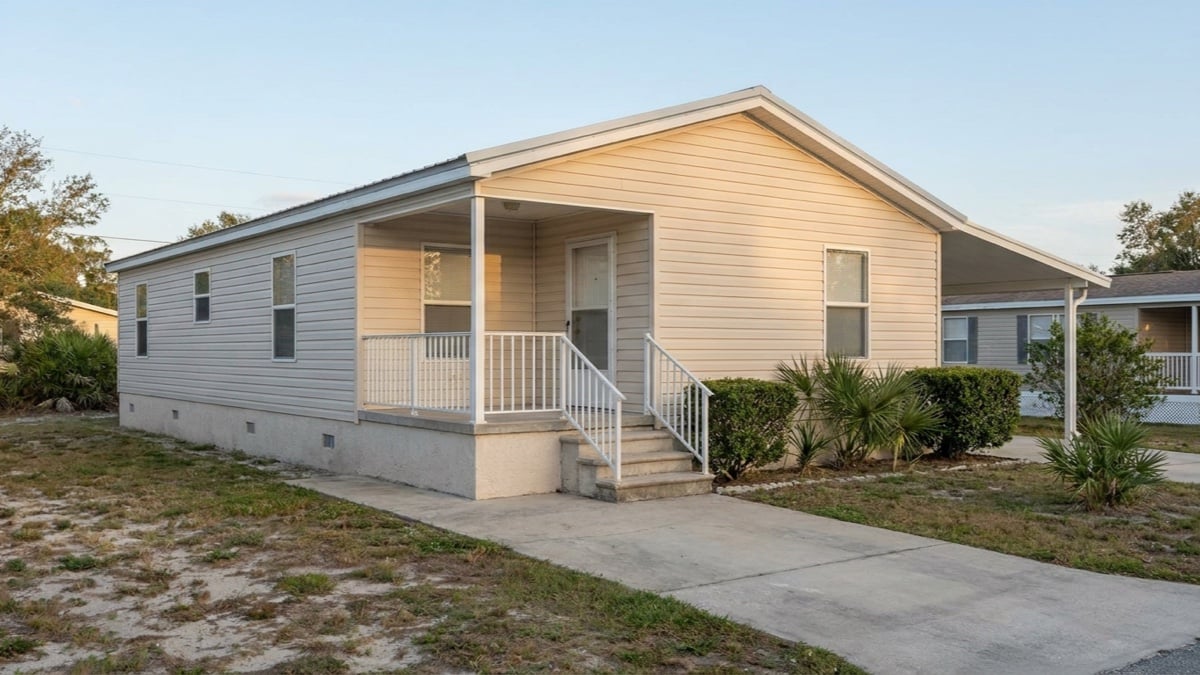
Featured image: AI-generated editorial illustration of a single-story manufactured home exterior set on a permanent concrete-block perimeter foundation, with lap siding, a low-pitch roof, a covered entry with railing and a concrete walk. No readable text or signage. Not a particular property.