

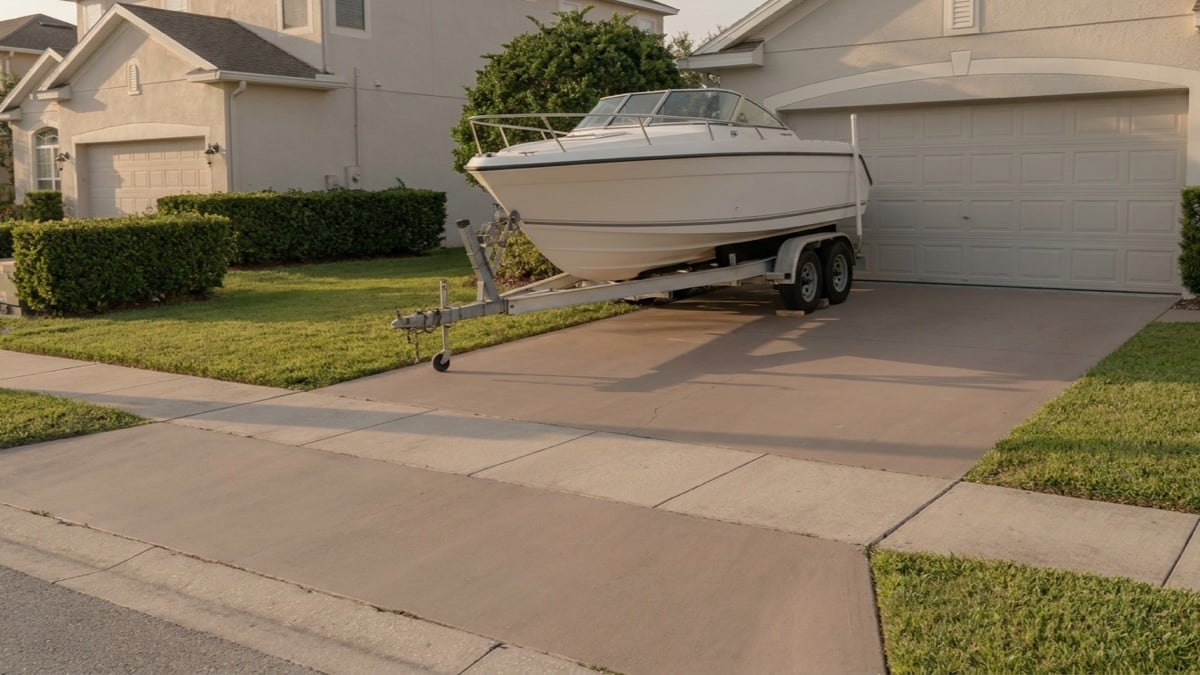
In the City of Minneola, the only place a boat, recreational vehicle, camper or oversized trailer can sit indefinitely at a home is inside an enclosed structure or behind the front building line extended. The driveway is a short-term spot at best, and the city code gives two different answers about how short. Your HOA is a second layer, and a 2024 state law limits what the HOA can police but hands the city back full authority.
Where the code actually lets a boat or RV sit
Minneola Code of Ordinances Sec. 44-203(a), in Article VI of Chapter 44, which governs off-street parking within residential districts, is the controlling sentence for most buyers. No recreational vehicle, boat and associated trailer, utility or cargo trailer over 16 feet in length, or camper may be parked or stopped on private property in a residential neighborhood unless it is parked inside an enclosed structure or behind the front building line extended of the building on the lot.
That phrase carries the entire rule, and the code does not define it. “Front building line extended” appears nowhere in the Sec. 44-201 definitions for this article, and it is absent from the land development code definitions at Sec. 82-12. Neither does the code say whether the line is measured from the front wall of the house, from a projecting garage face, or from the required front setback. On a lot where the garage pushes forward of the living space, those readings put the line in different places. Ask the city which face it measures from, for your specific lot, and keep the answer.
What the section does make clear is the direction of the answer: side-yard and rear-yard placement behind that line, or a structure you can close, is the durable solution. The driveway is not.
Two definitions in Sec. 44-201 decide close cases. A recreational vehicle is a motor vehicle, regardless of size, designed to let occupants sleep in it and be used for camping; food preparation and bathroom facilities are not required for it to count. A camper is the same thing without its own power. So a truck camper and a small teardrop trailer both fall inside the rule even though neither looks like a motor home.
The same section defines “driveway” in a way that matters on a wide lot. A driveway includes grassed areas immediately adjacent to the improved parking surface, but in no event may more than 40 percent of a lot’s total front yard area be used for parking or storage of vehicles. Widening a gravel pad to absorb a boat trailer runs into that 40 percent ceiling before it runs into anything else.
The code gives two different driveway answers
Sec. 44-203(b) permits temporary driveway parking. Boats and associated trailers, and utility or cargo trailers over 16 feet, are temporary if they remain in a driveway for less than 96 hours, which is four days. Recreational vehicles and campers are temporary if they remain no more than seven consecutive days.
Sec. 44-75(1), in the trucks and trailers article of the same chapter, says something different. No person may park or allow to be parked, within any residential or partial residential district, any box truck, semitruck, tractor trailer, house trailer, recreational vehicle, boat trailer, utility or cargo trailer on any driveway, street or public right-of-way, or upon any sidewalk in the city. There is no durational allowance in that sentence, and its four listed exceptions in Sec. 44-75(3) cover pickups and commercial vans of Class 5 or lower on the street, commercial vehicles actively working, personally owned Class 5 vehicles used for business, and loading or unloading with the owner present in the immediate area. None of those exceptions returns the driveway to a boat owner.
Sec. 44-75(2) then declares violating vehicles unlawful and public safety hazards, subject to parking fines and towing at the owner’s expense if they remain more than three days.
These provisions do not reconcile cleanly, and the gap is measurable. Sec. 44-203(b) lets a boat on a trailer sit 96 hours, while Sec. 44-75(2) authorizes towing after 72 hours, leaving 24 hours of exposure. For a recreational vehicle the spread is wider: seven days permitted against towing after three, a four-day window where one section allows what the other penalizes. Sec. 44-75 also bars utility and cargo trailers from driveways outright, while Sec. 44-202(b) expressly allows those of 16 feet or less so long as they do not encroach on the sidewalk or right-of-way.
Sec. 44-75 carries the later legislative date. It derives from Ord. No. 2002-20 and was amended by Ord. No. 2024-18, § 2, on August 6, 2024. The Article VI sections all derive from Ord. No. 2003-09, adopted May 27, 2003, and were not amended alongside it. That history points toward the 2024 amendment as the city’s current position, but the older sections remain in the published code and this post does not resolve which one enforcement follows. Before you write an offer on a home where the boat or RV has nowhere to go but the driveway, get that reading in writing from Minneola code enforcement, naming both Sec. 44-75 and Sec. 44-203.
What the rest of Article VI adds
- Sec. 44-202(a). An ordinary motor vehicle of 10,000 pounds gross weight or less must be on a driveway, in a designated business space in the OR zoning district, in an enclosed structure, or behind the front building line extended. Anything over 10,000 pounds may not sit on residential private property at all unless it is actively loading or unloading.
- Sec. 44-204. No vehicle may be parked on a vacant or unimproved lot or parcel in a residential district. Buying the empty lot next door does not create boat storage.
- Sec. 44-205. Repair, maintenance or restoration may happen in a residential driveway, but any individual instance must finish within one day. If it cannot, the vehicle and all associated tools and equipment move behind the front building line extended.
On the penalty side, the Sec. 44-167(c) schedule prices most parking violations at $15.00 and sets item 19, no parking for a semitruck or RV on a roadway or public right-of-way, at $50.00. That schedule has no line item for a driveway violation, which is why Sec. 44-75(2) reaches for towing instead. Where no specific penalty is provided, Minneola Sec. 1-14(a)(2) allows a fine up to $500.00, up to 60 days, or both, and Sec. 1-14(b) makes each day a violation continues a separate offense.
Your HOA is a separate layer, and state law moved the line in 2024
Section 720.3045 of the 2026 Florida Statutes provides that regardless of any covenants, restrictions, bylaws, rules or requirements of an association, and unless prohibited by general law or local ordinance, an association may not restrict parcel owners or their tenants from installing, displaying or storing any items on a parcel which are not visible from the parcel’s frontage or an adjacent parcel, an adjacent common area, or a community golf course. The statute names boats and recreational vehicles in its list of examples. It was created by chapter 2023-64 and amended by chapter 2024-221.
Read the whole sentence before you rely on it. The protection turns entirely on visibility. A boat screened in a rear yard, invisible from the street, from the neighbors’ lots, from common area and from any community golf course, is outside the association’s reach. Visible from any one of those vantage points, it is not protected, and the covenant applies normally.
The clause that matters most in Minneola is “unless prohibited by general law or local ordinance.” The statute strips the association of authority and hands it straight back to the city. If the city code bars the placement, s. 720.3045 gives you nothing, because the statute defers to that ordinance. The working sequence is city code first, covenant second, and s. 720.3045 only as a limit on the covenant. Note also that chapter 720 governs homeowners’ associations and parcels, so a condominium or co-op answers to a different statute.
Minneola against Clermont, side by side
Clermont is one of the adjoining corridors buyers weigh against Minneola. The two cities regulate this subject differently, and the rules are not interchangeable.
| Question | City of Minneola | City of Clermont |
|---|---|---|
| Is a boat trailer a “recreational vehicle”? | No. Sec. 44-201 defines a recreational vehicle as a motor vehicle for sleeping and camping; boats and trailers are listed separately throughout Ch. 44. | Yes. Sec. 22-1 includes any non-self-propelled vehicle whose primary use is recreational, naming campers and boat and horse trailers. |
| How long on the lot before it must be put away? | Sec. 44-203(b): under 96 hours for boats and trailers, up to seven consecutive days for RVs and campers. Sec. 44-75(2) authorizes towing after three days. | Sec. 22-4: unlawful to park or store any recreational vehicle more than 24 hours on any lot, piece or parcel of land, or on any street or highway. |
| Where is the permanent place? | Sec. 44-203(a): inside an enclosed structure, or behind the front building line extended. | Sec. 22-4: entirely within a closed building and not used for living or sleeping, or to the rear of the building setback line for that zone under the land development regulations. |
| Special rule for waterfront lots? | None in Ch. 44. | Sec. 22-5, added by Ord. No. 2023-006 on March 28, 2023. Detailed conditions apply. |
| General penalty ceiling | Sec. 1-14(a)(2): up to $500.00, up to 60 days, or both; each day a separate offense. | Sec. 1-7(c): up to $500.00, up to 60 days, or both; each day of a continuous violation a separate offense. |
Two differences drive real decisions. First, the reference line is not the same shape: Minneola measures from the front building line extended, Clermont from the rear of the building setback line for the zone. On an irregular or corner lot those two lines can sit many feet apart, and the Clermont test requires reading the land development regulations for that specific zoning district. Second, the tolerance differs fourfold at the short end, 96 hours in Minneola against 24 hours in Clermont, and Clermont’s 24-hour clock applies to boat trailers because its definition sweeps them in.
Clermont’s waterfront provision is narrower than it sounds. Sec. 22-5(b) permits a boat or trailer on water frontage property in a residential zoned district only where that frontage is a separate plot from the one holding the primary living structure, divided from it by a roadway, reached by a permitted driveway connection, and carrying no structure suitable for sleeping. Within those conditions it caps each parcel at four watercraft and two trailers, exempts paddleboats and kayaks under ten feet, requires registrations in the owner’s or immediate family’s name, bars paid storage in residential zones, and keeps everything off rights-of-way and dedicated easements. A lakefront house on a single parcel does not qualify.
What to check before you write the offer
- Confirm the jurisdiction. A Minneola mailing address is not proof of city limits. Parcels in unincorporated Lake County carry county rules, not Ch. 44. Verify with the Lake County Property Appraiser record and the city before you rely on any of this.
- Walk the side yard with a tape measure. Wherever the city draws the front building line, the trailer has to physically reach the space behind it. Measure the gate opening, the narrowest pinch point between the house and the fence or the neighbor’s wall, and the turning room at the street. A compliant spot you cannot back into is not a spot.
- Measure the vehicle, not the category. The 16-foot threshold in Secs. 44-202(b) and 44-203(a) is a length, so a utility trailer at 15 feet and one at 17 feet land on opposite sides of the rule.
- Read the recorded covenants, then walk the sight lines. Request the governing documents and find the storage article; the stricter of the covenant and the city rule controls your day-to-day. Then test the s. 720.3045 visibility question on foot, from the street, the neighbors’ lots, the common area and any golf course, before assuming a screened spot qualifies.
- Get the Sec. 44-75 versus Sec. 44-203 conflict resolved in writing. Ask Minneola code enforcement which section they apply to a residential driveway and what the current towing practice is. A written answer before closing is worth more than either code section alone.
- Price the fallback. If no compliant spot exists on the lot, commercial storage becomes a recurring cost attached to that house. Decide whether that changes what the home is worth to you before you negotiate, not after.
Frequently asked questions
The sellers kept their boat in the driveway for years. Doesn’t that make it allowed?
No. Minneola Sec. 1-14(b) makes each day a violation continues a separate offense, so time does not convert a violation into a right. Code enforcement in most Florida cities is complaint-driven, which means a long-tolerated arrangement can end the week a new neighbor objects. What the prior owner did is evidence of what went unreported, not evidence of what the code permits.
My HOA approved my RV pad in writing. Can the City of Minneola still cite me?
Yes. The association and the city enforce separate bodies of rules, and association approval is not a permit. Section 720.3045 of the 2026 Florida Statutes itself defers to local ordinance with the words “unless prohibited by general law or local ordinance,” so the city’s position survives the HOA’s blessing. If the placement violates Ch. 44, approval from the board does not cure it.
Is a 15-foot utility trailer treated like a boat trailer in Minneola?
Not under Article VI. Sec. 44-202(b) allows utility and cargo trailers of 16 feet or less in a residential driveway provided they do not encroach on the sidewalk or the public right-of-way, while Sec. 44-203(a) reaches only utility and cargo trailers in excess of 16 feet. Sec. 44-75(1) is the complication, because it lists utility and cargo trailers among the vehicles barred from any residential driveway without reference to length. That is the same unresolved conflict described above, and it is worth a written answer from the city if a trailer is part of your plan.
Where you keep the boat is a question about one specific lot, not about the city, so settle it on the property you are actually buying. For another Minneola question worth settling before closing, see our guide to South Lake Trail access, and for the area overview see the full corridor guide at livemoveorlando.com/minneola. To talk through a specific property, book a strategy session at mvphomegroup.com/nelsoncruz.
Nelson Cruz, P.A.
Founder & CEO
MVP Home Group, Real Broker LLC
Nelson brings nearly two decades in law enforcement to his work in real estate. View Nelson’s profile or contact our team at 407-901-9939 or [email protected].
Featured image: AI-generated editorial illustration of a white powerboat on a galvanized trailer parked on a concrete residential driveway beside a closed garage door. No people and no readable text. Not a particular property, street or neighborhood.