

The toll cost of a Clermont commute is set by two things that have nothing to do with how far you drive: which authority owns the road you pick, and whether a transponder reads your car or a camera photographs your plate. On Central Florida Expressway Authority roads, the Pay By Plate rate is exactly double the electronic rate, and only an E-PASS account earns the monthly volume credit. On Florida’s Turnpike, the plate premium at the Clermont-area entrances ranges from 18.6 percent to 48.3 percent above the SunPass rate, and each 30-day invoice adds a $2.50 administrative fee. Settling the transponder before you close is worth more than shaving a mile off the route.
Two authorities price the same drive under different rules
Florida’s Turnpike Enterprise and the Central Florida Expressway Authority (CFX) both operate toll roads between Clermont and Orlando, and each publishes its own schedule. The Turnpike’s Central Florida schedule, dated August 14, 2026, prices the mainline (State Road 91) point by point using mileposts. The CFX chart, effective July 1, 2026, prices every ramp and main-lane gantry on the CFX system, listing an electronic rate and a Pay By Plate rate for each number of axles.
CFX names its facilities: the East-West Expressway (SR 408), the Western Beltway (SR 429), the Central Florida GreeneWay (SR 417), the Apopka Expressway (SR 414), State Road 453, the Beachline Expressway (SR 528), the Poinciana Parkway (SR 538), and the Wekiva Parkway (SR 429) as far as Mount Plymouth Road.
State Road 429 is not one authority from end to end. The CFX list stops the Wekiva Parkway at Mount Plymouth Road, and the Turnpike’s schedule separately prices the southern Western Beltway Part C locations at Seidel Road, US 192 and Sinclair Road. Reading one schedule does not tell you what a whole route costs.
What the Turnpike charges at the Clermont-area entrances
These are the two-axle rates published on the Turnpike’s Central Florida schedule for the mainline locations nearest Clermont, plus the Orlando interchange at Interstate 4. The premium column is calculated from the two published rates.
| Tolling point (milepost) | SunPass | TOLL-BY-PLATE | Plate premium |
|---|---|---|---|
| 281, Minneola Plaza | $1.45 | $1.72 | 18.6% |
| 278, Minneola (Hancock Rd.) | $0.86 | $1.16 | 34.9% |
| 272, Winter Garden/Clermont (SR 50) | $0.58 | $0.86 | 48.3% |
| 259, Orlando (I-4) | $0.58 | $0.86 | 48.3% |
The SR 50 interchange and the I-4 interchange sit 13 mileposts apart on that schedule. Note what the schedule prices: locations, not trips. A given run costs the sum of the tolling points the vehicle actually crosses, which is why neither authority publishes a single number for a city pair.
The plate premium is a flat doubling on one system and a sliding figure on the other
CFX states its rule in one line: Pay By Plate toll rates are double the electronic rate. That holds across the chart. On the 47 two-axle rows of the July 1, 2026 chart carrying no footnote marker, the Pay By Plate figure is exactly twice the electronic figure in every case, from the $0.35 row to the $1.72 row. A CFX invoice is mailed monthly to the registered owner and is due within 30 days to avoid toll violations and fines.
The Turnpike works differently. TOLL-BY-PLATE photographs the plate when no compatible transponder is detected, then mails the registered owner one Toll Enforcement Invoice covering the tolls incurred over a 30-day period, plus a $2.50 administrative fee. The Turnpike puts the average SunPass saving at 25 percent against TOLL-BY-PLATE. The Clermont-area rows show why an average flattens the picture: the gap is 18.6 percent at the Minneola Plaza and 48.3 percent at the SR 50 interchange, so the cheapest of these points carries the steepest proportional penalty for skipping a transponder.
Only one of the two systems pays a volume credit
CFX runs the E-PASS Volume Savings Program, which credits 20 percent back on 40 to 79 CFX transactions per transponder in a calendar month, and 25 percent on 80 or more. Enrollment is automatic for E-PASS accounts in good standing, which CFX defines as holding a positive balance at some point during the month. The credit posts on the 15th of the following month, counts per transponder rather than per account, and carries no transaction or processing fee. CFX limits the program to its own roads and bridges and states that all other Florida toll roads are not included.
The thresholds are within reach of an ordinary five-day commute. November 2026 has 21 weekdays, which is 42 one-way trips. A route crossing one CFX gantry each way produces 42 transactions and clears the 20 percent tier. A route crossing two CFX gantries each way produces 84 and clears the 25 percent tier. The same mileage run on the Turnpike mainline earns no CFX credit, because the program covers CFX facilities only.
The electronic rate does not depend on which transponder you carry. SunPass Mini and SunPass PRO work across Florida, and CFX says E-PASS is accepted on all Florida toll roads. The account behind the transponder decides whether the volume credit is paid. A basic E-PASS Sticker is free; a SunPass account requires purchasing, activating and installing a transponder and funding a prepaid balance.
A worked month, with the assumption stated
Neither authority publishes a route total, so start from your own. Suppose your one-way electronic tolls come to $3.00. That is an assumption for the arithmetic below, not a figure from either schedule; replace it with your own route total before relying on it.
- 42 one-way trips at $3.00 electronic: $126.00 a month, or $1,512.00 a year.
- The identical travel billed Pay By Plate on CFX roads doubles to $252.00 a month, which is $126.00 of avoidable cost every month.
- At the 20 percent tier the CFX volume credit returns $25.20 a month. At the 25 percent tier it returns $31.50, cutting the net to $94.50 and the annual figure to $1,134.00.
The Turnpike side compounds more quietly. Passing the SR 50 interchange on all 42 one-way trips costs $24.36 with SunPass and $36.12 by plate. Add the $2.50 invoice fee and the plate route runs $38.62, a gap of $14.26 a month and $171.12 over twelve months, from one tolling point.
Why the figure moves every year
Both schedules are written to rise. Florida Statutes section 338.165(3) directs the Department of Transportation, including the turnpike enterprise, to index toll rates on existing toll facilities to the annual Consumer Price Index or similar inflation indicators, with inflation adjustments made no more than once a year and no less than once every five years. CFX operates under a Customer-First Toll Policy its board approved in 2017, under which rates adjust annually by 1.5 percent or to the annual Consumer Price Index.
Treat any toll figure as dated. A 1.5 percent step on the $1,512.00 annual example is $22.68, which is why an estimate carried over from an older relocation worksheet understates the current bill. Budget the commute alongside the rest of the carrying cost: taxes, insurance and association dues.
What to settle before you close
- Run your actual address-to-office route through each authority’s toll calculator in both directions, since tolls are priced per location and the two directions need not match.
- Count how many of those tolling points sit on CFX facilities. That count, doubled for the round trip and multiplied by your workdays, tells you whether you clear 40 or 80 CFX transactions a month.
- Open the account that matches the answer and register every vehicle and plate that will make the drive. A transponder read triggers the electronic rate; an unregistered plate triggers the invoice.
- Keep the account funded. The CFX credit requires a positive balance at some point in the month, and a lapsed balance forfeits the credit on travel you already paid for.
Frequently asked questions
Is SunPass or E-PASS cheaper on the same road?
The electronic toll rate at a given location is the published electronic rate, and both transponders are accepted across Florida’s toll roads. The difference is the volume credit. CFX pays its volume savings only to E-PASS accounts and only on CFX roads and bridges, and states that all other Florida toll roads are excluded, so the account you choose matters most when your route runs mainly on CFX facilities.
Can I commute between Clermont and Orlando without paying any toll?
A toll is charged only at the tolling locations these two schedules list, so a route that crosses none of them carries no toll cost. Both authorities publish calculators that total a specific route, which is how to confirm whether the route you have in mind is tolled at all. Neither publishes a travel-time comparison between tolled and untolled routes, so drive your candidates at the hour you would actually leave before treating either as settled.
Do the rates change if my vehicle has more than two axles?
Both schedules price by axle count. On the Turnpike’s Central Florida schedule, the SR 50 interchange at milepost 272 is $0.58 with SunPass for two axles, $1.16 for three, $1.74 for four and $2.32 for five, adding $0.58 for each additional axle. On the CFX chart, the Hiawassee Main Plaza electronic rate runs $1.02 for two axles, $2.08 for three, $2.40 for four and $3.11 for five.
Where to go from here
If you are still deciding whether this corridor fits, start with the full corridor guide at Live Move Orlando’s Clermont guide, which compares the area with its neighbors. For what homes are trading at here, our Clermont housing market report for October 2026 has the current figures.
When you want the commute math run against specific addresses, book a strategy session with our team at mvphomegroup.com/nelsoncruz. We price the route, the carrying cost and the offer together, because they are one decision.
Nelson Cruz, P.A.
Founder & CEO
MVP Home Group, Real Broker LLC
Nelson brings nearly two decades in law enforcement to his work in real estate. View Nelson’s profile or contact our team at 407-901-9939 or [email protected].
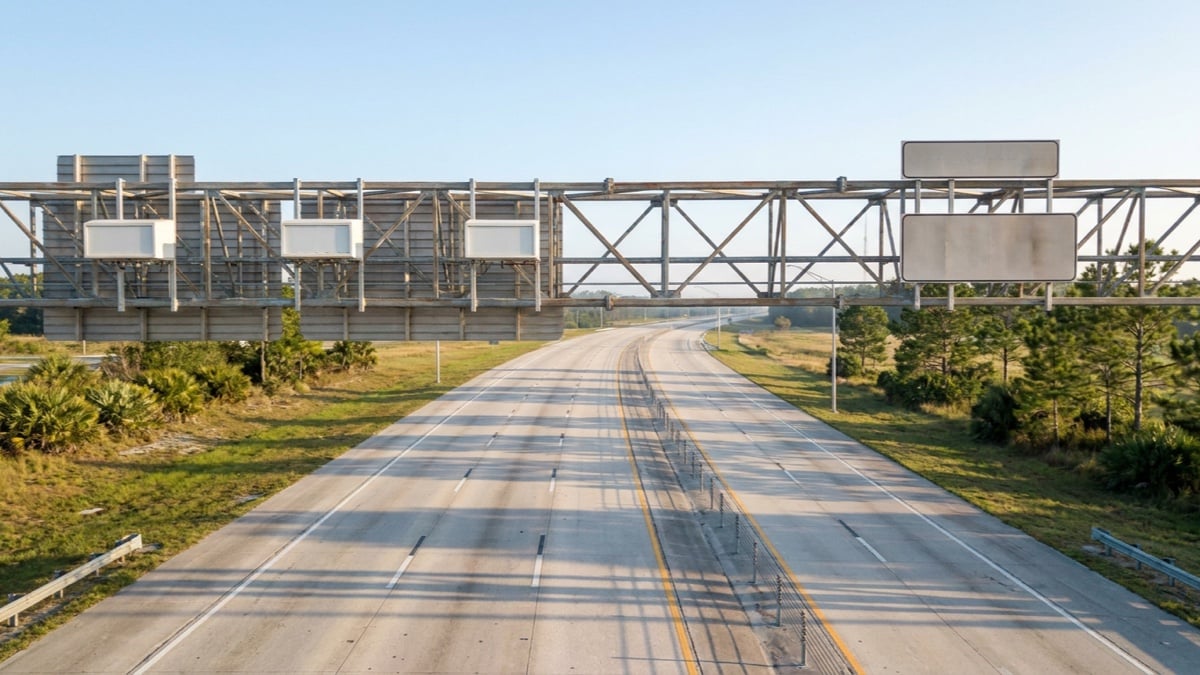
Featured image: AI-generated editorial illustration of an overhead electronic tolling gantry spanning an empty divided expressway, with boxed sensor and camera housings mounted along a steel truss, blank unmarked panels, concrete travel lanes, a cable-barrier median and palmetto and pine along the shoulders. Not a particular property, road or tolling location.