

A working farm beside your new Polk County home carries a statutory protection that complaining will not overcome. Once a farm operation has run for a year or more from its established date and follows generally accepted agricultural and management practices, Florida law stops treating its noise, dust, odors and spraying as a nuisance, and it keeps that protection after a subdivision arrives next door. The parcels touching your lot are worth reading before your deadlines run.
State law fixes what the operation may continue to do and who is even permitted to sue over it. The Polk County Land Development Code fixes what your subdivision’s developer already owed you at the shared property line.
What the Right to Farm Act removes from the table
Section 823.14, Florida Statutes, the Florida Right to Farm Act, provides that a farm operation which has been in operation for one year or more since its established date of operation, and which was not a nuisance at that established date, is not a public or private nuisance if the operation conforms to generally accepted agricultural and management practices. The established date of operation is the date the farm operation commenced.
The statute spells out what it covers. Section 823.14(3)(d) includes within the term “farm operation” the operation of machinery and irrigation pumps, the generation of noise, odors, dust, fumes and particle emissions, ground or aerial seeding and spraying, the application of chemical fertilizers, conditioners, insecticides, pesticides and herbicides, and the placement and operation of an apiary.
Four conditions are carved out as evidence of a nuisance, and all four concern sanitation and disease: untreated or improperly treated waste and harmful gases, improperly built or maintained septic tanks and privies, diseased animals kept outside a current state or federal disease control program, and unsanitary places where animals are slaughtered. Routine grove and pasture work appears nowhere on that list.
Section 823.14(4)(b) closes the argument a new neighbor reaches for first. A farm operation does not become a nuisance as a result of a change in ownership, a change in the type of farm product being produced, a change in conditions in or around the locality of the farm, or a change brought about to comply with best management practices. Your subdivision is the change in conditions in the locality. The one grandfather clause in the act, subsection (5), reaches homesteads and businesses that were already adjacent on March 15, 1982, which is 44 years back, so a newly built home draws nothing from it.
The label on the claim does not change the answer
Section 823.14(3)(f) defines nuisance as any interference with reasonable use and enjoyment of land, including noise, smoke, odors, dust, fumes, particle emissions or vibration, and then provides that the term also includes all claims meeting that definition regardless of whether the plaintiff designates them as brought in nuisance, negligence, trespass, personal injury, strict liability or other tort. Recasting the complaint keeps it inside the statute.
Three further limits stand in front of any claim. Section 823.14(4)(d) bars filing unless the real property affected lies within one-half mile of the source of the activity or structure alleged to be a nuisance, a distance of 2,640 feet and a radius enclosing roughly 503 acres. Section 823.14(4)(c) requires the plaintiff to prove by clear and convincing evidence that the claim arises out of conduct that did not comply with state or federal environmental laws, regulations or best management practices. Section 823.14(9) makes a plaintiff who fails to prevail against a qualifying operation liable for all costs, fees and expenses incurred in its defense.
Compensatory damages, should a claim survive all of that, are measured by the reduction in the fair market value of the plaintiff’s property and may not exceed that property’s fair market value, under section 823.14(7).
Why county code enforcement is the wrong door
Section 823.14(6) withdraws local authority over the same activities. A local government may not adopt any ordinance, regulation, rule or policy to prohibit, restrict, regulate or otherwise limit an activity of a bona fide farm operation on land classified as agricultural under section 193.461, where that activity is regulated through implemented best management practices or interim measures developed by the Department of Environmental Protection, the Department of Agriculture and Consumer Services or a water management district and adopted under chapter 120 as part of a statewide or regional program. The exception written into that subsection reaches an activity inside a wellfield protection area when the adopted practice does not specifically address wellfield protection.
The agricultural classification is the hinge. Section 193.461(1) directs the property appraiser to classify all land in the county annually as either agricultural or nonagricultural, and section 193.461(3)(b) limits the classification to land used primarily for bona fide agricultural purposes, which the statute defines as good faith commercial agricultural use of the land. We have covered how that classification is applied and reviewed on the owner’s side. A classified parcel plus a published best management practice puts the activity beyond the county’s reach.
What Polk’s code required at your property line
Polk County regulates the boundary instead of the farming. Section 720.H of the Polk County Land Development Code, in the version current as of August 26, 2026, requires landscape buffers between certain abutting land uses to mitigate or minimize potential nuisances such as noise, light, glare, dirt and litter, signs, parking or storage areas. The section applies to all new development within unincorporated Polk County.
Two tables produce the answer for a specific lot. Table 7.13 assigns agricultural, all uses, to Class 5, and single-family residential to Class 2. Table 7.12.a then reads a buffer type off the pairing of the proposed use with the use abutting each side.
| Use abutting your subdivision | Class | Buffer required of a proposed single-family residential development |
|---|---|---|
| Roadway or street | 1 | None |
| Single-family residential or duplex | 2 | None |
| Multi-family, mobile home park, congregate living | 3 | Type B |
| Retail, office, personal services, schools, religious institutions | 4 | Type B |
| Agricultural (all uses), industrial, utilities | 5 | Type C |
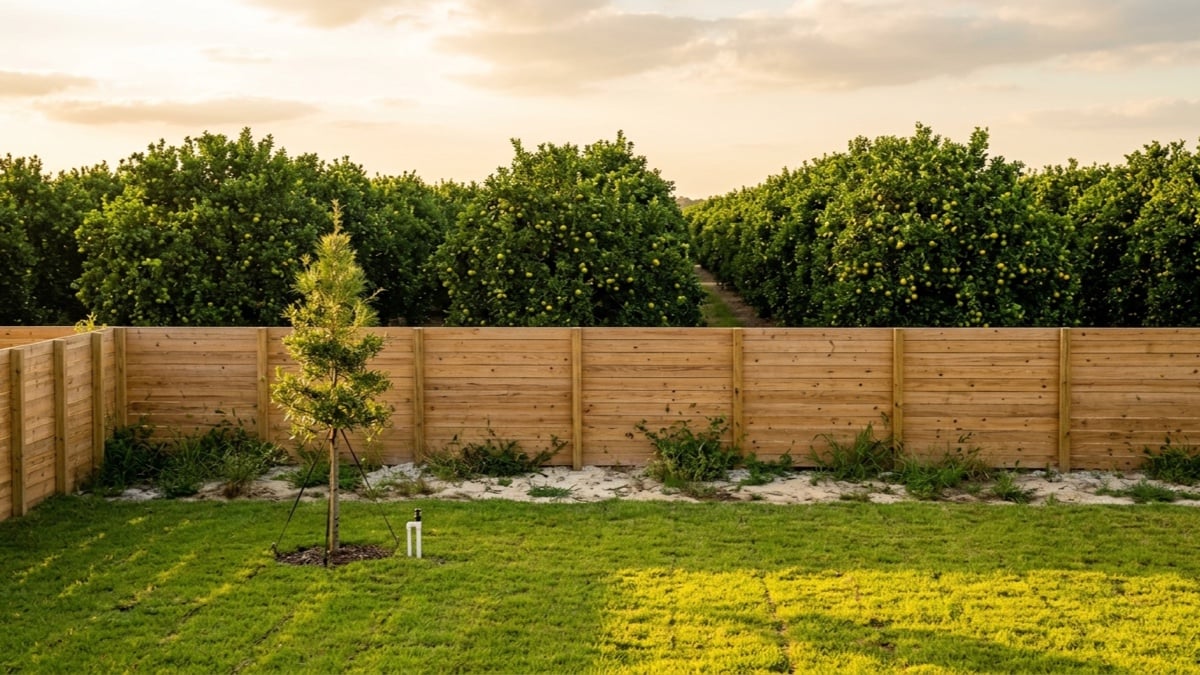
Type C is the heaviest of the three buffer types the matrix assigns, and Figure 7.3 of the code carries its specification. Section 720.H.2 places buffers on the outer perimeter of the lot or parcel, extending to the limits of the developed area of the site, which puts the buffer on the subdivision’s side of the line and makes it the developer’s obligation rather than the farmer’s. Where a fence or wall carries the buffer, section 720.H.3 requires fences to be a minimum six feet high and 100 percent opaque wood or PVC, requires walls to be brick or masonry and a minimum of six feet in height, and requires the landscaping to be planted along the exterior of the fence or wall.
One footnote reverses the result on an empty parcel. Table 7.13 provides that abutting land which is vacant and zoned RS, RL1, RL2, RL3, RL4, A/RR, RCC-R or PRESV is treated as Class 2, and the Class 2 to Class 2 cell of Table 7.12.a calls for no buffer. A fallow A/RR field behind your lot can therefore have produced no buffer requirement at all, and nothing in the matrix prevents that field from being planted or stocked afterward. All of this governs unincorporated Polk County; inside Davenport, Haines City, Winter Haven, Lakeland or any other municipality, that city’s regulations control.
Check these before your inspection and financing deadlines
- Pull every parcel that touches your lot on the Polk County Property Appraiser’s property search or interactive map, and record whether each one carries an agricultural classification.
- Request the approved construction plans for your phase, then locate the buffer along your rear and side lines and read its labeled type. Whether your phase is platted yet determines which document exists to look at.
- Walk the line before closing and compare the fencing and planting on the ground against what the approved plans show.
- Identify the owner of the abutting parcel and what is grown or grazed there now, because protection runs from the established date of operation rather than from what is visible on the day you tour.
- Compare candidate lots within the same phase. Perimeter lots facing Class 5 land carry the buffer, and interior lots abutting other single-family lots carry no buffer obligation under the matrix.
Frequently asked questions
Can the county stop the dust and the spraying next door?
Not where the operation qualifies. Section 823.14(6) bars a local government from adopting any ordinance, regulation, rule or policy limiting an activity of a bona fide farm operation on land classified agricultural under section 193.461 when that activity is regulated through implemented best management practices adopted as part of a statewide or regional program. A code enforcement complaint meets that same preemption.
The operation started after my home was finished. Does the act still cover it?
It can. The protection in section 823.14(4)(a) runs from the established date of operation, which the statute defines as the date the farm operation commenced, and it attaches once that operation has run a year or more from that date without having been a nuisance at it. Section 823.14(3)(b) adds that an expansion within the original boundaries of the farm land carries the original established date, while an expansion of the land boundaries receives its own separate and independent established date.
Who maintains the buffer after closing?
Section 720.I of the Polk County code makes the property owner responsible for the perpetual care and maintenance of all landscaped areas, and requires destroyed or dead plantings to be replaced with plantings equivalent to those approved in the landscape plan. Whether that owner is you or the association turns on whether the buffer sits inside your lot or on a common tract, which the recorded plat shows.
Where to go from here
This changes lot selection more than it changes whether to buy. A premium attached to an open rear view is a premium on land somebody else is entitled to keep working, and what may later be built on nearby land is set by the adopted plan rather than by the current view.
Send us the address or the lot and phase number and we will pull the abutting parcels, the classification on each, and the buffer shown on the approved plans before your inspection period closes. Book a strategy session with Nelson Cruz to walk through a specific community.
Nelson Cruz, P.A.
Founder & CEO, MVP Home Group, Real Broker LLC
Nelson brings nearly two decades in law enforcement to his work in real estate.
View Nelson’s profile or contact our team at 407-901-9939 or [email protected].
AI-generated editorial illustration of a new backyard fence line with a planted citrus grove immediately beyond it. It does not depict a particular property.