

Most homes inside Winter Park buy power from the city’s own electric utility, and the city’s public service area map also draws Duke Energy and Orlando Utilities Commission territory inside the same city limits. Under the city rate sheet effective October 1, 2026, a 1,000 kilowatt-hour month works out to about $134 once the franchise fee and two taxes are added. Confirm the provider for the exact address before you budget.
Winter Park has owned its electric system since June 1, 2005, after a September 9, 2003 referendum approving the purchase from Progress Energy Florida. Four things follow for a buyer: who sets the rate, what the bill is made of, who pays to move the service wire underground, and what you post to turn the power on.
Three electric providers inside one set of city limits
The city publishes an Electric Service Area layer in its public GIS, kept separate from its City Limit layer, and that layer names three providers. Queried on November 15, 2026, it draws two polygons for the city utility totaling about 5,972 acres, fourteen Duke Energy polygons totaling about 480 acres, and three Orlando Utilities Commission polygons totaling about 177 acres. The outside providers hold roughly 10 percent of the mapped acreage, and Duke’s share is scattered: its largest polygon runs about 360 acres, its smallest under a tenth of an acre.
Service territory follows territorial agreements rather than municipal boundaries. Section 366.04(2)(d) and (e), Florida Statutes, gives the Florida Public Service Commission authority to approve territorial agreements among municipal electric utilities and other electric utilities and to settle territorial disputes over service areas. An address can sit inside the city and still be served by a neighboring utility, so the check is the address rather than the mailing city. A listing sheet rarely answers it. Ask the seller for a recent bill, or call city Utility Billing at 407-599-3220 with the street address before you model a monthly payment.
What the city’s residential rate costs at current usage
The rate sheet effective October 1, 2026 sets a residential customer charge of $18.29 per month, energy and demand at $0.07549 per kWh for the first 1,000 kWh and $0.10113 above that, and fuel cost recovery at $0.01952 per kWh for the first 1,000 kWh and $0.02952 above. Three add-ons stack on top: a 6 percent franchise fee, a 2.5641 percent gross receipts tax and a 10 percent electric utility tax.
| Line | 1,000 kWh | 1,500 kWh |
|---|---|---|
| Customer charge | $18.29 | $18.29 |
| Energy and demand | $75.49 | $126.06 |
| Fuel cost recovery | $19.52 | $34.29 |
| Franchise fee, gross receipts tax, electric utility tax | $20.94 | $32.62 |
| Total | $134.24 | $211.24 |
The 1,500 kWh column is the city’s own sample bill on that rate sheet, and recomputing it from the posted rates returns the same $211.24 total, with the rounded lines reading two cents high because each charge is figured from unrounded amounts. The 1,000 kWh column is our calculation at the same rates. The structure penalizes heavy months: every kilowatt-hour above 1,000 costs $0.02564 more in energy and $0.01 more in fuel than the ones below it.
Base rates moved this fall. At 1,000 kWh the charges excluding fuel were $87.07 under the rates effective September 1, 2026, a figure the city published in its own fuel adjustment comparison, and $93.78 under the October 1, 2026 sheet. That is $6.71 more per month, or 7.7 percent, and $1.31 of it is the customer charge you pay whether or not the house is occupied.
The fuel line is the part that moves
On February 27, 2026 the city reported that a cold snap forced it to buy natural gas and diesel above normal prices, that it spent $3.1 million more on fuel than it recovered in January and February, and that its fuel cost stabilization fund fell from $2.3 million on December 31, 2025 to a projected $0.8 million by February 28, 2026. A fuel cost adjustment took effect March 1, 2026, adding about $21 per month at 1,000 kWh, and the city expected it to run nine months.
The reversal came early. In its September 2026 fuel adjustment notice the city put a 1,000 kWh bill at $148.20 effective March 1, 2026 and $126.23 effective September 1, 2026, a drop of $21.97 or 14.8 percent, with the fuel component falling from $39.58 to $19.52. Fuel is about 14.5 percent of a 1,000 kWh bill at the current factors.
One bill is not a budget. A seller’s February statement and a seller’s October statement can differ by $20 a month on fuel alone before anyone touches a thermostat, so ask for twelve months of history.
Who pays to put the service wire underground
The city approved a $0.009 per kWh rate increase on January 12, 2022 to fund undergrounding residential service lines from the pole to the house, effective April 1, 2022. The City Commission deferred it on March 9, 2022 after energy prices moved, then on June 22, 2022 approved undergrounding those service lines inside the existing schedule using the existing rate structure, so crews handle them while already working an area. That announcement also reported 72 percent of the system undergrounded at the end of May 2022, with 35.7 miles of overhead line left, and moved the completion target from 2026 to 2030.
The current schedule sits on the city’s Electric Underground Map, which divides the system into 26 lettered project areas. Queried on November 15, 2026, sixteen are complete, three are in progress and seven are planned, with target end quarters running from the first quarter of 2027 through the fourth quarter of 2030. One in-progress area carries a target quarter that has already passed, which is fair warning on how to read the dates.
Two city pages disagree here. The Electric Utility Department page still says service wires to homes are handled by individual homeowners with a city incentive, wording that predates the June 2022 action. Ask the department for the current answer on a specific address.
What you post to turn the power on
The city’s start, stop and transfer page lists residential deposits and one activation fee. The water rows are where the city limits matter.
| Service | Inside city limits | Outside city limits |
|---|---|---|
| Electric | $250.00 | Not applicable |
| Water | $60.00 | $75.00 |
| Water and sewer | $105.00 | $145.00 |
| Irrigation | $60.00 | $60.00 |
| Garbage | $30.00 | $30.00 |
| Activation fee | $30.23 | $30.23 |
The October 1, 2026 rate sheet states the electric deposit as $250.00 or two months of estimated charges, whichever is greater, so a large house with a pool and two air handlers can be asked for more than the table figure.
Five checks on the electric service before you close
- Identify the provider for the exact address through the city’s service area map or a recent seller bill, in writing from Utility Billing if the answer is unclear.
- Request twelve months of usage in kilowatt-hours rather than twelve months of dollar totals, because the fuel factor changed twice in 2026.
- Recompute the bill at your own expected usage against the rate sheet in force at closing, including the fee and the two taxes.
- Look the address up on the Electric Underground Map and note whether its project area is complete, in progress or planned.
- Budget the deposit and the $30.23 activation fee as closing-week cash, plus the water and sewer deposits for the same address.
Frequently asked questions
Does the Florida Public Service Commission set Winter Park’s electric rates?
No. Section 366.11(1), Florida Statutes, provides that chapter 366 does not apply to utilities owned and operated by municipalities except for a listed set of sections, so the City Commission adopts the retail rates you pay. The commission keeps authority under section 366.04(2)(d) and (e) over territorial agreements and territorial disputes, which is why the provider at a given address follows a service area line.
Why does the sample bill show the fuel charge on two lines?
Section 166.231(1)(b), Florida Statutes, provides that the municipal public service tax shall not be applied against any fuel adjustment charge and that the charge shall be stated separately on each bill. The city splits its fuel factor to match: on the October 1, 2026 sheet, $0.00699 per kWh sits inside the taxable subtotal and $0.01253 per kWh for the first 1,000 kWh sits outside it. The same statute caps that tax at 10 percent, which is the rate Winter Park charges.
Will I be assessed separately when my street is converted?
The June 22, 2022 Commission action put residential service lines inside the existing undergrounding schedule and the existing rate structure, and the separate $0.009 per kWh increase approved to fund those conversions was deferred before it took effect. No assessment appears in either document. The older homeowner responsibility language still on the department page is the reason to confirm your own address with the Electric Utility Department first.
About this guide
Sources opened on November 15, 2026: the city Electric Utility and Utility Billing pages, the residential rate sheets effective October 1 and September 1, 2026, the September 2026 fuel adjustment factors sheet, the February 27, 2026 cold weather fuel update, the 2022 announcements on the deferred $0.009 per kWh increase and on undergrounding service lines, the start and stop deposit table, the city public GIS service area and undergrounding layers, and sections 366.04, 366.11 and 166.231 of the 2026 Florida Statutes. Rate sheets and schedules change, so confirm current figures with the city. Nothing here is legal or tax advice, and MVP Home Group has no affiliation with the City of Winter Park, Duke Energy or the Orlando Utilities Commission.
For a related permit question on the same streets, see our guide to Winter Park tree removal permits and 2026 fees. For the wider picture of the corridor, see the full Winter Park relocation guide on Live Move Orlando.
If you are weighing a Winter Park home against another corridor, we pull the utility, permit and assessment record for the specific address while your inspection period is still open. Book a strategy session at mvphomegroup.com/nelsoncruz.
Nelson Cruz, P.A.
Founder & CEO, MVP Home Group, Real Broker LLC
Nelson brings nearly two decades in law enforcement to his work in real estate. View Nelson’s profile or contact our team at 407-901-9939 or [email protected].
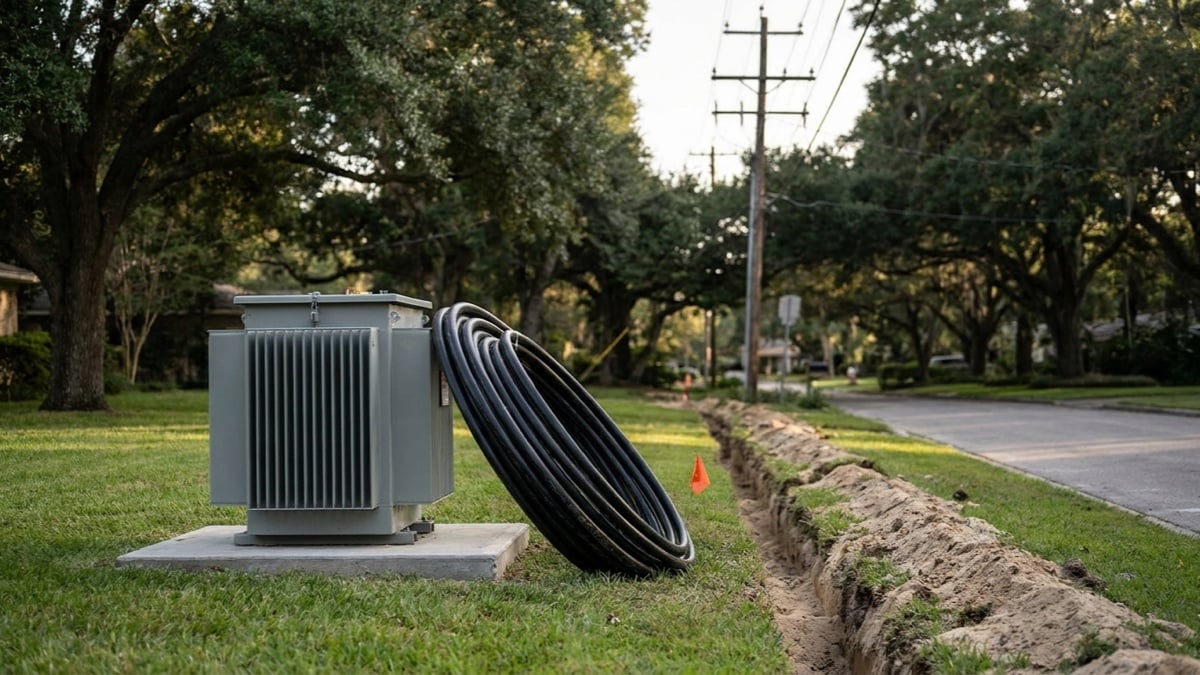
Featured image: AI-generated editorial illustration of a pad-mounted electric transformer beside a coil of electrical conduit and a shallow open trench in a residential yard, with an overhead power line on a wooden pole among oak trees behind it. It does not depict a particular property or a real utility installation.