

No. An agricultural classification does not transfer with the deed. Section 193.461(3)(a), Florida Statutes, bars classifying land as agricultural unless a return is filed on or before March 1 of each year, and the short reapplication form is open only to an owner whose “ownership or use has not changed.” A sale changes ownership, so the buyer files an original application and proves bona fide commercial agricultural use as of January 1. Inside the Town of Montverde a second thing ends at closing: under Sec. 10-90(f) of the town code, grandfathered farm animal counts do not run with a transfer of land ownership.
That pair catches buyers on the acreage that makes this corridor what it is. Montverde and the unincorporated Ferndale area just outside it are built on pasture, old grove land and horse property, and many of those parcels carry a classification that holds assessed value far below market. Underwrite off the seller’s current tax bill and you can be wrong by thousands of dollars on the first bill you receive. Live Move Orlando’s Montverde relocation guide is the full corridor overview; this post takes one decision inside it.
The classification is annual, not permanent
Section 193.461(1) requires the property appraiser to classify every parcel in the county as agricultural or nonagricultural on an annual basis. Subsection (3)(b) limits the classification to land “used primarily for bona fide agricultural purposes,” defined as “good faith commercial agricultural use of the land.”
Lake County does run a renewal system. Its published Guidelines for Agricultural Classification of Lands say an approved owner receives an automatic renewal card each year, then add the sentence that matters to a buyer: if there has been a change in ownership or use, the owner must notify the office, and some changes may require a new application. The renewal follows the owner and the use, not the dirt.
March 1 is the deadline, January 1 is the test
Two dates govern the outcome. January 1 is the assessment date, and the county’s guidelines state the property must be in bona fide commercial agricultural use on January 1 of the application year, with the burden on the applicant to evidence it. March 1 is the filing deadline, and section 193.461(3)(a) says missing it “constitutes a waiver for 1 year” of the agricultural assessment.
Together they decide how a closing date lands. Close in November 2026 and keep the operation running, and you are positioned to apply by March 1, 2027 for the 2027 roll. Close in February, let the cattle leave, then apply, and you are applying for a year in which the land was not in agricultural use on January 1.
Missing March 1 is not automatically fatal. The statute allows a late filing within 25 days after the appraiser mails the notice required under section 194.011(1), then a petition to the value adjustment board with a nonrefundable $15 fee. Approvals and denials both go out no later than July 1, and section 193.461(2) gives a denied owner the right to appeal to that board.
What Lake County asks a new owner to produce
The state form is DR-482 and Lake County attaches its own supplement. The 2026 application packet asks for agricultural income from the property for the past four years, broken out by year into crop or use, gross income, expense and net income. It also wants the date purchased and the purchase price, the agricultural use at purchase and as of January 1, an agricultural business plan, an income and expense statement, your IRS Schedule F if you file one, and a current fully executed lease if someone else farms the land. Applications are field checked systematically, intent for future use cannot be considered, and only acreage actually in the operation can be classified.
Most of those answers belong to the seller. Ask for the income history, the leases, the Schedule F and the equipment records while you still have leverage, before you are the one filling in the form.
One note on the purchase price. Section 193.461(3)(b)1.c. makes it one factor the appraiser may weigh, nothing more. The county’s guideline sheet, revised November 8, 2018, still recites a presumption against bona fide use when the price is three or more times the agricultural assessment; that language tracks former section 193.461(4)(c), which appears in the 2012 Florida Statutes and is absent from the 2013 and later editions.
Personal horses are not an agricultural operation
This is the most common misread on Montverde acreage, and the county addresses it directly. Under its commercial horse breeding standards, “production of livestock for one’s own use and pleasure will not qualify for agricultural classification.” Four pleasure horses on ten fenced acres is a lifestyle, not a farm.
The county’s standards for the operations common here read as follows. These are guideline minimums, not legal thresholds, because section 193.461(3)(b)1.d. states that size may be considered but “a minimum acreage may not be required for agricultural assessment.”
| Operation | Recommended acreage | What the county also looks for |
|---|---|---|
| Commercial horse breeding | At least 5 acres; one horse per acre as a rule of thumb | Three registered broodmares in production, a stallion, or evidence of stud service, with registrations and breeder certificates |
| Commercial cow or calf | At least 5 acres, or part of a larger operation | Fenced pasture free of harmful debris, purchase and sale receipts, tag or brand identification, a business plan |
| Goat or sheep | At least 5 acres, or part of a larger operation | 25 head on a five-acre pasture area is the recommended minimum; official flock or herd identification |
| Commercial hay | At least 10 acres, or part of a larger operation | Sales receipts for bales; a cutting agreement or a tangible return for baling equipment if the land is not leased |
| Row crops, specialty crops, nursery | At least 1 acre | Sales receipts and a crop description; production for your own use, such as a garden, does not qualify |
Boarding and training carry their own limits. Horse boarding needs a written agreement covering the lease of pastureland, classification is not normally granted for horses only boarded in a stable, and property whose income comes only from training or a riding center will not qualify. On old grove land, citrus has its own trap: the county requires citrus land to be registered with the Florida Department of Agriculture’s Citrus Health Response Program, and says land may not qualify for a non-citrus use while live, non-maintained citrus trees are present.
The house always comes out of the classification
Section 193.461(3)(c) says a dwelling does not by itself preclude classification, and subsection (3)(d) requires the residence and curtilage to be assessed separately under section 193.011 so it can qualify for the Save Our Homes limitation in section 193.155. Lake County puts a number on that split: both its guidelines and its DR-482 supplement state that any residence causes a minimum of one acre per residence to be removed from the classification, assessed at current market value, treated as a homesite and potentially eligible for homestead under Chapter 196.
So the bill has two halves that behave differently. The homesite acre and the house follow normal homestead rules, where our notes on Florida’s new $150,000 homestead exemption and Save Our Homes portability apply. The remaining acreage lives or dies on the classification.
What the exposure is worth in Montverde
The Lake County Property Appraiser’s 2026 Final Millage Rate Sheet puts the total millage for taxing authority 00MV, Montverde, at 15.3975 mills, including a 2.8300 mill municipal levy. Every $1,000 of taxable value costs $15.3975 a year.
| Taxable land value added if the classification is lost | Added annual tax at 15.3975 mills |
|---|---|
| $100,000 | $1,539.75 |
| $250,000 | $3,849.38 |
| $500,000 | $7,698.75 |
These are rate calculations, not predictions about any parcel, since how much value comes back on depends on the appraiser’s just valuation of that acreage. That rate is Montverde’s municipal rate. Ferndale appears nowhere on the sheet as a municipality, because it is unincorporated, so parcels there fall under one of the unincorporated taxing authority codes at a different total.
Inside town limits, the animals are regulated separately
The tax classification and the right to keep animals are two systems run by two governments, and clearing one tells you nothing about the other. Within the Town of Montverde, Sec. 10-90 of the land development code controls farm animals, fowl and livestock:
- One acre per animal. No horse, mule, donkey, jackass, jenny, bull, cow, calf, goat or steer may be permanently kept on a parcel containing less than one acre for each animal kept. “Permanently” means any period longer than 48 hours within any seven-day period, so a visiting horse counts.
- Hogs are not permitted in the town at all, aside from one pot-bellied pig of 120 pounds or less per parcel as a pet, and roosters are not permitted in any zoning district. On a parcel of one acre or more, fowl, rabbits and goats are capped at ten animals in total; smaller lots get narrower allowances, up to five chickens in the listed residential districts and two rabbits as pets.
- Grandfathering ends at closing. Sec. 10-90(f) lets properties registered with the town as having animals in violation of the section keep the same number, with no additions, “until such time as title to the property is transferred,” and states those rights “do not run with the transfer of land ownership.” It came in through Ordinance No. 2019-011, adopted January 28, 2020.
Notice how the two one-acre figures coexist without helping each other. The town will let you keep one horse per acre. The county will not classify the land as agricultural for horses kept for your own pleasure, no matter how much acreage you give them.
Zoning adds a third layer. The A, Agriculture district permits “field crops, groves and other agricultural uses and associated retail sales” on a five-acre minimum lot for buildings, while the RR, Residential rural district permits those same uses not involving retail sales on a one-acre minimum. That difference is not cosmetic, since the county wants sales receipts as proof of commercial activity and in RR you cannot make those sales on the property.
Sec. 10-90 applies “within the town limits.” Parcels outside them, Ferndale included, answer to Lake County’s regulations instead, so confirm which jurisdiction an address sits in before relying on either rulebook. County rural land rules can run deeper than people expect, as our look at the Green Swamp rules near Groveland shows.
A diligence sequence for a Montverde closing
- Pull the parcel record and confirm how many acres carry the classification today versus how many are assessed as homesite. Call the appraiser’s agricultural department at 352-253-2150 with the alternate key before your inspection period ends.
- Ask the seller in writing for four years of agricultural income and expense records, any lease, the business plan on file and the Schedule F.
- Confirm whether the address is inside the town or in unincorporated Lake County, and ask whether the seller holds a grandfathered animal count registered with the town. If so, price on the lawful count, not the one you see on your tour.
- Decide before closing whether you will actually run a commercial operation. If not, underwrite the carrying cost at full market assessment using the millage math above, and calendar the January 1 use date and March 1 deadline either way.
Frequently asked questions
If the seller has an agricultural classification, will my first tax bill match theirs?
Not reliably. The classification is applied annually under section 193.461(1), and the short reapplication form is limited by section 193.461(3)(a) to an owner whose ownership and use have not changed. You file an original DR-482 with Lake County’s supplement by March 1 and prove bona fide commercial use as of January 1. The bill in the year you close generally reflects the classification and the January 1 owner, which is a separate question from how closing-date taxes get split; our notes on property tax proration at a Florida closing cover that split.
Can I keep the classification if I just lease the pasture to a neighbor?
Possibly. Section 193.461(3)(a) lets a lessee apply where the lease or an owner affidavit empowers them to do so and a copy accompanies the application, and section 193.461(3)(b)1.f. makes the lease’s terms a factor. Lake County requires more than the document: the lease must be current, fully executed, attached, in effect as of January 1 and carry full contact information for the lessee, and the lessee’s income and expenses must be provided. A handshake with the neighbor who mows your field will not carry it.
How much land do I need in Lake County to qualify?
There is no legal minimum. Section 193.461(3)(b)1.d. permits size to be considered but states that “a minimum acreage may not be required for agricultural assessment.” The county’s guidelines recommend thresholds by operation type and describe them as minimum standards applied case by case. Documented income, intensity of use and care of the land carry more weight than acreage alone.
Where to go from here
On a specific Montverde or Ferndale parcel, the two numbers to settle before the inspection period closes are how many acres are classified today and what the land would be assessed at without the classification. The fencing, the barn and the animal count all follow from those. Our Montverde market report covers what is listed and where pricing sits now.
When you want that diligence run before contingencies come off, book a strategy session at mvphomegroup.com/nelsoncruz. On acreage we start with the classified acres and the seller’s operating records, because those two facts set the carrying cost the offer absorbs.
Nelson Cruz, P.A.
Founder & CEO
MVP Home Group, Real Broker LLC
Nelson brings nearly two decades in law enforcement to his work in real estate. View Nelson’s profile or contact our team at 407-901-9939 or [email protected].
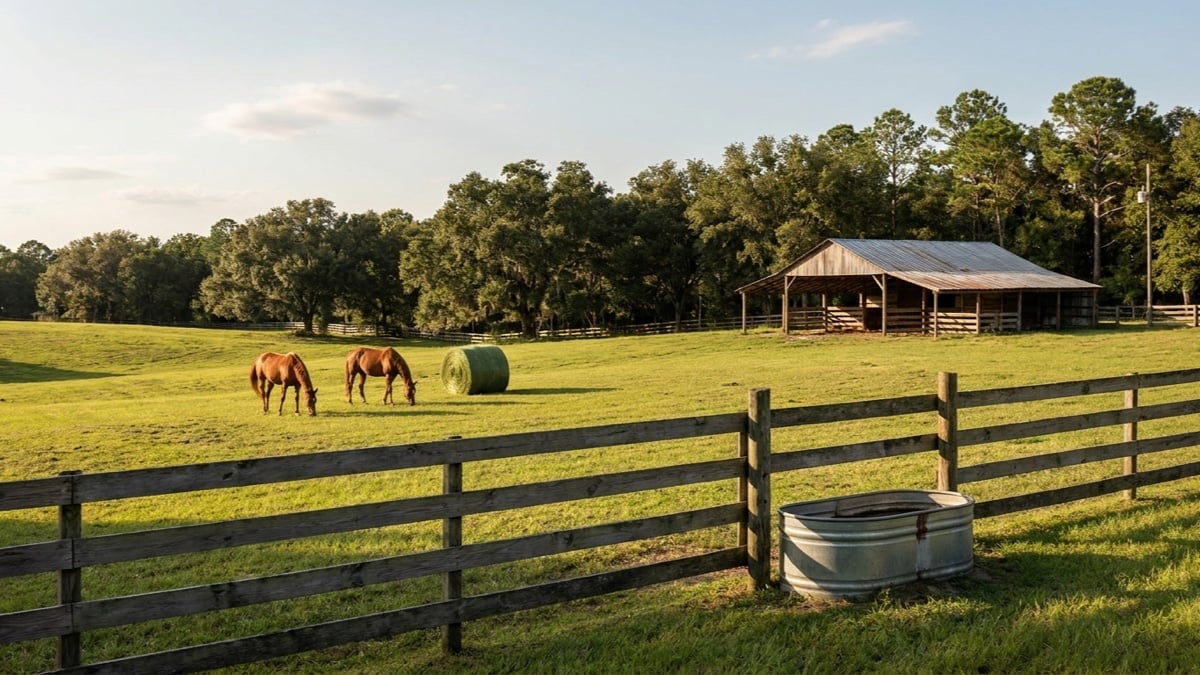
Featured image: AI-generated editorial illustration of fenced open pasture on gently rolling ground in late afternoon light, with two horses grazing on mown grass, a weathered board fence across the foreground, a galvanized water trough, a round hay bale and a metal-roofed open pole barn at a treeline of oaks and pines. No people and no readable text. Not a particular property, farm or neighborhood.