

No Florida statute requires a four-point inspection. The carrier you apply to and the age of the house decide it. If your coverage lands with Citizens Property Insurance and the home is more than 20 years old, the four-point is mandatory on the application. The report answers whether the house can be insured at all, a different job from the wind mitigation report that sets your discount.
Do I need a 4-point inspection to insure a Florida home?
Citizens Property Insurance requires a four-point inspection for all property owner, dwelling and mobile home applications for properties more than 20 years old. For a 2026 closing, an actual year built of 2005 or earlier trips the rule. A house built in 2006 is 20 years old this year, which does not meet the “more than 20” test on age alone.
A Florida-licensed inspector checks the electrical system, plumbing, heating and cooling system and roof, and must report the age, type and condition of each. Citizens adds a sequencing instruction buyers discover too late: serious hazards or deficiencies such as exposed wiring, active leaks or evidence of leaks should be repaired before an application for coverage is submitted.
Because no statute sets a threshold, a private carrier’s requirement comes out of its own underwriting rules. Ask the agent quoting you, in writing, whether this carrier requires a four-point at this home’s actual year built, and which form it wants.
What the four points actually cover
Citizens publishes the sample form its underwriters work from, coded Insp4pt 03 25. Reading it tells you what the inspector looks for before anyone arrives.
- Electrical. Panel type (circuit breaker or fuse), total amps and whether that amperage is sufficient for current usage, panel age, and wiring type: copper, copper clad, multistrand or single strand aluminum, cloth, knob and tube, or rubber insulated. Single strand aluminum branch wiring needs separate remediation documentation certified by a licensed electrician, and the form names COPALUM crimp and AlumiConn connections.
- Plumbing. Age of the supply and drain systems and whether each is original or re-piped, pipe types including copper, PVC and CPVC, galvanized, PEX and cast iron, a direct yes or no for polybutylene, water heater age and location, whether a temperature pressure relief valve is present, and any sign of an active or prior leak.
- Heating and cooling. Central air and central heat yes or no, the primary heat source and fuel type where heat is not central, system age, date of last servicing, whether a space heater serves as the primary heat source, and whether the air handler, condensate line or drain pan shows blockage or leakage.
- Roof. Predominant and secondary covering material, roof age, remaining useful life in years, date of the last roofing permit, overall condition, and visible damage such as cupping, granule loss, exposed felt, cracked tiles and soft spots in decking.
One report decides eligibility, the other decides price
The four-point and the wind mitigation inspection land in the same underwriting file during the same two weeks, which is why buyers blur them. They answer different questions, and only one is standardized by the state.
| Four-point inspection | Wind mitigation inspection | |
|---|---|---|
| What it decides | Whether the house is insurable | Which hurricane mitigation discounts you earn |
| Source of the requirement | The carrier’s underwriting rules. Citizens requires it above 20 years | Section 627.711, Florida Statutes |
| State-prescribed form | None. Citizens publishes its own and accepts a similar form | Yes. The Financial Services Commission must develop by rule a uniform form used by all insurers |
| Who may sign | A Florida-licensed inspector, described by Citizens as the Florida licensed professional of your choice | A list written into the statute: home inspectors under s. 468.8314 with hurricane mitigation training, building code inspectors, licensed contractors, engineers and architects |
| Cost of a poor result | The policy may not be written | A higher premium |
Citizens files the four-point under “Eligibility Inspections” on its own inspections page and labels wind mitigation “For Discount Eligibility.” Treat that labeling as the order of operations. Our walkthrough of how a wind mitigation inspection lowers your Florida insurance bill covers the discount side.
An inactive license voids the report you paid for
Citizens warns that a form may not be accepted if the appropriate professional does not perform the inspection, or if that professional’s Florida license is not active or cannot be verified. Florida licenses home inspectors under section 468.8314, Florida Statutes, and the Department of Business and Professional Regulation publishes a licensee search. Check it before you schedule, because a rejected form means paying twice and losing a week.
The form carries one more line worth reading closely. The information is used only to determine insurability and is not a warranty or assurance of the suitability, fitness or longevity of any of the systems inspected. A clean four-point tells you a carrier will write the policy. It does not replace your own buyer’s inspection.
Older roofs add a second document, unless one visit covers both
Citizens requires roofs older than 25 years (soft coverings such as shingle) or 50 years (hard coverings such as tile, slate, clay, concrete or metal) to carry documentation showing at least five years of remaining useful life. In 2026 that reaches a shingle roof installed in 2000 or earlier and a tile or metal roof installed in 1975 or earlier. Where a roof has less than five years of remaining useful life, the owner must provide proof of a full roof replacement to the inspector before any policy is written.
The four-point form offers a shortcut. Its roof section states that with photographs of each roof slope, that section can take the place of the separate Roof Inspection Form, turning two documents into one visit.
State law limits age-only decisions. Section 627.7011(5)(b), Florida Statutes, bars an insurer from refusing to issue or renew a homeowner’s policy on a structure whose roof is less than 15 years old solely because of the roof’s age, and subsection (5)(c) requires the insurer to allow an inspection on older roofs, barring refusal on age alone where that inspection shows five years or more of useful life remaining. Those protections reach an age-only refusal and leave a condition-based decline untouched. For the same statute from the listing side, see whether an older roof can stop your Florida home from selling.
How often a Central Florida buyer meets the Citizens rule
Citizens is a smaller presence than most buyers assume. For the reported period ending September 30, 2026, Citizens held 196,317 personal residential multiperil policies in force statewide. The six counties our team serves accounted for 17,062 of them, or 8.69 percent of that book.
| County | Citizens PR-M policies in force, 09-30-2026 | Share of statewide PR-M |
|---|---|---|
| Polk | 4,833 | 2.46% |
| Orange | 3,616 | 1.84% |
| Lake | 3,077 | 1.57% |
| Volusia | 2,855 | 1.45% |
| Osceola | 1,706 | 0.87% |
| Seminole | 975 | 0.50% |
Most buyers in Winter Garden, Clermont, Ocoee and Kissimmee will be quoted by a private carrier instead, and that carrier sets its own threshold. The question belongs in your first conversation with the agent rather than your last.
Sequence it inside your inspection period
- Ask the quoting agent in writing whether a four-point is required at this home’s actual year built, and which form satisfies it.
- Verify the inspector’s Florida license is active through the Department of Business and Professional Regulation before you schedule.
- Order the four-point early, leaving room to repair a hazard before the application goes in.
- Have the inspector photograph every roof slope so that section can replace a separate roof form.
- Price polybutylene supply piping, single strand aluminum branch wiring, insufficient panel amperage and a roof under five years of remaining life as negotiation items.
- Keep your buyer’s inspection on the calendar, since the four-point speaks to insurability only.
Frequently asked questions
Is a 4-point inspection the same as a home inspection?
No. The four-point looks at four systems, and Citizens’ form states that the information is used only to determine insurability and is not a warranty or assurance of the suitability, fitness or longevity of any system inspected. A buyer’s home inspection has a wider scope and a different purpose, which is why your right to back out after the inspection turns on that report rather than the insurance form.
Who pays for it, and can my home inspector write it?
Eligibility inspections are the applicant’s cost. Citizens states that underwriting will rely on its sample form, or a similar form, obtained from the Florida licensed professional of your choice, so an inspector holding an active Florida license can often produce it alongside your buyer’s inspection. That differs from the underwriting field surveys Citizens may order during the life of a policy, which it runs at no cost to the policyholder.
Can a bad four-point stop my closing?
It can stop the policy, which reaches the closing by the same route. Citizens expects serious hazards such as exposed wiring or active leaks to be repaired before the application is submitted, and where a roof shows less than five years of remaining useful life it requires proof of full replacement before any policy is written. Learning that in the first week of the inspection period leaves room to renegotiate or repair.
Where to go from here
Two dates settle insurability: the day your four-point is ordered and the day your inspection period expires. Put the first well ahead of the second.
If you are under contract on an older Central Florida home and want the insurance questions answered before your inspection period runs, book a strategy session with our team at mvphomegroup.com/nelsoncruz. We start with the actual year built, the roof install date and the panel, because those three facts predict most of the underwriting friction. This is general information about carrier requirements and Florida statutes, not legal or insurance advice.
Nelson Cruz, P.A.
Founder & CEO
MVP Home Group, Real Broker LLC
Nelson brings nearly two decades in law enforcement to his work in real estate. View Nelson’s profile or contact our team at 407-901-9939 or [email protected].
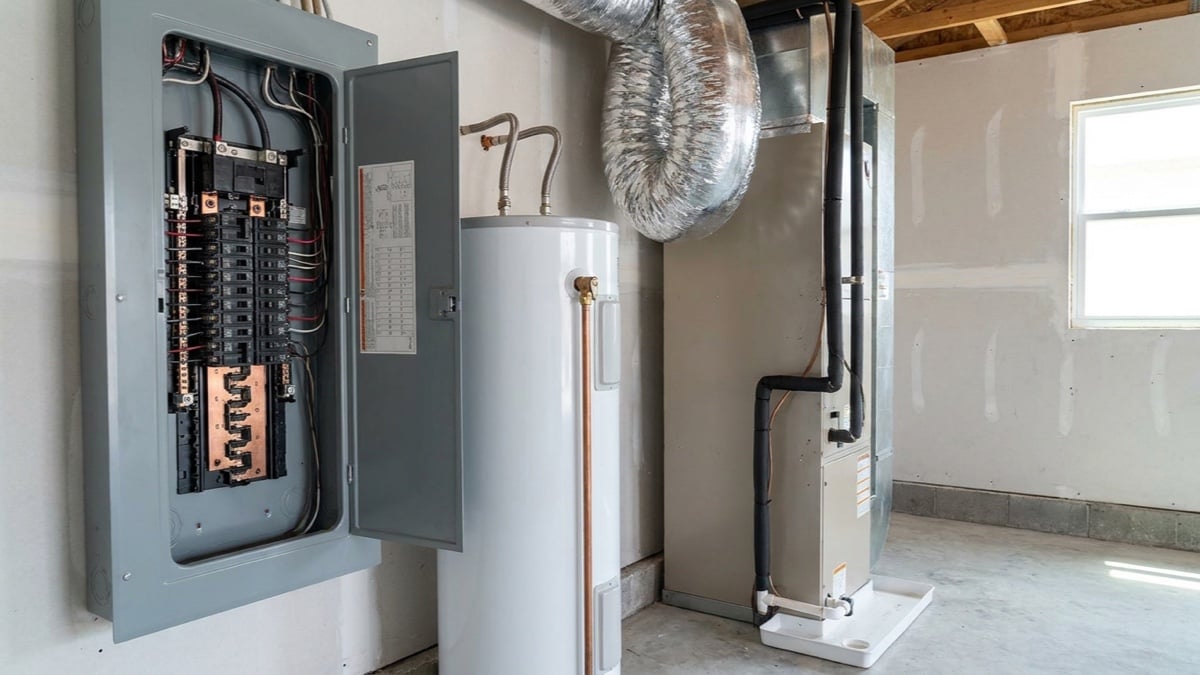
Featured image: AI-generated editorial illustration of a home utility wall with an open electrical service panel, a water heater with copper relief piping, an HVAC air handler and an overhead flexible duct. No readable text. Not a particular property or inspection.