

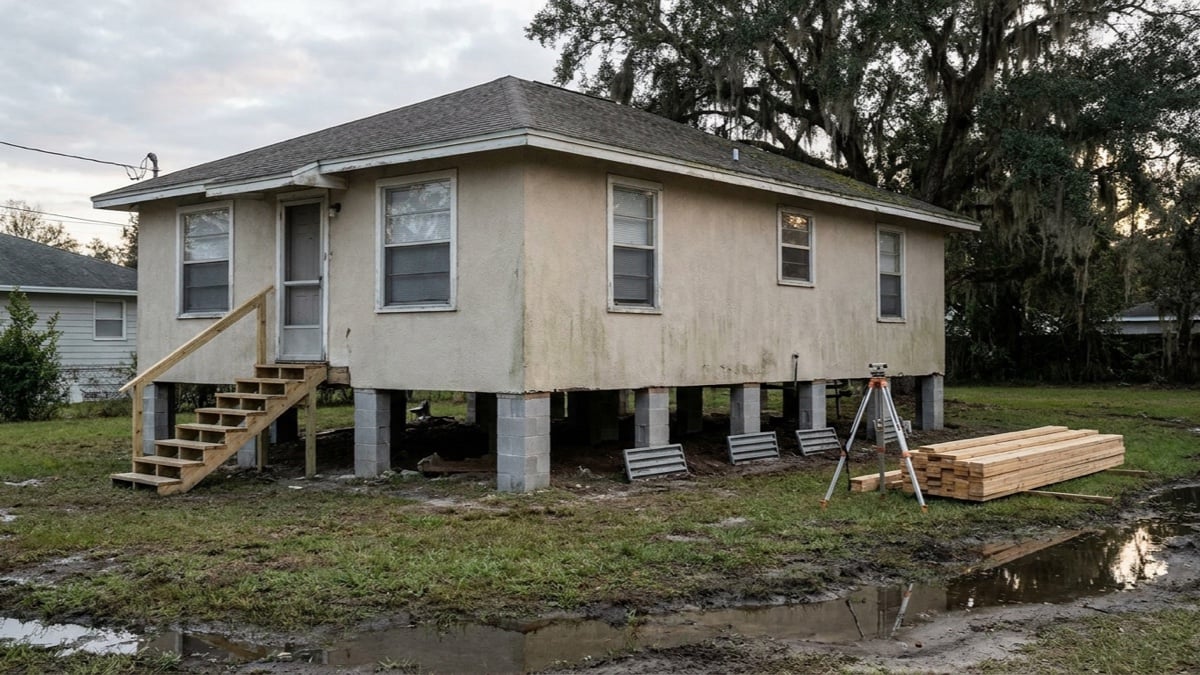
If you buy an older Apopka home inside a mapped flood zone and your renovation costs reach 50 percent of the structure’s value, the city stops treating the job as a remodel and treats it as new construction. That means the lowest floor has to sit at base flood elevation plus 2 feet, which Apopka adopted in 2021 and which is 2 feet above the federal minimum. Apopka applies the 50 percent test to the Orange County Property Appraiser’s assessed value of the structure alone, with the land excluded, so the dollar trigger is usually far lower than owners expect.
The full Apopka corridor guide describes the draw accurately: mature trees, established neighborhoods, and lots near water. What it does not cover is the rule that decides whether those older homes can be renovated the way a buyer is imagining. Finish this piece of due diligence before the inspection period ends.
What makes an improvement “substantial”
The term is federal. Under 44 CFR 59.1, a substantial improvement is “any reconstruction, rehabilitation, addition, or other improvement of a structure, the cost of which equals or exceeds 50 percent of the market value of the structure before the ‘start of construction’ of the improvement.” The same rule adds that the term “includes structures which have incurred ‘substantial damage’, regardless of the actual repair work performed.” Substantial damage is the storm version of the same arithmetic, measured against the structure’s market value before the damage. Cross either line and the consequence is identical.
Two things are carved out: work to correct existing health, sanitary, or safety code violations that a local code enforcement official identified and that are the minimum necessary to assure safe living conditions, and alteration of a historic structure where the work will not preclude its continued historic designation.
How Apopka actually runs the number
Here the local practice matters more than the federal text. The City of Apopka states that if the cost of the improvement equals or exceeds 50 percent of the Orange County Property Appraiser’s assessed tax value of the structure, the improvements are considered substantial improvements. The City Engineer or Floodplain Administrator estimates the value of the existing structure and of the proposed improvements, and the improvement value is typically estimated by a Registered Florida Contractor with the City Engineer’s approval.
Read that denominator carefully. It is the structure, not the property, and land value is excluded. On an older Apopka home where the lot carries much of the purchase price, the building value on the tax roll can be a fraction of what you paid, and the 50 percent threshold falls with it.
A worked example, using round numbers rather than a specific address. If the Property Appraiser carries the building at $180,000, the threshold is $90,000. A kitchen, two baths, windows, and a roof quoted together at $95,000 lands $5,000 over the line. The same $95,000 of work on a house carried at $400,000 would not come close. Nothing about the scope changed; only the denominator did.
What gets triggered once you cross the line
At the federal level, 44 CFR 60.3(c)(2) requires that all new construction and substantial improvements of residential structures in A1-30, AE, and AH zones have the lowest floor, including basement, elevated to or above the base flood level. Apopka requires more. Sec. 18-23 of the city code, adopted by Ord. No. 2861 on August 4, 2021, amends the Florida Building Code, Residential, Section R322, so that buildings and structures in flood hazard areas “shall have the lowest floors elevated to or above the base flood elevation plus 2 feet, or the design flood elevation, whichever is higher.”
The same section covers two other situations a buyer runs into. In areas of shallow flooding, the AO zones, the lowest floor must sit above the highest adjacent grade by not less than the depth number shown on the flood map plus 2 feet, or not less than 4 feet where no depth number is specified. And enclosed areas below the design flood elevation, including crawl spaces, may be used solely for parking, building access, or storage, and may not be partitioned or finished into separate rooms except for stairwells, ramps, and elevators unless the fire code requires a partition.
That second rule kills a common plan. A converted ground-floor den or a built-out crawl space below the flood elevation is not a design choice the permit will accommodate. Separately, any development in the floodplain requires an approved development plan under the Apopka Land Development Code plus a building permit.
The same flood map, three different insurance discounts
Apopka buyers often compare an address inside city limits against one in unincorporated Orange County or in Ocoee, which the corridor guide names as the established-value neighbor to the south. All three share the same current effective flood map date of September 24, 2021. The flood insurance discount still differs, because the Community Rating System rewards each community separately for floodplain work beyond the federal minimum. These figures come from FEMA’s Community Status Book report for Florida, dated November 7, 2026.
| Community | NFIP ID | Current effective map | CRS class | Premium discount |
|---|---|---|---|---|
| Apopka, City of | 120180D | September 24, 2021 | 8 | 10% |
| Ocoee, City of | 120185D | September 24, 2021 | 6 | 20% |
| Orange County (unincorporated) | 120179D | September 24, 2021 | 5 | 25% |
Apopka describes its own Class 8 in more detail: a 10 percent reduction on National Flood Insurance Program premiums for properties inside Special Flood Hazard Areas, and 5 percent for properties outside them. Orange County states that it entered the program in 1991 and that its Class 5 means residents with flood insurance “are receiving a 25% discount on their premium.” Ocoee’s standing is the newest of the three, with a CRS entry date of October 1, 2024 and its current class effective October 1, 2026, so a quote pulled earlier in 2026 may not reflect it.
On a hypothetical $2,000 annual premium, a 10 percent discount saves $200 and a 25 percent discount saves $500, a $300 yearly difference between two houses that may be a mile apart. Use your own quote rather than this illustration, and ask the agent to confirm the CRS credit was applied.
A due diligence checklist for an Apopka flood zone home
- Confirm the zone before the inspection period ends. Apopka’s Engineering Division will provide the community name, map number, effective FIRM date, flood zone, base flood elevation, the elevation datum, and any completed elevation certificates for a property in city limits, at 407-703-1627. The Orange County InfoMap public viewer also shows FEMA flood zones under its “Water” layer.
- Ask whether an elevation certificate already exists. Apopka keeps them available for review during office hours. One tells you where the lowest floor actually sits relative to base flood elevation, which is the difference between a cosmetic renovation and a lift.
- Get the structure value, not the total assessed value. The building figure on the Orange County Property Appraiser’s roll is Apopka’s denominator. Half of it is your working budget ceiling before the flood rules change the project.
- Price the renovation before you waive inspection. Have a Registered Florida Contractor scope the work, since that is who the city expects to value the improvements anyway.
- Verify jurisdiction. City limits versus unincorporated Orange County changes who issues the permit and which CRS discount applies. An Apopka mailing address does not prove city limits.
- Quote flood insurance early. There is generally a 30-day waiting period before a new policy takes effect, so this is not a closing-week task.
The coverage that pays to comply
If a home is later declared substantially damaged, FEMA’s Increased Cost of Compliance coverage pays up to $30,000 toward elevation, demolition, relocation, or floodproofing, and FEMA notes that an ICC claim “is adjusted separately from the flood damage claim you file under your Standard Flood Insurance Policy.” Eligibility runs through a substantial damage determination or a repetitive loss history, meaning two flood damages within 10 years where repair costs averaged 25 percent or more of market value and a claim was paid for each. ICC attaches to an NFIP policy, so a buyer who skips flood insurance because the lender did not require it also skips this.
Frequently asked questions
Does the 50 percent rule apply if my Apopka home is not in a flood zone?
No. The substantial improvement rules apply to structures in mapped flood hazard areas. The catch is that the mapped areas changed. Apopka’s current effective flood map dates to September 24, 2021, and the city warned that because the Special Flood Hazard Area boundary expanded in some places and contracted in others, some structures that were not previously in it would be afterward. Check the current map for the specific address rather than relying on what an owner remembers.
Can I avoid the trigger by splitting the renovation into phases?
Do not plan on it. The determination belongs to the City Engineer or Floodplain Administrator, not to the permit applicant, and the federal definition sweeps in a structure that has incurred substantial damage regardless of the actual repair work performed. Ask Apopka’s Engineering Division how it treats a sequence of permits on one structure before you count on phasing, because the answer governs your budget.
Is base flood elevation plus 2 feet unusual?
It is higher than the federal floor, which sets no added margin above the base flood level. Ocoee likewise states that while FEMA and the State of Florida set minimum floodplain management standards, the city “chooses to adopt higher standards.” The tradeoff runs both ways: added freeboard raises the cost of a lift and lowers flood insurance cost over time.
Where to go from here
On an older Apopka home that needs work, the flood zone and the structure value on the tax roll decide what the renovation can be, so pull both before the inspection period closes. For wider context see our Apopka area page, and on the insurance side read when flood insurance is actually required in Florida and why homes outside a flood zone still flood. If the house has had past work done, open and expired permits is the companion check.
To talk through a specific Apopka address and a renovation budget, book a strategy session at mvphomegroup.com/nelsoncruz. Flood zone, substantial improvement and elevation determinations are made by the City of Apopka, not by our team, and boundaries and code provisions change. This is general information, not a flood determination, an insurance quote, or legal advice for a particular property.
Nelson Cruz, P.A.
Founder & CEO
MVP Home Group, Real Broker LLC
Nelson brings nearly two decades in law enforcement to his work in real estate. View Nelson’s profile or contact our team at 407-901-9939 or [email protected].
Featured image: AI-generated editorial illustration of an older single-story house raised on new concrete block piers above a damp yard during a flood-elevation retrofit, with a temporary access stair, framing lumber and standing water at the edge of the lawn. Not a particular property, street or community.