

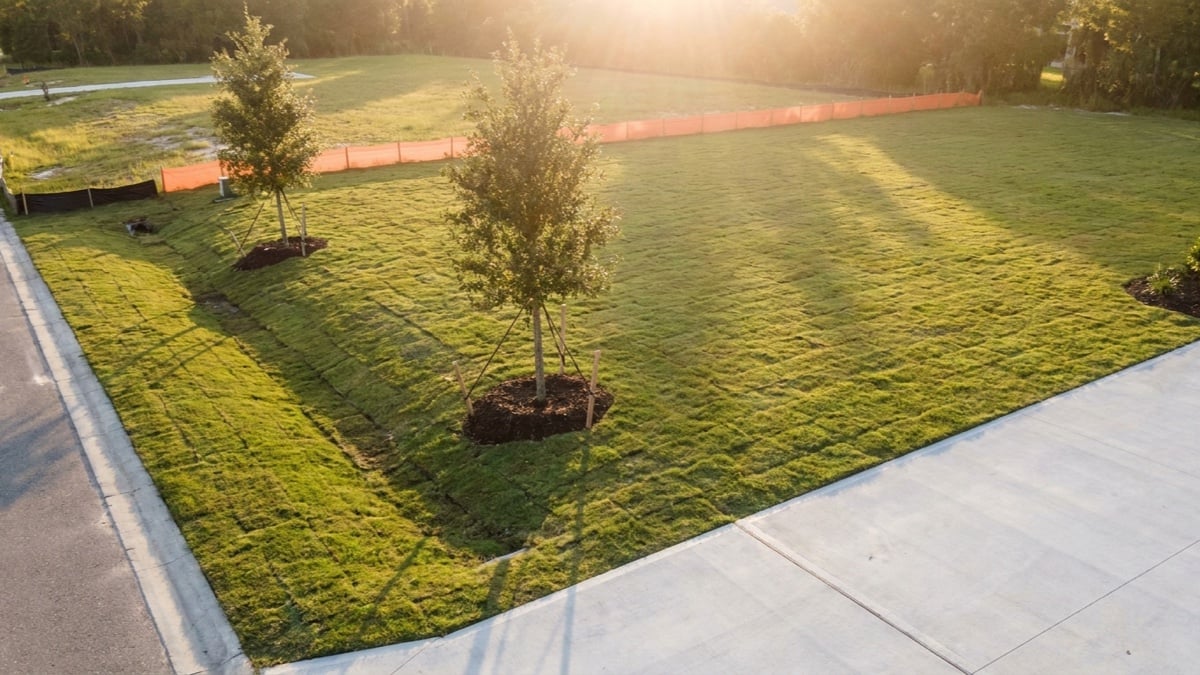
Your yard is part of the permit. In unincorporated Lake County, Section 9.01.08 of the Land Development Regulations opens with a sentence worth reading twice: no certificate of occupancy shall be issued unless the lot complies with the canopy tree requirement. The count is set by lot size, the trees carry a minimum size of their own, and the ground under them is graded to a plan that in most subdivisions was approved before your lot had a buyer.
One warning up front: the county’s own Tree Removal web page publishes a count that does not match the code.
The canopy trees are a condition of your certificate of occupancy
Section 9.01.08(A) sets a minimum number of canopy trees per single-family or duplex lot, noted on the development permit or plot plan. Existing trees meeting the quality and size standards inside required buffers immediately adjacent to the lot may be credited toward the count.
| Lot size | Minimum canopy trees | A lot that lands here |
|---|---|---|
| 6,000 square feet or less | 2 | 50 by 120 feet is exactly 6,000 |
| 6,001 to 10,000 square feet | 3 | 60 by 120 and 70 by 120 |
| 10,001 to 15,000 square feet | 4 | A quarter acre is 10,890 |
| 15,001 square feet to 1 acre (43,560) | 5 | A half acre is 21,780 |
| 1 acre to less than 2 acres | 8 | |
| 2 acres to less than 3 acres | 11 | |
| 3 acres to less than 5 acres | 15 | |
| 5 acres or greater | 25 |
Now the discrepancy. Lake County’s Tree Removal page lists five trees for lots over 10,001 square feet up to one acre, then adds three per acre and caps the total at 15. The code says four in the 10,001 to 15,000 band and 25 at five acres or more, a ten-tree gap at the top end. That page also cites Section 9.02.01 for protected trees and 9.02.04 for exemptions, but those numbers moved when the county rewrote the tree ordinance in March 2026: protected trees are now 9.02.02 and the exemptions 9.02.06. Get the count for your lot in writing from Planning and Zoning at 352-343-9641.
What the code will accept as a tree
A sapling in a five-gallon pot does not satisfy the requirement. Under Section 9.01.07, a required canopy tree is a minimum of 2.5 caliper inches in a 30-gallon container or larger, at least eight feet tall with a four-foot spread, and needs at least 100 square feet of pervious area around the trunk. On lots of a half acre or less, one required tree goes between ten and twenty feet outside the right-of-way, and at least half of the required plants must be native. Palms may substitute, but all palm species combined may not exceed 20 percent of the required canopy trees. On a quarter-acre lot requiring four, 20 percent is 0.8, leaving no room for a palm to replace a required canopy tree at all.
Your lot is graded to a plan, and it is probably not your plan
Section 9.11.00 splits Lake County lots into three tracks, and which one you are on is the most useful thing to learn before you close.
Subdivisions with an approved mass grading plan. If the county approved a mass grading plan with the plat, grading on your lot must match it. No individual plan is required, but the county still inspects the lot for consistency, and grading that departs from it needs a lot grading plan approved first. Most production subdivisions sit here, which means the slope of your back yard and where water leaves it were settled before the lot was sold.
Simplified approval. Lots in subdivisions with no mass grading plan, and residential lots outside subdivisions, can skip the engineered plan under one of three situations, all requiring any driveway other than a shared one to sit five feet or more from the property line: a grade change of no more than one foot with no grading within five feet of the line; no more than two feet with no grading within ten feet; or stem wall construction producing slopes no steeper than four to one.
Everything else. A full lot grading plan from a Florida-licensed landscape architect, surveyor or engineer, showing existing and proposed elevations including finished floor, spot elevations at the property corners and street centerline, and the drainage pattern. One is required regardless before grading that would affect flood zones or wetlands.
Three limits apply on every track. Lot grading may not adversely affect surrounding or downstream wetlands, floodplains or neighboring property, though runoff directed into a drainage easement does not count as an adverse impact. Filling or cutting may not produce slopes steeper than four to one within five feet of a property line. Swales are required to divert runoff around structures. Quote those when a new build next door starts sending water your way.
After you move in, what you may take down
Under Section 9.02.03 it is unlawful to clear, kill or remove a protected tree without a permit unless an exemption applies. Protected trees are Florida-native or Florida-Friendly trees and palms three inches or larger measured at 54 inches above the ground, wetland trees of any size, and Specimen and Heritage trees. Invasive, citrus and non-native fruit trees are not protected.
The homeowner exemption in Section 9.02.06(A) is narrower than it sounds. On a single-family lot of two acres or less that already contains a dwelling, trees may come down without a permit or mitigation, but it excludes the trees required by 9.01.08(A), reaches only trees not needed for any landscape requirement, and caps removal at a combined 30 caliper inches of protected trees in any three-year period. Three ten-inch oaks hit the limit exactly. Two sixteen-inch oaks are two inches over.
Size changes the stakes. A Specimen Tree is 30 caliper inches or greater measured at 54 inches; a Heritage Tree is 40 or greater. On a permitted removal, replacement runs 50 percent of total caliper inches for protected and Specimen trees and 100 percent for a Heritage Tree. A 30-inch Specimen owes 15 caliper inches, or six trees at the 2.5-inch minimum; a 40-inch Heritage owes 40, or sixteen trees. Remove one without the permit and Section 9.02.04(A) multiplies the mitigation by 2.5, turning that Heritage oak into 100 caliper inches, or 40 trees.
The state hazard route, and the trap in it
Section 163.045, Florida Statutes, bars a local government from requiring notice, permit, fee or mitigation to remove a tree on residential property when the owner holds documentation that it poses an unacceptable risk, and bars it from requiring a replant. That documentation must be a signed onsite assessment by an ISA-certified arborist or a Florida licensed landscape architect, performed under Best Management Practices – Tree Risk Assessment, Second Edition (2017). Unacceptable risk means removal is the only practical way to bring the risk below moderate.
Here is the part that matters on a construction site. The statute defines residential property as a single-family detached building on a lot actively used for single-family residential purposes. A cleared, permitted lot with no house yet has neither, so the shortcut is unavailable while the home is going up. County rules govern instead, and they do leave room to build: Section 9.02.08(C)(2) excuses replacement for trees inside the footprint and ten feet around the perimeter of a new dwelling, septic drainfield or driveway, but only where the lot has nowhere else to put them while meeting setbacks. Those trees may come out only after the permit is issued, and if an approved inspection is not completed within six months, they must be replaced.
One change is worth raising with your builder. Ordinance 2026-11, adopted March 10, 2026, now bars removing a Heritage Tree unless it endangers persons or property, and requires development to be designed around Heritage Trees absent a waiver or variance from the Board of County Commissioners. Section 9.02.05(C) reaches the pipeline too: where an approved zoning ordinance had not reached site plan, preliminary plat or master park plan submittal as of March 1, 2026, the developer must design around those trees or get a variance. In a community whose later phases are unbuilt, that can move lots and roads.
What to check before you sign
- Ask whether the subdivision has an approved mass grading plan. If it does, your lot is inspected against that plan and your own regrading is limited.
- Get the tree count for your lot in writing, since the county’s Tree Removal page and Section 9.01.08(A) disagree in two of the eight size bands.
- Read the development permit or plot plan, where the tree requirement is noted, and confirm the trees went in at 2.5 caliper inches rather than being promised later.
- Walk the side and rear property lines looking for slopes steeper than four to one within five feet of the line, and for the swales the code requires.
- If the lot has large trees, measure caliper at 54 inches. Thirty inches makes it a Specimen Tree and forty makes it Heritage, and both carry mitigation you inherit.
- Confirm the jurisdiction. These rules govern unincorporated Lake County; the municipalities have their own codes.
Frequently asked questions
Can Lake County hold up my certificate of occupancy over landscaping?
Section 9.01.08 states that no certificate of occupancy shall be issued unless the lot complies with that section, and that section is the canopy tree requirement. It is noted on the development permit or plot plan, so it is visible well before the walk-through. If your closing is tied to the certificate of occupancy, treat the trees as a schedule item rather than a finishing touch.
The builder graded my lot so water runs toward my neighbor. Whose problem is that?
Section 9.11.00(A)(1) states that lot grading shall not adversely affect neighboring property, and that the volume, rate and quality of runoff must stay consistent with conditions before the grading or with the approved plan. Runoff directed into a drainage easement is excluded. Section 9.11.00(E)(4) adds the measurable limits: no slopes steeper than four to one within five feet of a property line, and swales to divert runoff around structures. In a mass-graded subdivision, ask the county whether the lot was inspected as consistent with the approved plan.
Can I take down a tree in my own back yard without a permit?
Sometimes. On a single-family lot of two acres or less that already has a dwelling, Section 9.02.06(A) exempts trees that are not required by Section 9.01.08(A) and not needed for any landscape requirement, up to a combined 30 caliper inches of protected trees in any three-year period. Beyond that, or for a Specimen or Heritage Tree, you need a permit.
A new home in unincorporated Lake County comes with a graded lot and a tree count, and both are checkable before you sign. For the rest of what the county decides about a to-be-built home, see which capacity documents it issues and how long they last, what the impact fees cost, and the stricter standards inside Wellness Way. To walk a lot and read its plan set before you commit, book a strategy session at mvphomegroup.com/nelsoncruz.
Nelson Cruz, P.A.
Founder & CEO
MVP Home Group, Real Broker LLC
Nelson brings nearly two decades in law enforcement to his work in real estate. View Nelson’s profile or contact our team at 407-901-9939 or [email protected].
Featured image: AI-generated editorial illustration of a freshly graded and sodded new-home lot with two young staked canopy trees in mulch rings, a shallow grassed drainage swale along the property line, silt fencing and a concrete driveway apron. Not a particular property. No people and no readable text.