

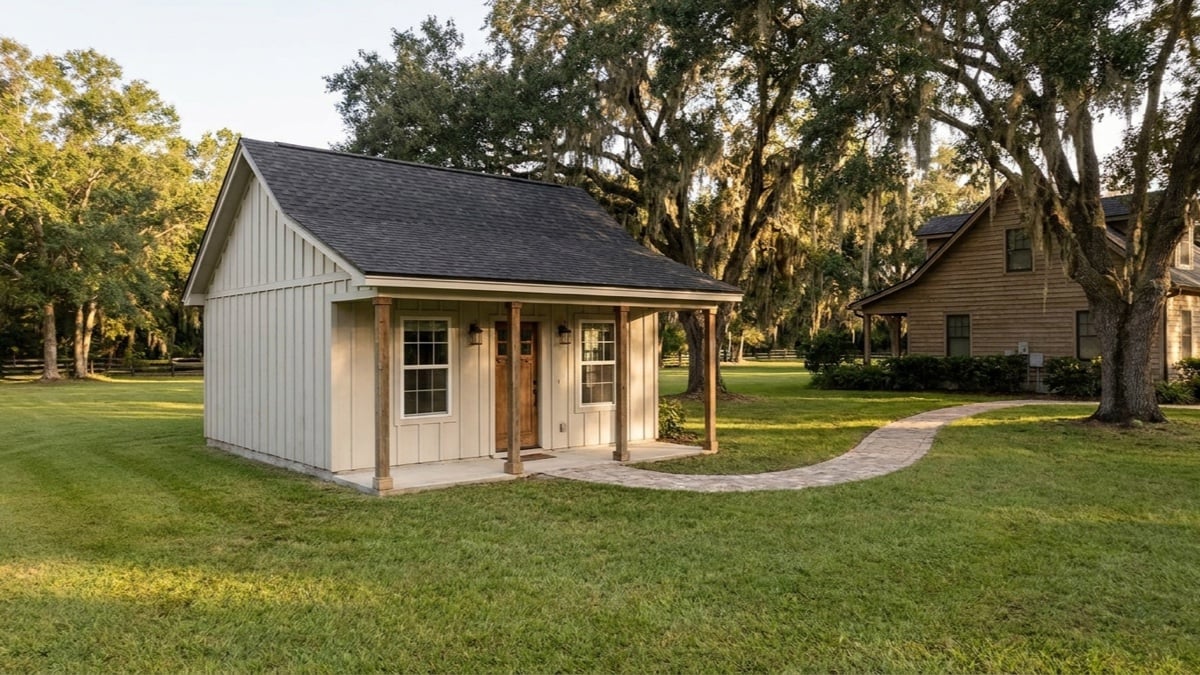
Apopka allows a separate, self-contained second dwelling on a residential lot in only four zoning districts, and three of them require the lot to be at least one acre. Everywhere else in the city, including the planned development districts, the use table marks an accessory dwelling unit as prohibited. Where it is allowed, it still takes a special exception approved at a public hearing.
So on a multigenerational purchase in Apopka, the lot decides the answer before the floor plan does. Here is how to read a specific address against the city’s current land development code.
The four districts where a second dwelling is possible at all
Apopka’s Land Development Code sets out allowed uses in Table 4.2.2.C, the Principal Use Table, with a short legend: “P” means permitted, “S” means allowed only with approval of a special exception, and a blank cell means prohibited in that district.
The accessory dwelling unit row carries an “S” in four of the table’s twenty-two district columns, AG, RCE, RSF-1A and MU-D, and a blank everywhere else, including RSF-1B, the two-family RTF district, the multifamily districts and the PD planned development district. The use-specific standards behind that row, at Sec. 4.2.3.C.1.b, then add a lot-size condition the table does not show.
| Zoning district | Accessory dwelling unit | Lot minimum in the ADU rule | Maximum ADU size |
|---|---|---|---|
| AG, Agriculture | Special exception | One acre | 1,000 sq ft |
| RCE, Residential Country Estate | Special exception | One acre | 1,000 sq ft |
| RSF-1A, Residential Single-Family Estate | Special exception | One acre | 1,000 sq ft |
| MU-D, Mixed-Use Downtown | Special exception | None stated | 500 sq ft |
| RSF-1B, RTF, RMF, RMU, PD and all others | Prohibited | Not applicable | Not applicable |
Source: City of Apopka Land Development Code, Table 4.2.2.C and Sec. 4.2.3.C.1.b, read November 20, 2026.
The acre test removes most lots in the eligible districts
RSF-1A is where this bites hardest. The district’s own minimum lot area is 12,500 square feet, while the ADU standard asks for one acre, 43,560 square feet. That is 3.49 times the district minimum, so a lot built to the district standard holds about 29 percent of the land the ADU rule wants.
The city publishes its parcel layer alongside its zoning map, and the counts show how narrow that gate is. Of the 2,487 parcels carrying Apopka’s RSF-1A code in that layer, 191 are an acre or larger, or 7.68 percent. RCE and AG behave as their minimums predict: 34 of 38 RCE parcels and 209 of 221 AG parcels clear an acre.
Across the three acre-rule districts together, 434 parcels of an acre or more sit among the 25,764 parcels carrying an Apopka zoning code, about 1.7 percent. Those are parcel records rather than houses, and they include vacant, institutional and commercial land, so read the figure as the size of the search.
One caution about that record. It carries legacy zoning labels alongside current ones, including APK-PUD on 5,351 parcels and an APK-RCE-2 variant absent from the current district table. The adopted Official Zoning District Map controls. Check the parcel on the city’s zoning map page and confirm with Planning and Zoning rather than trusting a tax record or a listing remark.
What the special exception actually costs you in time
A special exception is not a counter permit. Sec. 2.4.2 requires a community meeting before the application is submitted, with mailed and posted notice at least 14 days ahead, and the mailing list under Sec. 2.4.7.C.2 includes every owner of real property within 300 feet, by first class mail with return receipt requested. The Director may waive that meeting.
After submittal, the Development Review Committee prepares a technical staff report and the Planning Commission decides at a quasi-judicial hearing, with the power to approve, approve with conditions or deny. Approval requires findings on competent substantial evidence that the use is consistent with the comprehensive plan, complies with district and use-specific standards, and is compatible with the general character of surrounding lands.
Approval also has a shelf life. The development order expires automatically if the use is not established or substantially commenced within two years, and if the authorized use is discontinued for a year.
The declaration you record before the building permit
Before a building permit issues, Sec. 4.2.3.C.1.b requires the owner to record a declaration of restrictions in the Orange County public records. It must state that the unit will not be sold or conveyed separately from the principal residence, that it is restricted to the approved size, and that the permit holds only while the owner of record occupies the main house or the unit as a principal residence. The declaration runs with the land, binds later owners, can be removed only with the city’s express written approval, and lapses when the unit is removed.
Four other standards shape the build. Only one unit is allowed per lot. It may be attached or detached, but it has to meet the district’s front, side and rear yard setbacks. A single-family home must already exist on the lot or be built along with it. A mobile home or similar off-site constructed dwelling cannot serve as the unit.
What does not count as a second dwelling
The code’s definition is the useful part for buyers whose lot will never qualify. Article 10 defines an accessory dwelling unit as a secondary unit subordinate to the principal dwelling that has separate ingress and egress independent from the main home and provides complete independent living facilities, including provisions for living, sleeping, eating, cooking and sanitation. It also notes that an ADU does not count as a dwelling unit when density is calculated.
Both halves of that definition matter. A bedroom, bathroom and sitting area inside the house that shares the home’s entrance and has no separate cooking facilities is living area within the single-family dwelling rather than a second unit. That is the path most Apopka subdivision buyers take, and it still needs a building permit and inspections. Because the line sits on entrances and kitchens, confirm your plan with Apopka’s Planning and Zoning Division before you design around it. One navigation note: the Article 10 definition points readers to Sec. 4.3, but the operative standards are in Sec. 4.2.3.C.1.b.
State law, covenants and financing sit on top of the zoning
Florida law does not force the answer either way. Section 163.31771(3), Florida Statutes, says a local government may adopt an ordinance to allow accessory dwelling units in any area zoned for single-family residential use. Where a unit is allowed by an ordinance adopted under that section, subsection (4) requires the building permit application to carry an affidavit that the unit will be rented at an affordable rate to an extremely-low-income, very-low-income, low-income or moderate-income person. Apopka’s published ADU standards set out districts, acreage, size, owner occupancy and a recorded declaration, and carry no affordable-rent condition.
Private covenants are a separate layer. LDC Sec. 1.6.3 says nothing in the code supersedes any deed restriction or covenant, that private agreements do not excuse compliance with the code, and that the city does not enforce them. A homeowners association can prohibit what the city would approve.
If the plan is to buy a property that already has a rentable unit, see our breakdown of the USDA zero-down rule change effective December 28, 2026. If the lot sits in a mapped flood zone, any substantial improvement runs into the 50 percent rule we covered for Apopka.
A five-step check before you write the offer
- Pull the parcel’s current zoning from the city’s zoning map and confirm it with Planning and Zoning at 407-703-1712, since the parcel record carries legacy labels.
- Confirm the recorded acreage. In AG, RCE or RSF-1A, anything under 43,560 square feet ends the conversation.
- Read the subdivision’s recorded covenants before the inspection period closes, not after.
- Decide whether a suite without a separate entrance or kitchen solves the family’s actual problem, since that path needs no special exception.
- If you need the separate unit, budget the calendar: a community meeting with 14 days of notice, then a Planning Commission hearing, before any building permit.
Frequently asked questions
Can I add a mother-in-law suite to a house in an Apopka subdivision?
If the subdivision is zoned PD, RSF-1B, RTF or anything other than AG, RCE, RSF-1A or MU-D, a separate accessory dwelling unit is prohibited by Table 4.2.2.C. An interior suite sharing the home’s entrance, with no separate cooking facilities, is living area in the single-family home and still needs a building permit.
Can the accessory unit be rented out?
The recorded declaration bars commercial use other than leasing for residential purposes, and keeps the permit valid only while the owner of record occupies the main house or the unit as a principal residence. A long-term residential tenant is contemplated; an owner who moves out of both units puts the approval at risk. Covenants still apply.
Does an accessory dwelling unit count as a second home on the lot?
Not for density. Article 10 says it does not count as a dwelling unit when maximum density is determined, though Sec. 4.2.3.C.1.b treats it as a second principal use. It cannot be sold separately from the principal residence, so it does not create a second salable property.
Where to go from here
For the wider picture on the area, the full Apopka relocation guide lives at Live Move Orlando, which covers price bands, commute times and nearby corridors.
If you want a specific Apopka address checked against its zoning district, the acre test, the Sec. 4.2.3.C.1.b standards and the subdivision’s recorded covenants before your inspection period closes, book a strategy session with our team at mvphomegroup.com/nelsoncruz. This is general information about Florida statutes and one city’s current code rather than legal advice; the adopted code and your recorded documents control, and both can change.
Nelson Cruz, P.A.
Founder & CEO
MVP Home Group, Real Broker LLC
Nelson brings nearly two decades in law enforcement to his work in real estate. View Nelson’s profile or contact our team at 407-901-9939 or [email protected].