

Inside Winter Garden city limits, an existing building has 60 days to connect to city water and sanitary sewer once the city certifies that service is available, and the connection is at the landowner’s expense regardless of how far the pipe has to run. Florida law gives the owner of a properly functioning septic system 365 days. One exemption survives that gap: a single-family lot lawfully served by private well or septic under the county code before it was annexed. Everything else is a cost you inherit with the deed, and the city’s adopted schedule prices a one-unit wastewater connection at $5,843 before any digging.
What Winter Garden Code Sec. 78-30 actually requires
Section 78-30(a) of the Winter Garden Code requires the owner of every developed lot inside the corporate limits to connect to the city’s water and sanitary sewer systems at the landowner’s expense, “regardless of the distance of the lot, parcel or plot of land to the service.”
The clocks sit in the next two subsections. An existing building gets 60 days after service is certified available by the city, under Sec. 78-30(b). A new building gets 30 days under Sec. 78-30(c). If the deadline passes, Sec. 78-30(d) directs the public services department to proceed forthwith to require the connection in whatever lawful manner is required, and Sec. 78-31 makes connection and use mandatory and places the work under that department’s supervision.
Septic is tolerated in the meantime and only in the meantime. Section 78-39 permits septic tanks inside the city limits in areas the city does not serve, upon approval of the public services department, “until such time as such service becomes available.” The city’s certification is the trigger, and the Sec. 78-26 definitions do not define “available” or “certified available,” nor does the code publish a notice form or an appeal route for the certification itself. These provisions are current in the code version dated September 21, 2026.
The exemption attaches to the lot’s history, not to the owner
Section 78-30(e) is the one place a well or septic home inside the city has standing. After December 31, 2001, the owner of a developed lot used for single-family residential purposes and lawfully served by private well or septic, pursuant to the Orange County Code of Ordinances, before annexation into the city may continue to be served that way, and is exempt from Sec. 78-30 as it stood at the time of annexation, provided such use remains lawful.
Three conditions are doing work in that sentence: the service had to be lawful under the county code at the time, the lot had to be annexed rather than always inside the city, and the use has to remain lawful going forward. A failing system ends the argument. Under s. 381.00655(1)(b), Florida Statutes (2026), the owner of a system that needs repair or modification to function in a sanitary manner must connect to an available sewer within 90 days of written notification from the department, with one hardship extension of no more than 90 days available on request.
None of that is visible on a listing. Ask the city for the annexation ordinance or agreement covering the parcel, and ask in writing whether Sec. 78-30(e) is the city’s position for that address.
A private well inside the city is an irrigation well
Section 78-37(a) allows wells to be drilled and used inside the corporate limits only for lawn sprinkling, irrigation, operation of air conditioning units, filling swimming pools or similar uses, and expressly not for human consumption. Section 78-37(b) makes it unlawful to bore, dig or drill such a well without a permit from the city building official, and the application has to state the proposed size, anticipated depth and exact location.
Read against Sec. 78-30(e), a city-limits house drinking from a well is relying on the annexation exemption, because Sec. 78-37 would not authorize that use on its own. Confirm which provision the city says applies before you remove an inspection contingency. Condition and capacity are separate questions, and our guide to buying a Florida home with a private well covers the records and water testing side.
What the connection costs on the city’s adopted schedule
Section 78-26 defines an impact fee as a charge levied by the city “for new development or new customers connecting to a water/wastewater system,” so the development schedule is the relevant price list for a house leaving septic. The water, wastewater and irrigation fees below were adopted on April 1, 2026 by Ordinance No. 25-36 and are stated per 1.00 ERU meter, the residential unit.
| Charge | Amount | Adopted |
|---|---|---|
| Wastewater impact fee, 1.00 ERU | $5,843 | Ord. No. 25-36, 04/01/2026 |
| Water impact fee, 1.00 ERU, single metered service | $1,880 | Ord. No. 25-36, 04/01/2026 |
| Water impact fee, 1.00 ERU, dual metered service | $1,343 | Ord. No. 25-36, 04/01/2026 |
| Irrigation impact fee, 1.00 ERU, dual metered service | $2,685 | Ord. No. 25-36, 04/01/2026 |
| Water meter installation | $230.00 to $710.00 by meter size | Ord. No. 11-02, 01/13/2011 |
| Water meter installation and tap in | $470.00 to $1,230.00 by meter size | Ord. No. 11-02, 01/13/2011 |
| Deposit fee | $190.00 | Ord. No. 11-02, 01/13/2011 |
| Initiation set-up fee | $10.00 | Ord. No. 11-02, 01/13/2011 |
| Irrigation permit fee | $25.00 | Ord. No. 11-02, 01/13/2011 |
Run the arithmetic on a single-family house taking both services on a single metered connection. Impact fees come to $7,723, the deposit and initiation set-up add $200, and the meter installation lands between $230.00 and $1,230.00 depending on meter size and whether a tap in is included. Published charges total roughly $8,153 to $9,153. Above the largest meter size on the schedule, the city charges actual cost.
Two real costs appear on no published schedule. The first is the plumbing from the house to the city main. The second is the permitted abandonment of the old system. Rule 62-6.011(1), Florida Administrative Code, effective June 8, 2026, requires that once use is discontinued following connection, the system be abandoned within 90 days and any further use of it is prohibited. The work runs under a general permit or a system construction permit, the contractor files the notice of intent and the fee on the general permit route, and the tank has to be pumped by a permitted septage disposal company or certified in writing as already empty and dry.
Winter Garden against unincorporated Orange County
Horizon West, the corridor the Winter Garden relocation guide names as its nearest comparison, is unincorporated. That single fact changes the deadline. Orange County Code Sec. 37-536 requires every on-site sewage disposal system other than an approved graywater system to connect to a publicly owned or investor-owned sewage system within 365 days after notification that such a system is available, and puts the duty to give timely notice on the utility. That provision dates to Ord. No. 92-16 and is current in the county code version dated September 16, 2026.
Two houses on either side of the city line, both on septic, are 305 days apart on how long the owner has to act. Confirming which side a parcel sits on is the first step, and our guide to Winter Garden city limits versus unincorporated Orange County walks through the parcel check.
Section 78-38(b) adds a trap on the county side. When an owner outside the city applies for city water or wastewater service, a contiguous parcel has to annex as a prerequisite, and a non-contiguous parcel has to sign an annexation agreement binding on the property, with failure to annex a ground for terminating service. The code defines “application” broadly enough to cover reactivating prior service and a new owner’s use of the previous owner’s connection, so a buyer who simply turns the old account back on is applying. Our Orange County water service guide covers the provider check that belongs in the same inspection period.
What to confirm before the inspection period ends
- Confirm the parcel’s jurisdiction from the property record rather than from the mailing address.
- Ask the public services department in writing whether water and sanitary sewer are certified available at the address, and on what date that certification was made.
- If the home is on septic or a well, ask the city to confirm in writing whether Sec. 78-30(e) applies, and request the annexation ordinance or agreement for the parcel.
- Get a written fee quote for the address under the current schedule rather than working from the brochure totals.
- Inspect the septic system on its own merits. Condition drives the 90-day rule in s. 381.00655(1)(b), and a pump-out receipt is not an inspection.
- If the home is county-side and already on a city utility account, ask what reactivating that account triggers under Sec. 78-38(b).
Frequently Asked Questions
The sellers have been on septic inside the city for years. Does that prove the house is exempt?
No. Section 78-39 permits septic only where the city does not serve and only until service becomes available, so years of use can mean nothing more than that service has not been certified available yet. The exemption in Sec. 78-30(e) turns on whether the lot was lawfully served under the county code before annexation, and it holds only while the use remains lawful. Ask the city to confirm it for that address in writing.
Does the Florida 365-day rule override the city’s 60 days?
Section 381.00655(1)(a), Florida Statutes (2026), gives the owner of a properly functioning system 365 days after written notification from the utility, and the same paragraph closes by stating that nothing in it limits the power of a municipality or county to enforce other laws for the protection of the public health and safety. Winter Garden Sec. 78-30(b) says 60 days. The published code does not reconcile the two. Treat 60 days as the city’s stated position and get a written answer from the city before planning around a year.
Can the connection requirement be waived?
Two narrow routes exist. Section 78-30(a) allows the city commission to waive the requirement on a specific finding that connection would create an extreme hardship on the owner. Separately, s. 381.00655(2)(b) allows a sewerage system, with department approval, to waive mandatory connection when it determines connection is not required in the public interest due to public health considerations. Both are discretionary decisions by a body, not an administrative step at a counter.
The answer for any particular house comes from the city in writing about that address, not from the neighborhood. For the area overview see the full corridor guide at livemoveorlando.com/winter-garden. To talk through a specific property, book a strategy session at mvphomegroup.com/nelsoncruz.
Nelson Cruz, P.A.
Founder & CEO
MVP Home Group, Real Broker LLC
Nelson brings nearly two decades in law enforcement to his work in real estate. View Nelson’s profile or contact our team at 407-901-9939 or [email protected].
Sources: City of Winter Garden Code of Ordinances Ch. 78 Art. II, Secs. 78-26, 78-30, 78-31, 78-37, 78-38 and 78-39, code version September 21, 2026; City of Winter Garden Impact Fees schedule, publication date April 1, 2026 (Ord. No. 25-36 and Ord. No. 11-02); Orange County Code Sec. 37-536, code version September 16, 2026; s. 381.00655, Florida Statutes (2026); Rule 62-6.011, Florida Administrative Code, effective June 8, 2026. Fee amounts are the published schedule amounts and are not a quote for any address.
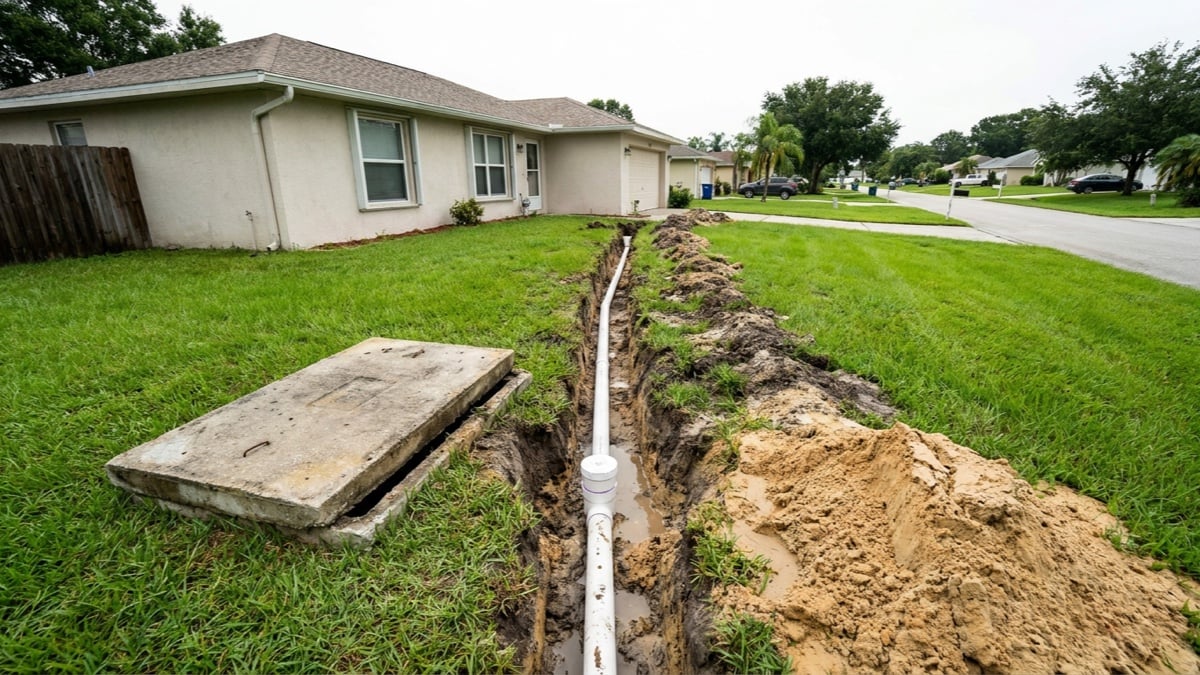
Featured image: AI-generated editorial illustration of an open trench across a residential front lawn carrying a new white PVC sewer lateral and cleanout from a single-story house toward the street, with a concrete septic tank lid lifted aside in the grass. No people and no readable text. Not a particular property, street or neighborhood.