

Who pays to repair a private road when you buy a home? Do not assume the county or a helpful neighbor will pay. Confirm who maintains the exact road segment, obtain the documents allocating repair responsibilities, and have your lender review the arrangement before relying on it.
Orange County’s Roads and Drainage Division describes its responsibility as maintaining county roads, with privately owned roads excluded. County maintenance scope. That distinction makes road responsibility a purchase question, not simply something to sort out after a pothole appears.
Our framework below separates maintenance status, payment obligations and financing review. It does not declare a particular road public or private or interpret a property’s access rights.
Confirm responsibility for the road segment you actually use
Identify the route from the property to the connecting street, including the shared stretch serving the driveway. Ask the seller what entity maintains each segment and what record supports that answer. Avoid treating a street sign, paved surface or ordinary vehicle traffic as proof of maintenance responsibility.
For an Orange County road question, the county directory lists Roads and Drainage contacts through 311 or 407-836-3111. County division contacts. Give the exact location and ask which office can confirm whether the segment is county-maintained. If it is not, ask who can identify the applicable maintaining party.
The county’s Streets and Drainage page directs pothole reports to 311 and says road work on a county right-of-way needs county involvement. County road-work instructions. That reporting page is not an address-specific maintenance determination. Do not treat a service-request contact as a promise that county crews will repair a private lane.
Request the maintenance document, not just a description
Ask for the road-maintenance agreement, covenant or other document that the seller says governs the shared road. If an association handles the work, ask which governing provision assigns that responsibility and request the relevant maintenance and budget records. A verbal statement that neighbors “split it when needed” leaves important questions unanswered.
As a useful document-review benchmark, Fannie Mae’s Selling Guide identifies responsibility for repair payments and each party’s share, default remedies, and the effective term as provisions in a private-street maintenance agreement or covenant. Fannie Mae private-street provisions. Ask an attorney to explain how the actual documents apply to your property rather than assuming equal shares or automatic enforcement.
| Evidence to request | Question it helps answer | What remains to check |
|---|---|---|
| Confirmation of maintenance status | Which entity handles the identified road segment? | The exact limits of that responsibility |
| Agreement or governing covenant | Who pays, in what share, and what happens after nonpayment? | Whether it applies to this property and future owners |
| Invoices, budget and current work information | What has been done or planned? | Whether another repair or contribution is pending |
| Lender review of the actual documents | What does this loan require? | Any unresolved condition before closing |
This is our due-diligence comparison, not an official county checklist. Request available records early enough for the responsible professionals to explain gaps.
Distinguish a recorded document from a complete legal answer
The Orange County Comptroller’s Official Records Department records, indexes and archives documents such as deeds and mortgages. Official Records functions. Ask the seller for the recording reference for the claimed maintenance document, then ask your title professional or attorney to obtain and review the relevant instrument and any amendments.
The Comptroller’s FAQs state that responsibility for proper document preparation lies with the customer and that staff do not review document content except for recording requirements. Recording-review limits. Recording is therefore not a substitute for document-specific professional review. Do not assume that a recorded document necessarily allocates the expense you are worried about.
Keep the questions focused: Does the document cover the road segment? Which properties and owners are bound? Who can authorize repairs, collect contributions and address nonpayment? Ask separately about your right to use the road; a maintenance payment arrangement and the property’s access rights are not interchangeable review tasks.
Let the lender apply the rules for your loan
Fannie Mae’s guide says an adequate, legally enforceable agreement or covenant is required when a property is on a community-owned or privately owned and maintained street. It says the agreement should be recorded and generally bind future owners. Community-owned and private-street guidance.
The same section includes a state-statutory-responsibility exception and a separate lender-indemnification path when the described requirements are not met. Guide exceptions and lender responsibility. It is not an automatic loan denial or a universal rule for every mortgage program. Ask your lender which standard applies and what documentation it will accept; this article does not determine whether a Florida statutory exception applies to a particular property.
For a hypothetical shared lane, a seller might provide a recent paving invoice but no agreement allocating future costs. The invoice answers what was paid previously, not who must pay next time. Send the documents to the lender and attorney rather than filling that gap with a neighbor’s expectation.
Review road condition separately from the payment arrangement
Ask what work is pending and whether the seller has received a repair notice, estimate or contribution request. Request any available inspection or contractor information about the surface, drainage and structures serving the road. A written payment arrangement does not tell you the current physical condition.
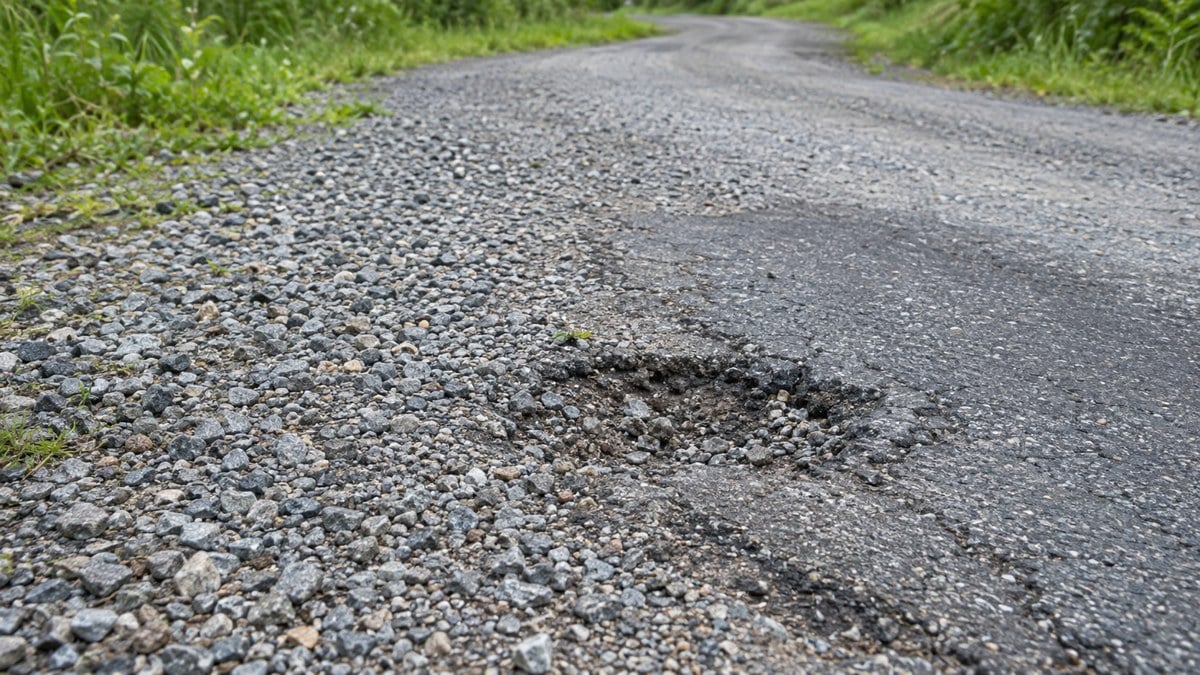
If access during wet weather is important to your decision, ask for property-specific information and an appropriate professional assessment. Do not rely on our generic featured illustration or a dry-day showing as evidence about a particular road’s performance.
Frequently Asked Questions
Does a paved road mean Orange County maintains it?
Do not infer that from pavement alone. The county division excludes privately owned roads from its stated scope; ask for confirmation covering the specific segment. County maintenance scope.
Does every private-road purchase require the same agreement?
No universal conclusion is appropriate. Your lender must apply its program requirements, including any applicable exception, and an attorney should review the property’s documents. Fannie Mae’s program-specific framework.
Is a previous repair invoice enough to establish my future share?
No. Request the document governing future repair payments and have it reviewed. Fannie Mae’s maintenance provisions distinguish repair-payment responsibility and each party’s share from other agreement terms. Payment-share provisions.
Make road responsibility part of the property questions
Tell our team if shared-road responsibility is unresolved. Through our MVP Home Group buyer services, we can help organize the record requests while your lender, title professional and attorney address their respective questions.
Nelson Cruz, P.A.
Founder & CEO
MVP Home Group, Real Broker LLC
Nelson brings nearly two decades in law enforcement to his work in real estate. View Nelson’s profile or contact our team at 407-901-9939 or [email protected].
Featured image: AI-generated editorial illustration of a generic road surface, not a particular property, local road condition or maintenance assessment.