

Winter Garden deleted its front yard artificial turf ban on September 29, 2026. Ordinance 26-25 also removed the five-foot side and rear setback, the private rights-of-way prohibition, and the rule that counted turf as impervious surface. A permit is still required, and the published code on Municode still shows the old rules.
That last point is the trap. Winter Garden’s online Code of Ordinances is codified through Ordinance No. 26-23, enacted July 23, 2026, with online content updated September 21, 2026. Ordinance 26-25 came eight days after that cutoff, so the Chapter 114 text a homeowner or installer reads today is the version the city replaced. The corridor overview sits in our Winter Garden relocation guide; what follows is the lot-level rule set underneath it.
The state rule that forced the change
Section 125.572, Florida Statutes, created by chapter 2025-140 and amended by chapter 2026-164, directed the Department of Environmental Protection to adopt minimum standards for installing synthetic turf on single-family residential properties of one acre or less. Once DEP adopted those rules, subsection (3)(a) barred a local government from prohibiting compliant turf on single-family residential property and from regulating it inconsistently with the state standards. DEP adopted Rule 62-308.100, Florida Administrative Code, effective May 19, 2026.
Winter Garden’s second recital in Ordinance 26-25 states the city amended Section 114-38 to comply with Section 125.572. The ordinance took effect immediately on adoption and applies to all permit applications received on or after that date. Scope is narrow: DEP’s own frequently asked questions document states the rule covers single-family residential properties one acre or less and does not apply to condominiums, duplexes, parks, athletic fields or commercial properties, and that DEP issues no permit of its own.
Five rules the published code still shows that no longer apply
Each of these still appears in the codified Section 114-38(g) and was struck by Ordinance 26-25.
| Rule still published in the code | Status after Ordinance 26-25 |
|---|---|
| Installations are not permitted within front yards or within ten feet of any side street property line | Deleted. No front yard or side street restriction replaced it |
| Installations are not permitted within five feet of any side or rear property line or within a drainage or utility easement | Deleted. Easements are now addressed as a cost risk rather than a prohibition |
| Installation within public and private rights-of-way is prohibited | Narrowed. Public rights-of-way only |
| Artificial turf may not be installed within 50 feet of any artificial or natural water body | Replaced. Ten feet on single-family residential of one acre or less, 50 feet on every other property |
| For impervious surface ratio calculations, artificial turf will be considered an impervious surface | Deleted, along with the requirement to submit new total impervious area coverage with the permit application |
The water body change is worth measuring on your own lot. Where no buffer zone has been established, the setback is ten feet from the applicable ordinary or mean high water line, and it does not apply where a physical barrier such as a seawall or bulkhead sits between the turf and the water.
The one-acre line decides which rule set you get
Winter Garden wrote the acre threshold into its own ordinance. The relaxed ten-foot water setback and the PFAS allowance apply to single-family residential properties of one acre or less, and the ordinance then holds every other property, including commercial, to 50 feet. A single-family home on 0.9 acre fronting a pond faces ten feet. The neighbor on 1.2 acres faces 50, because the state floor does not reach that lot. Pull the parcel’s acreage from the Orange County Property Appraiser before an installer quotes a layout.
What Winter Garden requires on top of the state floor
DEP’s rule sets a minimum, and the department’s FAQ confirms local governments may still regulate so long as they are not inconsistent with it. Winter Garden goes further in four places.
- A permit. Section 114-38(g)(1) requires a permit to install artificial turf, and that paragraph survived the amendment untouched. The state rule creates no state permit and does not require a city to have an ordinance at all.
- Appearance. The turf must replicate common species of natural grass used in Central Florida such as St. Augustine, Bahia or Bermuda in color and appearance. DEP’s rule says only that green synthetic turf shall be allowed.
- A numeric PFAS threshold. The state rule bars heavy metals and intentionally added per- and polyfluoroalkyl substances without setting a number. Winter Garden sets a baseline of 100 parts per million of total fluorine or total organic fluorine for single-family residential of one acre or less, treats anything above that as intentionally added, and requires the owner to be able to submit proof of PFAS testing from the manufacturer. Ask the installer for that test before signing.
- On-site retention. The first inch of runoff from the turf must be retained on site under Chapter 106-7, waivable only if the property is included in a St. Johns River Water Management District permit. The state rule has no equivalent.
What the city ordinance leaves out
Rule 62-308.100(9)(c) requires that installed synthetic turf provide access to the septic tank for routine pumpout. Ordinance 26-25 does not carry that requirement into the city code, but the state rule is the floor for a single-family lot of one acre or less, so plan the layout around the tank and the drainfield anyway. That matters in the parts of town still on septic rather than city sewer, which we covered in when Winter Garden can make you connect to city water and sewer.
The state rule also lets a local government require existing in-ground irrigation heads to be removed and the pipe capped, and lets a city set a maximum permeability standard of ten inches per hour across all layers. Winter Garden adopted neither, though it did keep the prohibition on using in-ground irrigation to water turf areas.
Easements, associations and districts
The easement prohibition is gone, and what replaced it is a cost. The ordinance encourages owners to keep turf out of drainage and utility easements, then states that if turf in an easement area is damaged during drainage or utility work, the owner pays to repair, reinstall or replace it with natural sod, and that installing turf in an easement may violate the easement’s terms. DEP’s rule is explicit that the state standards do not modify property rights, including easements and rights-of-way. Our post on where a pool or fence can go on an Orange County lot covers how to find those lines on a survey.
The preemption in Section 125.572(3)(a) is addressed to local governments, and subsection (3)(b) carves out a community development district enforcing deed restrictions. Nothing in the statute speaks to a homeowners association’s covenants, so read your declaration before assuming the city rule is the only one that applies.
Jurisdiction decides whether any of this governs your home, and a Winter Garden mailing address does not always mean a Winter Garden parcel. We set out how to tell in Winter Garden city limits versus unincorporated Orange County. A Municode search of the Orange County code on November 26, 2026 returned no artificial or synthetic turf section, so an unincorporated parcel works from the state rule rather than a county chapter. Confirm that with the county.
What the permit costs
The city fee schedule, updated February 24, 2024, carries no artificial turf or landscape line item, so the job falls under the valuation table. Between $1,000.01 and $15,000.00 in value, the fee is $30.00 for the first $1,000.00 plus $6.00 for each additional thousand or fraction of a thousand. A $6,000 valuation computes to $60.00 and a $12,000 valuation to $96.00, before state surcharges. Those are illustrative valuations rather than turf prices. Skipping the permit adds double the fee or $50.00, whichever is greater, on top of the fee itself, which on the $12,000 example is $192.00 above $96.00.
Maintenance follows the turf regardless of when it went in. Subsection (h) reaches all artificial turf in the city limits whether it was installed before or after that subsection was adopted, and whether or not a permit was required at the time. Turf that fades, develops holes or goes loose must be replaced, repairs must use like materials from the same manufacturer, and edges and seams must stay anchored against wind or flooding. City-owned properties and public recreational facilities are exempt from the chapter.
Where to go from here
Before signing an installation contract, confirm the parcel is inside the city limits, pull its acreage, ask the installer for the manufacturer’s PFAS test, and apply for the permit. Work from the ordinance rather than the published code until the next supplement lands, and get the city’s position in writing if an installer quotes a rule only the codified text still shows. To talk through how a turf conversion reads to a future buyer or an appraiser, book a strategy session at mvphomegroup.com/nelsoncruz.
Common questions
Can I put artificial turf in my front yard in Winter Garden now?
Yes, as far as the city’s front yard rule goes. Ordinance 26-25 struck the paragraph barring installations within front yards and within ten feet of any side street property line, and nothing replaced it. The permit requirement, the appearance standard, the material and permeability standards, the stormwater requirements and the tree drip line restriction all still apply, as do any covenants recorded against your community.
Does Winter Garden still count artificial turf as impervious surface?
No. Ordinance 26-25 struck the paragraph treating turf as impervious surface for impervious surface ratio calculations, along with the requirement to submit new total impervious area coverage with the permit application. In its place the turf itself must be permeable, affixed to permeable backing over a pervious subgrade prepared for positive drainage, with the soil beneath the subgrade not compacted to the point that it hurts percolation. The published code still shows the old impervious surface language.
Can I install turf under the oak in my yard?
Not inside the drip line, with two exceptions. Installation is barred under tree canopies or within the drip line of any existing tree canopy unless the tree is a noxious weed as defined by Chapter 581, Florida Statutes, or unless a certified arborist certifies that installation within that drip line would not harm the tree. No installation may compromise the health of nearby trees, including damage to roots, and DEP’s rule applies the drip line test to trees on adjacent properties as well as your own.
Nelson Cruz, P.A.
Founder & Team Leader
MVP Home Group, Real Broker LLC
Nelson brings nearly two decades in law enforcement to his work in real estate. View Nelson’s profile or contact our team at 407-901-9939 or [email protected].
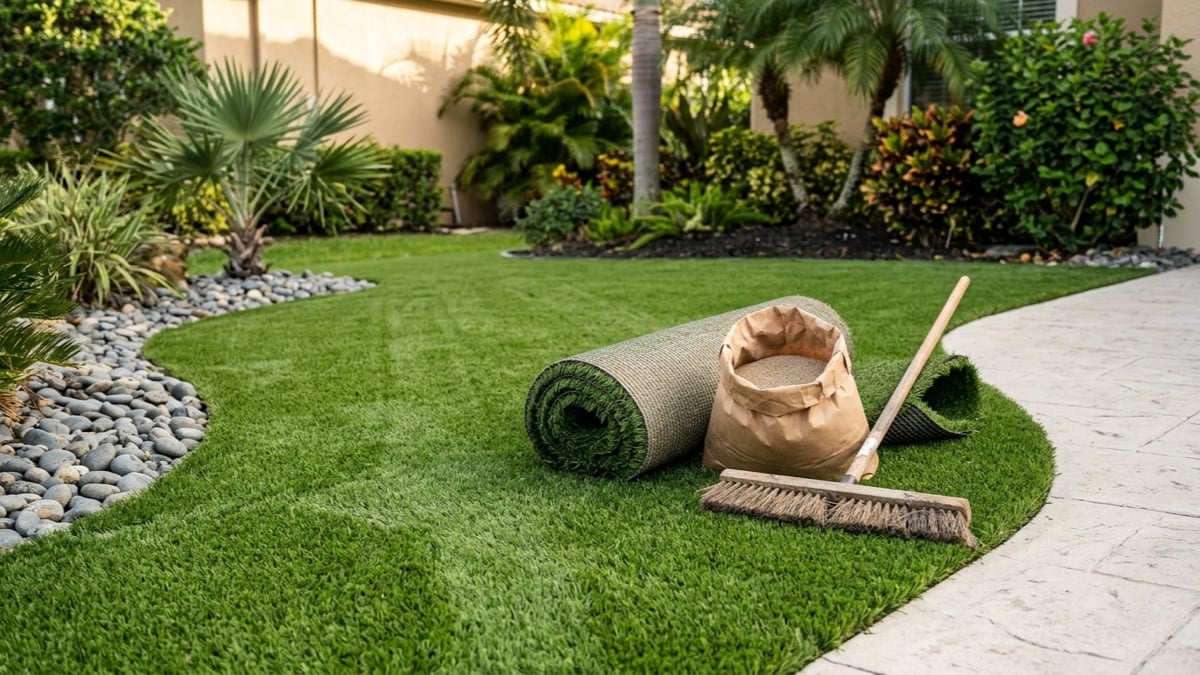
Featured image: AI-generated editorial illustration of a seamed synthetic turf lawn meeting a concrete walkway and a river rock border, with a partly unrolled roll of turf, a bag of sand infill and a push broom. Not a particular home, community or property.