

Who is actually allowed to live in a new 55 and older home in Sumter County? Two separate documents answer that, and only one of them binds you. Federal law supplies an exemption that lets a community operate as housing for older persons. The rule you agree to live under is the Declaration of Restrictions recorded against your specific platted unit in Sumter County Official Records. The builder’s brochure is neither one.
The 55 and older rule is a federal exemption, not a county category
The Fair Housing Act bars housing discrimination based on familial status. 42 U.S.C. 3607(b)(2)(C) carves out an exemption for housing intended and operated for occupancy by persons 55 years of age or older, conditioned on three things: the 80 percent occupancy test, published policies demonstrating that intent, and compliance with HUD rules for verifying occupancy. 24 CFR 100.306(a) lists the factors showing that intent, and they lean heavily on paperwork: lease provisions, and written rules, regulations, covenants, deed or other restrictions, are two of the seven. Section 100.307 requires the community to produce verification through reliable surveys and affidavits in response to a complaint, and to update occupancy information at least once every two years.
Florida mirrors the same three-part test in Florida Statutes section 760.29(4)(b)3, then closes the door on local variation: the subsection ends by stating that a county or municipal ordinance regarding housing for older persons may not contravene it. Sumter County and the City of Wildwood do not get to write their own version of the age rule.
What the 80 percent rule actually counts
The test is 80 percent of occupied units, not of all units. Under 24 CFR 100.305(b), an occupied unit is one actually occupied on the date the exemption is claimed, or a temporarily vacant unit the primary occupant lived in within the past year and intends to return to. Empty inventory does not break the exemption so long as 80 percent of the occupied units qualify. In a section with 240 occupied homes, at least 192 must have a resident aged 55 or older and the other 48 need not. A community’s own recorded declaration can be stricter, but the federal rule by itself leaves that headroom in place.
New construction gets separate treatment. Under 24 CFR 100.305(d), newly constructed housing for first occupancy after March 12, 1989 need not comply with the 80 percent requirement until at least 25 percent of the units are occupied. In a 300-home platted unit, that threshold is 75 occupied homes. Buy into an early phase and the 80 percent figure describes a test that has not started applying yet.
Federal law does not require excluding children
This is the part that surprises buyers. 24 CFR 100.306(d) states that a community may allow occupancy by families with children as long as it still meets the 80 percent test and the published-intent requirement. The exemption is permission to prefer older occupants, not an instruction to bar younger ones. So when a Sumter County community tells you no one under a stated age may be a permanent resident, that rule comes from its own recorded declaration, not from the Fair Housing Act.
| The federal exemption | Your recorded declaration | |
|---|---|---|
| Answers | May the community operate an age preference at all? | What may the occupants of this lot do? |
| Binds | The community as an operator | You, by taking title |
| Changes by | The community failing a requirement | A recorded amendment under its own terms |
Older documents read differently. Florida Statutes section 760.29(4)(b)3.b deems a declaration providing for an adult, senior or retirement facility to be housing for older persons where the community meets the 80 percent and verification tests and the document lacks an amendment procedure, prohibits amendments, or restricts them until a specified future date. It also construes a recorded ban on residents 16 or younger to reach residents 18 or younger instead. Your new declaration is drafted under current law; an older one nearby may not mean literally what it says.
Where the rule for your Sumter County lot is recorded
Sumter County contains five municipalities, Bushnell, Webster, Center Hill, Wildwood and Coleman, plus unincorporated land, per the county’s own cities and communities listing. Age restriction is not a function of which of those you buy in, but of the document recorded against your plat.
The Village Community Development Districts in the City of Wildwood show how granular that gets. District 15 was established under Chapter 190, Florida Statutes and City of Wildwood Ordinance O2022-88 on October 10, 2022, covering roughly 1,378.40 acres. District 16 followed under Ordinance O2025-4 on February 24, 2025 across roughly 1,316.1 acres.
Checked October 30, 2026, the District 15 page publishes 29 separate recorded Declarations of Restrictions, numbered consecutively from S15-203 through S15-231 and labeled by unit, among them Griffin Villas and Moultrie Creek Verandas West. One district, 29 documents. Two homes a few streets apart can sit under different declarations, which is why an answer about “the community” at a sales center is not an answer about your lot. A Chapter 190 district is also an infrastructure and assessment body, not the source of the age restriction; we covered what it does charge in our walkthrough of CDD assessments on new homes.
Pulling the document yourself
Start at the Sumter County Property Appraiser record search for the parcel’s subdivision name and legal description, then take that to Official Records. The Clerk of the Circuit Court records deeds, plats and restrictions, and states that its office keeps a complete list of developer restrictions and covenants for the recorded subdivisions in Sumter County.
One current limitation is worth knowing first. On the Clerk’s official records search page, verified October 30, 2026, the office states that records recorded prior to April 1, 2024 are being evaluated and may not be available online until they clear an updated redaction process. A message that the image is unavailable for viewing means the document is still queued, and the Official Records Division at 352-569-6600 can assist with copies. A declaration recorded for a brand-new phase after that date should be viewable immediately; an older subdivision’s may not be, which matters when your contract review window is short.
Five things to confirm before you sign
- The declaration by name and recording reference for your platted unit. In a district publishing 29 of them, “the community rules” is not specific enough to rely on.
- The minimum age for a permanent occupant, and whether the document requires one qualifying occupant per home or applies to every occupant. The federal test needs only one occupant aged 55 or older for the unit to count.
- How long a guest may stay before the document treats them as a resident. That is where an adult child’s or grandchild’s long visit gets decided.
- The written statement of compliance. Florida Statutes section 760.29(4)(d) shields a person from personal monetary liability only on a showing of no actual knowledge that the community is or will become ineligible and that it has stated formally, in writing, that it complies. If nobody will put that in writing, treat the silence as information.
- The occupancy verification you will complete, and its schedule. Under 24 CFR 100.307(c) it recurs at least every two years, so it is an ongoing obligation, not a one-time form.
Questions buyers ask
My spouse is under 55. Can we buy and live there?
Under the federal test the unit counts toward the 80 percent as long as at least one occupant is 55 or older, the rule in 24 CFR 100.305(c)(1). Nothing in the exemption requires every occupant to be 55. Whether your household may occupy that specific home still depends on the declaration recorded against your unit, which can set its own requirement.
Can our grandchildren stay with us?
Federal law does not require a 55 and older community to exclude children at all, per 24 CFR 100.306(d). Any limit on how long someone under a stated age may stay comes from the recorded declaration and the district’s adopted rules. Ask for the document rather than a number quoted at a design center, because the person quoting it is not the party who enforces it.
If the community loses its exemption, does the restriction on my deed disappear?
No. The exemption governs whether the community can maintain an age preference without running into the familial-status provisions of the Fair Housing Act. The restriction itself is a recorded covenant running with the land, and it changes only by a recorded amendment under its own terms. Separately, Florida Statutes section 760.29(4)(b)3.b requires governing documents amendable at a future date to be amended and recorded within one year after that date for the community to continue as housing for older persons.
What this changes about your purchase
The age question feels like a marketing detail at a sales appointment and becomes a title question the moment you take the deed. It also shapes who you can sell to later, because the next buyer inherits the same recorded restriction. See also our guide to Florida HOA disclosure documents and estoppel letters and our Florida new home warranty guide.
If you are weighing a new-construction contract in an age-restricted community and want the recorded documents read before your deposit goes hard, book a strategy session with our team.
Nelson Cruz, P.A.
Founder & CEO
MVP Home Group, Real Broker LLC
Nelson brings nearly two decades in law enforcement to his work in real estate. View Nelson’s profile or contact our team at 407-901-9939 or [email protected].
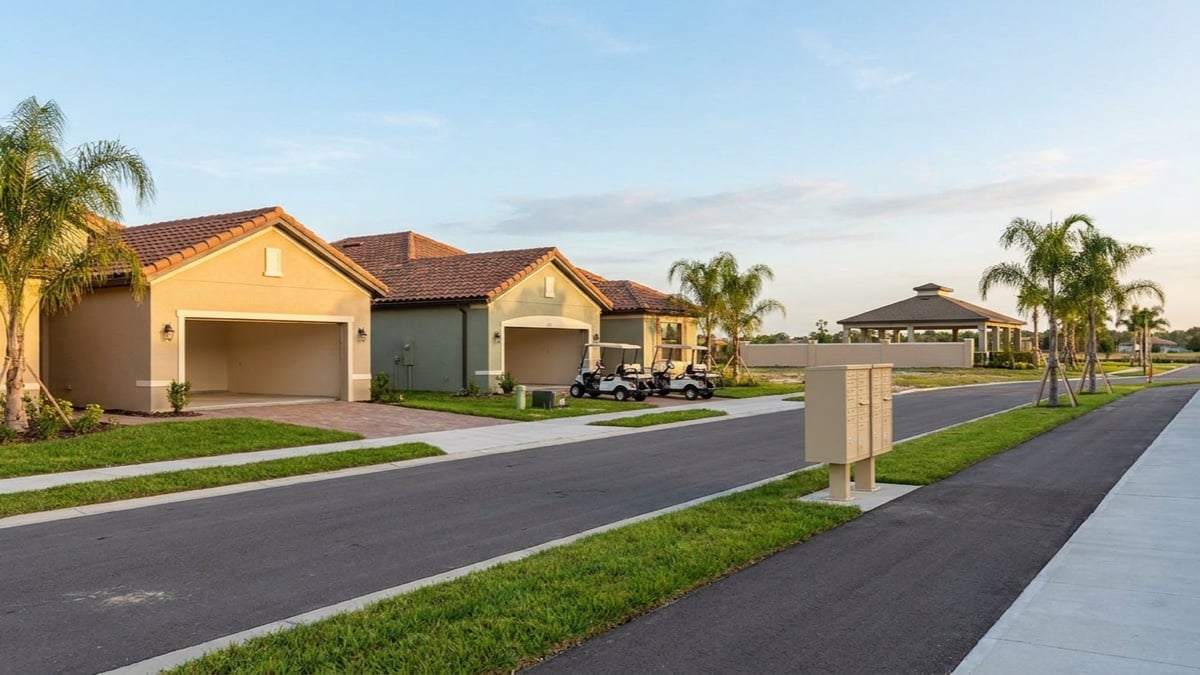
Featured image: AI-generated editorial illustration of a newly built single-story residential street with tile-roof homes, parked golf carts, a cluster mailbox kiosk, young palms and a community pavilion. Not a particular property or community.