

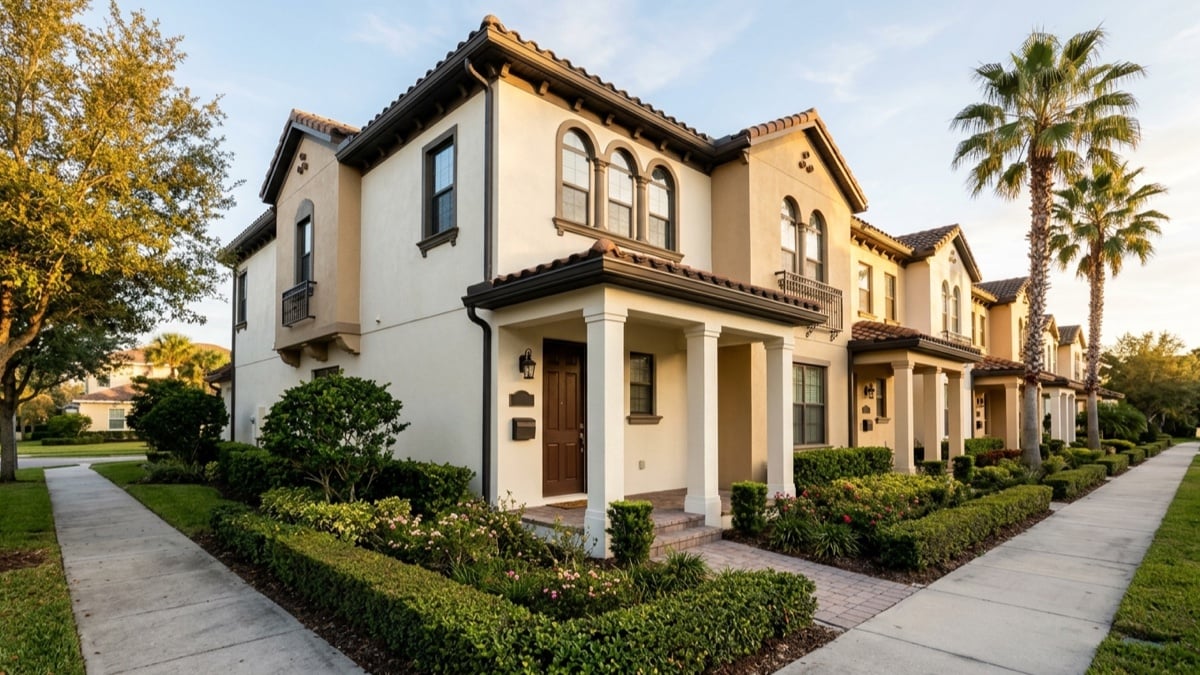
An FHA loan on a Florida condominium unit depends on the project as much as on you. FHA will insure the unit only if it sits in an FHA-approved project, meets FHA’s definition of a Site Condominium, or clears the Single-Unit Approval process one loan at a time. Find out which of the three applies before you write the offer, because the answer can move your down payment.
The rule comes from HUD’s Single Family Housing Policy Handbook 4000.1, last revised August 12, 2026, whose Condominiums section carries an effective date of November 10, 2026. The handbook puts the test in a single sentence: a condominium unit must be located within an FHA-approved condominium project, meet FHA’s definition of a Site Condominium, or have completed the FHA Single-Unit Approval process before a mortgage can be insured. Your own approval letter answers none of that.
A townhouse can legally be a condominium
Florida settles that question in the public records rather than in the architecture. Section 718.104(2), Florida Statutes, creates a condominium by recording a declaration in the public records of the county where the land is located, executed and acknowledged with the requirements for a deed. A building that reads as a row of townhouses can be a condominium, and the recorded declaration is what decides it.
FHA then carves out one category that skips project review entirely. A Site Condominium is a project consisting entirely of single family detached dwellings with no shared garages or any other attached buildings, or a project of detached or horizontally attached townhouse-style dwellings where the unit consists of the dwelling and land, which contains no manufactured housing units and is encumbered by a declaration of condominium covenants or a condominium form of ownership. The owner must be responsible for all required insurance and maintenance costs on the unit dwelling, landscaping excluded. Site condominiums require neither condominium project approval nor single-unit approval.
FHA’s wording turns on whether the unit consists of the dwelling and land, so that is the line to read. Ask the title agent for the recorded declaration during the inspection period.
Reading FHA’s approved list
FHA publishes approved projects in a public lookup that searches by state, county, city, project name, ZIP code or FHA Condo ID. Its status filter offers Approved, Expired, Rejected and Withdrawn, and only the first of those carries a loan. Approval runs to an expiration date, so a project that let the date pass shows as expired until someone files to renew it.
Timing matters more than a screenshot saved during your home search. The handbook requires the lender to confirm the project is on the list of FHA-approved condominium projects at the time of case number assignment and to enter the FHA Condo ID on the case assignment screen in FHA Connection. A project approved in March can be expired by the week you go under contract.
Renewal runs on a fixed window. A recertification review is performed no earlier than six months before the expiration date and no later than six months after it, and a project that misses the window has to re-apply through a full review. Full review also applies to any project whose approval has been expired for more than six months.
The single-unit route is the narrower door
Single-Unit Approval covers a unit in a project that is not approved, and it is verified loan by loan instead of once for the whole community. Several of its tests are tighter than the ones applied inside an approved project.
| Test | Unit in an FHA-approved project | Single-Unit Approval |
|---|---|---|
| Project on FHA’s approved list | Required at case number assignment | Project must not be on the list |
| Owner-occupancy floor | At least 35 percent of units | At least 50 percent of units |
| FHA loan concentration | FHA may suspend new case numbers above 50 percent of units | Above 10 percent of units in projects of 20 or more; two loans total in projects under 20 units |
| Project size | Two- to four-unit projects are an eligible classification for approval | At least five units |
| Age or occupancy of your unit | No separate loan-level test | Certificate of occupancy issued at least a year ago, or the unit has been occupied |
| Developer control | No separate loan-level test | Control must already have passed to the unit owners |
| Units over 60 days behind on dues | 15 percent ceiling | 15 percent ceiling |
| Borrower underwriting | Standard FHA, maximum 96.5 percent loan-to-value on a purchase | Accept from TOTAL Mortgage Scorecard, or 90 percent maximum if manually underwritten |
Two rows reach past the paperwork. The borrower row reaches your bank account, because single-unit approval requires an Accept from the TOTAL Mortgage Scorecard and caps a manually underwritten file at 90 percent loan-to-value against the 96.5 percent FHA allows on a purchase. On a $300,000 contract where the appraisal supports the price, 96.5 percent finances $289,500 and asks $10,500 down. Ninety percent finances $270,000 and asks $30,000. Same unit, same buyer, $19,500 more cash at the table.
The concentration row can close the door with no warning at all. Under single-unit approval FHA may suspend new case numbers once FHA-insured loans exceed 10 percent of the units in a project of 20 or more, and projects under 20 units are held to two FHA-insured mortgages in total. A 60-unit community therefore supports six loans at exactly 10 percent, while the seventh lands at 11.67 percent and sits over the line. No counter appears on the listing.
What the association has to tell your lender
These numbers are collected on form HUD-9991, the FHA Condominium Loan Level/Single-Unit Approval Questionnaire. The lender completes it, and the instructions, last updated February 14, 2025, require information obtained within the last 90 days from verifiable sources, named as a condominium association or its assigned management company, public records, independent third parties or other data sources. Sections 1 through 3 apply to every condominium file, and section 4 applies only when the project is unapproved.
The 90-day clock puts an association’s responsiveness onto your closing timeline. The questionnaire asks for the owner-occupancy count, the number of units more than 60 days past due on dues and special assessments excluding late fees and administrative expenses, whether any single owner holds more than one unit, and whether the master policy covers the interior of the unit. Where the master policy stops at the walls, you have to carry an HO-6 walls-in policy covering replacement of interior improvements and betterments.
Reserves carry a stated floor on the single-unit route: a reserve account for capital expenditures and deferred maintenance funded with at least 10 percent of the aggregate of 12 months of unit assessments, unless a lower amount is deemed sufficient based on an acceptable reserve study. In a 60-unit community charging $350 a month, 12 months of assessments aggregate to $252,000, which puts the floor at $25,200. Florida’s milestone inspection and structural reserve study requirements run alongside that test as a separate obligation.
Projects FHA will not approve
Some characteristics end the conversation regardless of the buyer or the lender. FHA will not approve condominium projects with cooperative ownership, condominium hotel or condotel operation, mandatory rental pooling agreements that require unit owners to rent their units or give a management firm control over occupancy, timeshare or segmented ownership, more than one dwelling per condominium unit, houseboat projects, continuing care facilities, a Coastal Barrier Resources System location, or an adverse determination for significant issues identified by FHA.
The rental pooling line is the one that reaches resort-style inventory. A rental program an owner may opt into is a different instrument from a declaration that compels participation, and the declaration is where that gets settled. Any project with a part inside the Coastal Barrier Resources System is also ineligible for single-unit approval outright.
Where to go from here
Before the offer goes out, send your lender the project’s legal name and ask three questions in writing: whether the project is on FHA’s approved list today, whether the declaration describes the unit as the dwelling and land, and which of the three routes the file will take. Ask the listing agent for the association’s management contact at the same time, since the questionnaire carries a 90-day currency rule. The documents a Florida condominium association owes a buyer are set out separately. To have our team read a declaration and a project’s approval status against a draft contract before you sign, book a strategy session at mvphomegroup.com/nelsoncruz. This is general information rather than lending or legal advice, and your lender, the association and your closing agent control the outcome.
Questions buyers ask
The listing says the community is FHA approved. Is that enough?
No. Approval attaches to the project and runs to an expiration date, and FHA’s lookup reports Expired, Rejected and Withdrawn alongside Approved. The handbook requires your lender to confirm the project is on the approved list at the time of case number assignment and to enter the FHA Condo ID then. A line in the listing remarks is not that confirmation, and it carries no date.
Can I pay to get the project approved before my closing?
Requests come from a defined list of sources: a mortgagee, builder, developer, condominium association, management company, project consultant, or an attorney acting as agent for the developer, builder, association or management company. A buyer is not on that list, so the request runs through the association or your lender, and FHA pays none of the fees associated with the process. The package goes to the FHA Resource Center as a single PDF, so treat approval as a project-level effort you do not control.
Does a HUD foreclosure condo need approval?
No. HUD Real Estate Owned mortgage transactions require neither condominium project approval nor single-unit approval. Where the project has an FHA Condo ID, the lender still enters it when the case number is requested. Streamline refinances carry the same exemption, which matters later if you refinance the unit.
Nelson Cruz, P.A.
Founder & Team Leader
MVP Home Group, Real Broker LLC
Nelson brings nearly two decades in law enforcement to his work in real estate. View Nelson’s profile or contact our team at 407-901-9939 or [email protected].
Featured image: AI-generated editorial illustration of a row of attached two-story townhouse-style units with cream stucco walls, barrel tile roofs, covered entry porches with white columns, clipped hedges along a paver walkway and palms at the end of the row in early morning light. Not a particular property, community or association.