

Inside Clermont’s city limits you may keep up to five hens on a developed, occupied detached single-family property, you must register with the city, and no roosters are allowed anywhere in town. The detail most buyers miss is the clock: Clermont’s code says the backyard chicken program expires February 11, 2027 unless extended by city council. The second detail is the map.
A Clermont mailing address outside the city limits follows Lake County’s rules instead, and the county requires the coop to sit 20 feet from every property line rather than Clermont’s five.
What Clermont’s code actually allows
Clermont treats chickens as livestock. Section 6-2 of the city code defines livestock to include goats, sheep, equine, bovine, swine and domestic fowl such as chickens, geese, ducks, turkeys and guineas. Section 6-45 then makes keeping livestock inside the city unlawful, with two exceptions: a conditional use permit granted by city council, or compliance with the urban backyard chicken rules written into that same section.
Those rules are the whole of what the city permits:
- Hens only, five maximum. The code defines “chicken” as female chickens only. The cap is five hens per property.
- No roosters, anywhere. Roosters are prohibited in every zoning district in the city, and the code states that any chicken that crows is deemed a rooster.
- Detached single-family only. The program applies to developed and occupied detached single-family properties.
- You register with the city. Section 6-45 requires the property owner to register. The city’s Residential Backyard Chicken Application is on Clermont’s applications and forms page.
- No selling, no slaughtering. Selling eggs, meat, feathers or other chicken products from permitted birds is prohibited, and slaughtering on the owner’s property is prohibited.
The five-hen cap does not eat into your household pet allowance. Section 6-46 limits a Clermont resident to five animals over four months old, and says plainly that chickens allowed under Section 6-45 are not counted toward that number.
Coop and run: the measurements that decide where it goes
The coop rules are where a plan usually succeeds or fails, because the rear yard has to satisfy two different setbacks at once.
- A coop is required. A run is optional.
- Any structure built to house or exercise chickens must sit a minimum of 20 feet from any neighboring residential dwelling and a minimum of five feet from any property line.
- Coops and runs go in the rear yard only. Neither is allowed in a front or side yard.
- The coop must provide at least four square feet per chicken and may be no taller than six feet measured from natural grade.
- A run must be entirely fenced and no larger than 100 square feet.
- The coop must be durable, anchored to the ground, ventilated, and secure against predators.
Read the first bullet twice. The 20-foot measurement runs to a neighboring dwelling, not to the property line, so the binding constraint depends on how close the house next door sits to the shared line. On a narrow lot where the neighbor’s wall is 10 feet off the line, a coop five feet inside your own line is still too close.
Three operating rules follow. Chickens may never run free without direct personal supervision, and only inside the owner’s fenced yard. Feed must be stored in an enclosed container that keeps rodents and pests out. Removed excrement and other waste must be kept in airtight containers until properly disposed.
Clermont city limits vs. unincorporated Lake County
A Clermont mailing address is not the same thing as a Clermont jurisdiction. Homes along the SR 50 and US 27 corridors can carry a Clermont address while sitting in unincorporated Lake County, which has its own backyard chicken rule in Section 10.01.06 of the Land Development Regulations. The two rulebooks agree on the headline number and diverge on almost everything that affects a build.
| Rule | City of Clermont (Sec. 6-45) | Unincorporated Lake County (LDR 10.01.06) |
|---|---|---|
| Maximum chickens | Five hens | Five chickens |
| Roosters | Prohibited citywide; any chicken that crows is deemed a rooster | Not allowed; the rule covers chickens other than roosters |
| Where allowed | Developed, occupied detached single-family property | Accessory use in the R-2, R-3, R-4, R-6, R-7 and RM zoning districts |
| Coop setback from property line | Minimum 5 feet | Minimum 20 feet from all property lines |
| Setback from a neighboring dwelling | Minimum 20 feet | Not specified in this section |
| Coop placement | Rear yard only | Not in front or side yards |
| Coop height and size | Max 6 feet tall; min 4 sq ft per chicken | Not specified in this section |
| Run | Optional, fenced, max 100 sq ft | Chickens must be secured in the coop or fenced enclosure at all times |
| Supervised free-ranging | Allowed with direct personal supervision in a fenced yard | Not allowed; birds stay secured at all times |
| Manure | Removed waste in airtight containers | Fly-tight bin kept 20 feet away; composting bin 20 feet from all property lines |
| Registration | Required with the city | Not required by this section |
| Expiration | February 11, 2027 unless extended | No expiration in the regulation |
The county’s 20-foot setback from every property line is the rule that catches people. On a standard 70-foot-wide subdivision lot, holding 20 feet off both side lines leaves a 30-foot-wide strip, and the rear setback trims it again. That is workable on an acre out toward Groveland and tight to impossible on a platted quarter-acre. Clermont’s five-foot line setback is far more forgiving, an unusual case of city rules being looser than county rules.
So confirm which side of the line the parcel sits on before you plan anything. If you are not certain the address is inside Clermont’s city limits, ask the city, because registering with Clermont does nothing for a parcel the county regulates.
Your HOA can still say no
Clermont wrote the answer into the ordinance itself. Section 6-45 states that the section does not authorize anyone to violate applicable restrictive covenants or homeowners’ association rules, that the city does not police or enforce private covenants and HOA rules, and that homeowners are solely responsible for compliance with them. The city’s own application repeats it: the program does not supersede or allow violation of any HOA’s rules, and the form describes eligible residents as those in single-family homes with no HOA objections.
That means two separate approvals, and the private one usually decides it. A recorded declaration prohibiting poultry or livestock still binds the lot after the city hands you a registration, so read the declaration before the contract deadlines run. Our guide to what a Florida HOA fee includes and how to verify it walks through where the governing documents come from and when they have to be delivered.
The February 2027 expiration is the part to plan around
Clermont adopted the program through Ordinance 2025-008 on February 11, 2025. Subsection (e) of Section 6-45 reads that the urban backyard chicken program will expire on February 11, 2027 unless extended by city council. The city’s application form says the same thing in plainer words, asking the registrant to acknowledge a two-year pilot program that may end February 11, 2027.
As of the code version current through September 1, 2026, that expiration is still in the ordinance and we found no adopted extension. Treat the program as temporary until the council acts, and do not let a seller’s existing coop stand in for permission, because the registration belongs to the property owner and the underlying program has an end date. February 11, 2027 falls inside a normal contract-to-closing timeline for a purchase made today, so call the city before you spend money on a build this winter.
What a violation costs
Clermont handles this through its animal code rather than a building permit. Section 6-6 sets a civil penalty of $150 for a livestock prohibited violation, $300 for the same offense within 12 months of a prior conviction, and $300 plus a mandatory county court appearance on a third or subsequent citation for the same offense.
Separately, Section 6-45 provides that chickens must be removed after three violations of the code for three separate events, as determined by the city’s code enforcement board or special magistrate. The standard that triggers those violations is broad: coops and runs must be kept so they do not create a nuisance for neighbors by noise, odor, or accumulation of flies, rodents or other pests.
A checklist before you write the offer
- Confirm jurisdiction. City of Clermont or unincorporated Lake County decides which rulebook applies and whether your setback is five feet or 20.
- Read the declaration. Look for poultry, fowl, livestock and animal restrictions, and for any accessory structure approval requirement.
- Measure the rear yard. Plot 20 feet from each neighboring dwelling and five feet from each line, then confirm a six-foot-tall coop and a run under 100 square feet fit in the rectangle that is left.
- Inspect any coop that conveys. Check its placement against the current setbacks rather than assuming it was ever compliant.
- Register with the city, and ask at the same time whether the council has extended the program past February 11, 2027.
Frequently asked questions
Can I keep ducks, geese or turkeys in Clermont instead?
No. Clermont’s code groups chickens, geese, ducks, turkeys, guineas and similar domestic fowl together as livestock, and the exception in Section 6-45 is written only for chickens, defined as hens. Other fowl would require a conditional use permit granted by city council.
Can I sell eggs from my Clermont backyard hens?
No. Section 6-45 prohibits the sale of eggs, meat, feathers or other chicken products from chickens kept under the program, and it states that keeping chickens under this section is not considered a farm or the process of farming.
My neighbor’s hen started crowing. What is the city’s position?
The code resolves it by definition rather than by argument. Roosters are prohibited in every Clermont zoning district, and any chicken that crows is deemed a rooster for purposes of the code. A crowing bird is a rooster regardless of what it was sold as.
About this guide
Rules here come from the City of Clermont Code of Ordinances, Chapter 6, Sections 6-2, 6-6, 6-45 and 6-46, version current through September 1, 2026; the City of Clermont Residential Backyard Chicken Application; and Lake County Land Development Regulations Section 10.01.06, version current through October 26, 2026. Ordinances change and this program carries an expiration date, so confirm the current rule before you build. For the wider picture of the corridor, see the full Clermont relocation guide on Live Move Orlando.
If you are weighing a Clermont home against a larger lot out in the county, the setback math above is one of the quieter differences that decides what the yard can actually do. We can tell you which side of the city line a parcel sits on before you write an offer. Start with a home valuation or book a strategy session at mvphomegroup.com/nelsoncruz. For what the market is doing in town right now, our Clermont housing market report updates weekly.
Nelson Cruz, P.A.
Founder & CEO, MVP Home Group, Real Broker LLC
Nelson brings nearly two decades in law enforcement to his work in real estate. View Nelson’s profile or contact our team at 407-901-9939 or [email protected].
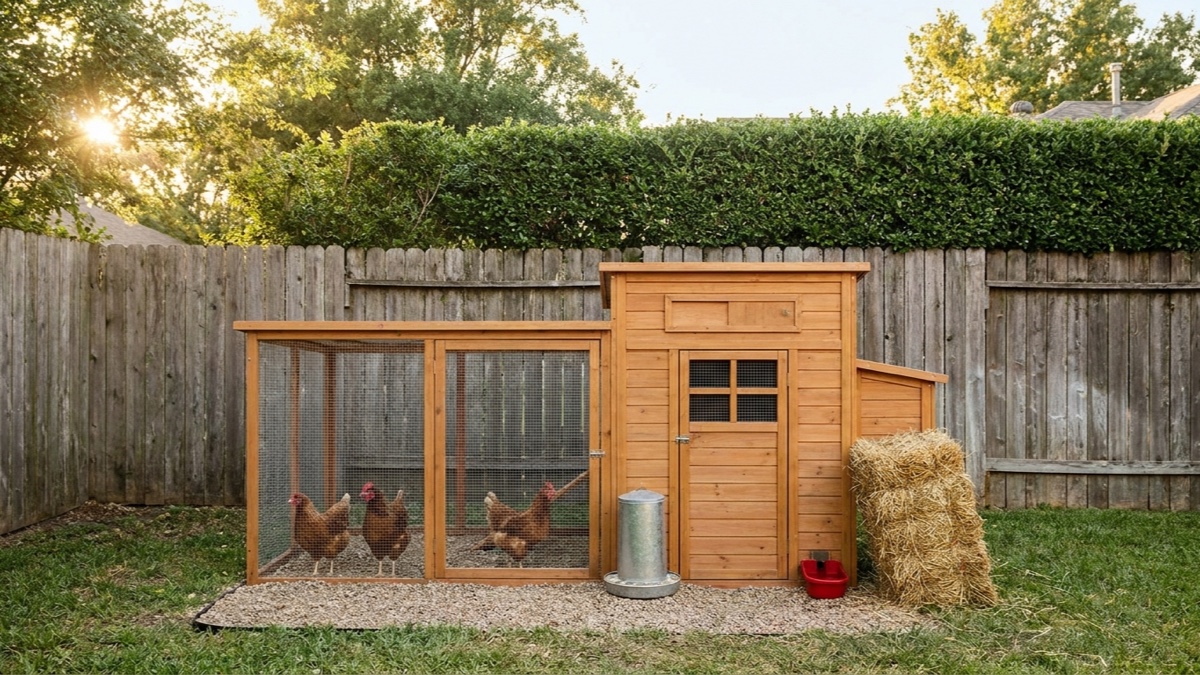
Featured image: AI-generated editorial illustration of a wooden backyard chicken coop with an attached wire run on grass in a fenced residential rear yard, with hens, a metal feeder and a bale of straw. It does not depict a particular property.