

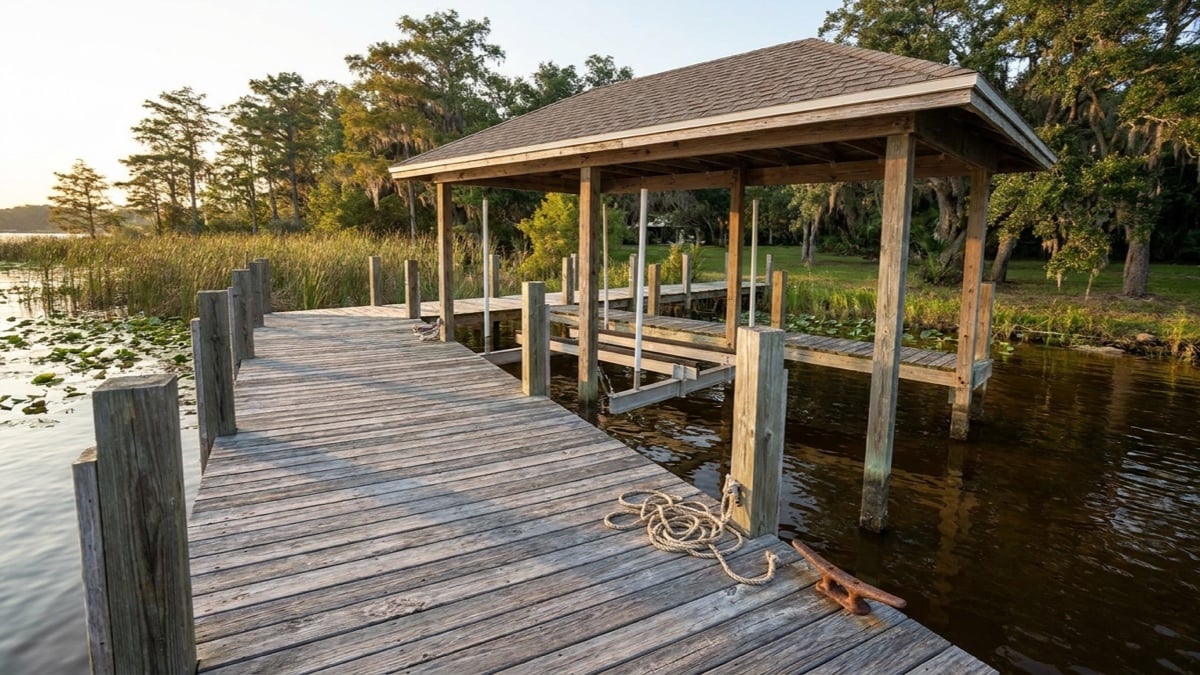
A dock on the Butler Chain of Lakes needs an Orange County Environmental Protection Division permit before a building permit can issue, and the state size threshold that decides whether you also need a water permit is 500 square feet of over-water area instead of the 1,000 square feet that applies on unlisted lakes. Rule 62-302.700(9)(i)4., F.A.C., lists the Butler Chain of Lakes as an Outstanding Florida Water, and Rule 62-302.700(1) directs the state to give those waters the highest protection. Before you write an offer on a lakefront home in the Dr. Phillips area, confirm which lake the shoreline touches and what the existing dock is permitted to be.
Which waters the designation covers
The rule does not designate the lakes around Windermere and Dr. Phillips as a group. It names eleven waters: Lake Butler, Lake Down, Wauseon Bay, Lake Louise, Lake Palmer (also known as Lake Isleworth), Lake Chase, Lake Tibet, Lake Sheen, Pocket Lake and Fish Lake, plus the waterways connecting them, designated March 1, 1984, and Lake Blanche with its connecting waterway, added February 18, 1987. The current rule version took effect November 25, 2025.
Lakes outside that list are treated differently a mile away. Big Sand Lake, which several established Dr. Phillips neighborhoods front, appears nowhere in Rule 62-302.700. Two lakefront houses in the same ZIP code can carry two different state thresholds, so the lake name belongs in your notes next to the address.
The county permit comes first
Dr. Phillips is not an incorporated city. Orange County lists thirteen towns and cities inside its borders and Dr. Phillips is not among them, so the county regulates these parcels directly. Docks fall under Chapter 15, Article IX of the Orange County Code. The county’s permitting guide states that all new docks require an EPD permit plus a building permit, and that the Building Division will only accept plans EPD has already approved. The same sequence covers docks in Oakland, Ocoee and Windermere.
EPD reviews side setbacks, roof height, terminal platform size and other criteria in Article IX. The permit is valid for one year. The application form, revised October 1, 2026, carries a $965.50 filing fee and a $120.69 minor modification fee. Orange County is phasing in updated environmental permit fees over two years, with the current step effective October 1, 2026.
Section 125.022, Florida Statutes, gives the county 5 business days to confirm receipt, 30 days to review completeness in writing, and 120 days to decide once the application is complete, or 180 days where a hearing is required. EPD adds the consequence for applications received on or after October 1, 2025: you have 30 days to answer a Request for Additional Information, and without a response or an approved waiver in that window EPD closes the application and you reapply with the fees again.
Three state paths, decided by square footage
Section 403.813(1)(b), Florida Statutes, exempts a private dock from state water permitting when it meets five conditions, and the first is the size test the designation changes.
| Path | Trigger on the Butler Chain | What it requires |
|---|---|---|
| Statutory exemption | 500 square feet or less of over-water surface area, plus the four other conditions in s. 403.813(1)(b) | No state water permit. The county permit and building permit still apply. |
| General permit, Rule 62-330.427 | Private single-family dock with up to two boat lifts whose total over-water area, counting all existing structures on the property’s shoreline, stays at or under 2,000 square feet | Notice to the agency. Under s. 403.814(1) the permit becomes usable 30 days after notice with no agency action. |
| Individual permit | Anything larger, or outside the general permit conditions | Reasonable assurance under s. 373.414(1) that the activity is clearly in the public interest, a higher showing than the not-contrary-to-the-public-interest test on unlisted waters. Rule 62-4.242(2) bars any lowering of existing ambient water quality beyond thirty days of construction. |
The remaining exemption conditions catch older docks. The structure must sit on pilings or float without filling or dredging beyond the pilings, it may not substantially impede water flow or create a navigational hazard, it must serve recreational noncommercial use, and it must be the only exempt dock within 65 feet along the shoreline, with one allowed per lot shorter than that.
The general permit has its own limits: two moored vessels at most, mooring and access areas that already hold two feet of water below the expected average low water level, walkways no wider than six feet, no walls or screens enclosing any side, and one dock per parcel. Roofs are allowed, and roof area overhanging the decking counts toward the square footage.
The shoreline you may clear, and where the dock goes
Shoreline vegetation is a separate county permit question. Under Chapter 15, Article VII, a lakeshore homeowner is entitled to a vegetation-free access corridor of 20 percent of total linear shoreline or 30 feet, whichever is greater, without a permit. Clearing nuisance or exotic vegetation outside that corridor or inside an adjacent shoreline wetland requires a Lakeshore Protection Permit, currently $717.00, and replanting with appropriate native vegetation afterward.
Two lines in the county guide decide where a dock can physically go: boat docks are generally to be placed in the access corridor, and an access corridor is not allowed within any adjacent shoreline wetland. Run the arithmetic on the parcel, because the 30-foot floor controls until the shoreline reaches 150 feet and a 200-foot shoreline yields 40 feet. Seawalls and rip rap fall under Chapter 15, Article VI, which requires rip rap and native aquatic plantings in front of any new or repaired seawall.
What the application file has to prove
The county application asks for documents a seller may not have on hand, so request them during the inspection period:
- Evidence of title, such as a copy of the deed, and documentation showing riparian rights to the shoreline.
- A survey that accurately depicts current conditions.
- A site plan naming the water body and showing setbacks from adjacent and projected property lines to all portions of the dock.
- Floor and roof elevations, plus water depth at the end of the dock and at every proposed mooring location.
- The normal high water elevation as established by the county and field verified by a professional surveyor.
- Any existing permit for the dock already there.
Relief from an Article IX standard is priced by whether a hearing is required. A variance is $409.00 administratively and $3,294.00 with a public hearing; a waiver is $204.50 and $1,647.00 on the same split. Each jumps by a factor of about eight, so settle which track a design falls on before committing to it. The application also warns that the dock may need a permit from the Florida Department of Environmental Protection or the applicable water management district, and that deed restrictions and homeowners association approval sit outside every public permit, the same sequencing problem behind Orange County driveway permits.
The district line on the tax bill
The chain is managed through a dependent special district. The Windermere Water and Navigation Control District was created by Laws of Florida chapter 63-1711, section 19, covers 16,854.39 acres, and is governed by the Orange County Board of County Commissioners with operations run from the Environmental Protection Division. Its stated purpose includes regulating alteration of shorelines and water areas, protecting riparian property rights, and controlling boat speed and operation.
Funding is an ad valorem millage capped at 1 mill by Orange County Code Section 33-134, and the current rate is 0.2528 mills. On a taxable value of $1,000,000 that line is $252.80 a year, against a $1,000.00 ceiling at the cap. Pull the seller’s tax notice and look for the district line rather than assuming a lakefront parcel sits inside the boundary. Whether a specific address is inside is a question for EPD, the same office that issues the dock permit.
Frequently Asked Questions
Does an existing dock transfer to me when I buy the house?
The structure conveys with the property. Its permit history is a separate record. Orange County notes that some docks may be grandfathered and directs owners to EPD for the rules on maintaining and repairing older docks, so ask EPD what is on file before planning a replacement, an extension or a new roof. A dock built under the state exemption was never reviewed through an application, so there may be no state file to inherit.
Can I add a boat lift and a roof to a 500-square-foot dock?
Roof area overhanging the decking counts toward the over-water total under Rule 62-330.427, so a roof can move a dock out of the exemption and into the general permit. That permit allows up to two boat lifts and a roof over the mooring areas, lifts and terminal platform, inside a 2,000-square-foot cap that counts every existing structure on your shoreline. The county permit is separate, and roof height is one of the items EPD reviews.
How does this compare with lake rules elsewhere in Central Florida?
The controlling layer changes by location. Some cities write motor limits lake by lake in their own code, as in our guide to Ocoee lake rules. On the Butler Chain the layers are the state Outstanding Florida Water designation, the Orange County code and a special district. Identifying which jurisdiction regulates a parcel is the same exercise as checking city limits against unincorporated county.
Shopping the Butler Chain
Dock capacity is a value question here, and public records answer it before an inspection contingency expires. We can pull the permit history for an address and place a planned dock among the three state paths above. For the wider corridor picture see the full corridor guide at Live Move Orlando’s Dr. Phillips guide, or our Doctor Phillips community page. To settle the permit questions before you are under contract, book a strategy session at mvphomegroup.com/nelsoncruz. This is general information about permitting requirements, not legal advice, and not a determination about any particular property or parcel.
Nelson Cruz, P.A.
Founder & CEO
MVP Home Group, Real Broker LLC
Nelson brings nearly two decades in law enforcement to his work in real estate. View Nelson’s profile or contact our team at 407-901-9939 or [email protected].
Featured image: AI-generated editorial illustration of a private wooden boat dock with a covered slip extending over a calm freshwater lake at golden hour, with cypress and oak along the far shoreline. No readable text. Not a particular property or listing.