

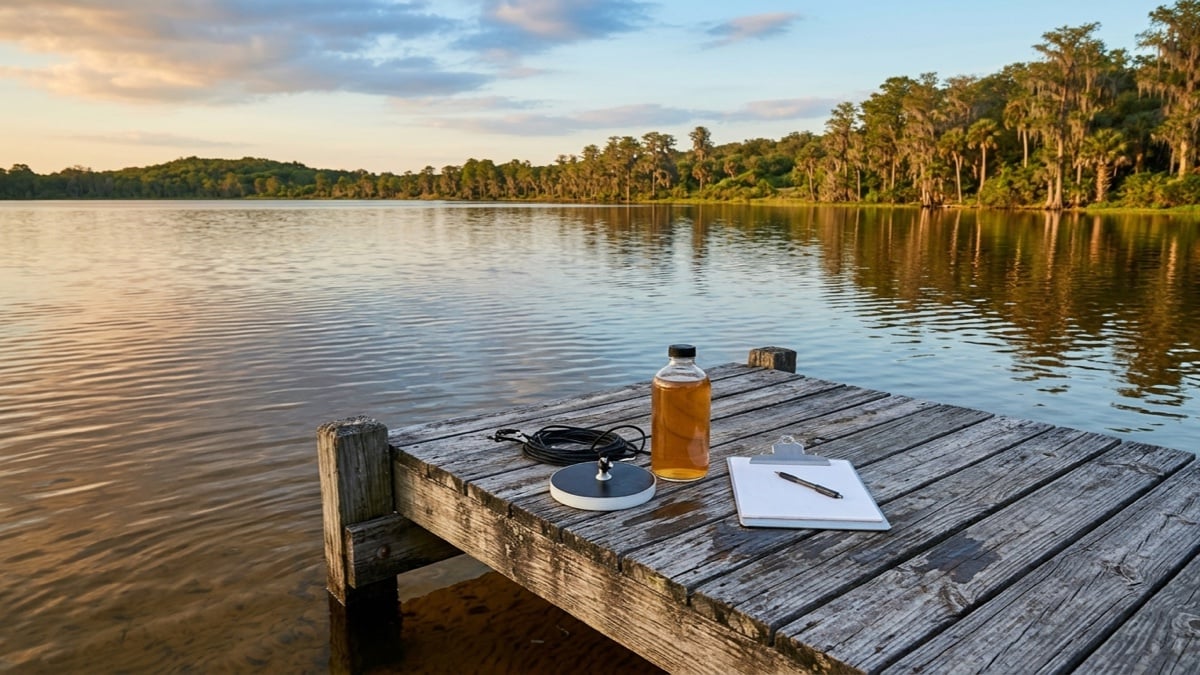
Florida’s current assessment lists Lake Minneola as impaired on two counts: biology, because repeated plant surveys failed, and mercury in fish tissue, which traces straight back to a health department fish advisory. The water chemistry itself passes, and the latest nutrient readings sit well under the state thresholds. Those are separate answers to separate questions, and a lakefront buyer needs all of them.
Lake Minneola sells itself on paddleboards and the trail along the south shore. The marketing stops there. Below is what the agencies that sample the lake have on file and where to find it.
The state’s current listing, in plain terms
Lake Minneola is waterbody ID 2839A in the Florida Department of Environmental Protection’s system, a Class 3F lake in the Ocklawaha basin group and the Palatlakaha River planning unit. Under the 2022 to 2024 Biennial Assessment, referred to by DEP as Cycle 6, the lake carries two entries on the state’s Waters Not Attaining Standards list.
The first is Biology, assessment category 4d, status Study List. DEP’s note on that record reads that the waterbody is impaired for this parameter based on failing bioassessments and will remain on the Study List and the 303(d) List because a causative pollutant has not been identified. The state can measure that something is wrong with the lake’s plant community and cannot yet name the cause.
The second is Mercury in fish tissue, category 4a, status TMDL Complete. DEP’s note says it has insufficient data for the parameter, that the lake meets Planning List requirements based on the Department of Health fish consumption advisory, and that the parameter stays in 4a because an adopted statewide mercury TMDL already exists.
Two segments of the Palatlakaha River, which drains the chain, carry their own category 4a listing for dissolved oxygen. The river leaving Lake Minneola is assessed separately from the lake.
Two state maps, two different answers
This is where online research goes wrong. DEP publishes more than one impaired waters layer, built to different rules.
The layer labeled Impaired Waters compiles Cycle 6 and includes categories 4a, 4b, 4e and 5. Its documentation states that it excludes mercury in fish tissue, because that parameter is addressed through a statewide TMDL, and category 4d is not in it either. Query Lake Minneola against that layer and nothing comes back. The layer labeled Waters Not Attaining Standards compiles the last five assessment groups and includes 4a, 4b, 4d, 4e and 5. Query the same lake there and both entries appear.
Neither map is wrong. A buyer who checks only the first one will conclude the lake is clean while the state’s own file says otherwise. For one page that reconciles them, the Lake County Water Atlas entry for Lake Minneola, run by the Lake County Water Authority and the USF Water Institute, prints both rows with DEP’s status definitions underneath.
The fish advisory is the mercury listing
The mercury entry traces to the Florida Department of Health advisory for fish caught in the lake, published through a searchable tool organized by county and waterbody. For Lake Minneola it covers four species, all for mercury. Pull the same advisory for Lake Minnehaha, the Lake County lake connected to Lake Minneola through the chain, and the advice differs.
| Species | Lake Minneola: women of childbearing age, young children | Lake Minneola: all others | Lake Minnehaha: women of childbearing age, young children | Lake Minnehaha: all others |
|---|---|---|---|---|
| Largemouth bass | One per month | One per week | One per month | One per month |
| Bluegill | One per week | Two per week | One per month | One per week |
| Redear sunfish | One per week | Two per week | One per week | Two per week |
| Channel catfish | One per week | Two per week | One per week | Two per week |
| Yellow bullhead catfish | No listing | No listing | One per month | One per month |
Read the bass row across. A general adult angler is told one meal a week from Lake Minneola and one a month from Lake Minnehaha, 52 meals a year against 12. Minnehaha also adds a fifth species and tightens bluegill by a step. The advice is written lake by lake rather than chain by chain, so a buyer who fishes should know which lake the dock sits on.
The chemistry passes and the plant community does not
The nutrient side reads well. These are the latest values on the Lake County Water Atlas, most sampled by Lake County Water Resource Management on August 27, 2026, against the thresholds the Atlas applies.
| Measure | Latest value | Threshold | Share of threshold |
|---|---|---|---|
| Trophic State Index | 30, in the 0 to 59 band | 60 and above is Fair, 70 and above is Poor | Within the best band |
| Total nitrogen | 1.24 mg/L | 2.23 mg/L | 55.6 percent |
| Total phosphorus | 0.02 mg/L | 0.16 mg/L | 12.5 percent |
| Chlorophyll a, corrected | 0.93 ug/L | 20 ug/L | 4.7 percent |
| E. coli | 8 cfu/100mL | 410 cfu/100mL | 2.0 percent |
The historic record is less flattering. That same Trophic State Index series runs 552 samples back to March 1979 and ranges from 9 at the good end to 78 at the poor end, and E. coli has 139 samples since April 2016 with a high of 2,420 cfu/100mL. One good reading describes a day. The range describes the lake.
The biology entry comes from different fieldwork. DEP’s EcoSummary for Lake Minneola, covering sampling on May 12, 2016 and September 14, 2017, concluded that the lake met applicable state water quality criteria while the plant community did not meet expectations for a healthy, well balanced lake. The Lake Vegetation Index scored 36 and then 40 out of 100 against a passing mark of 43, so the lake came up seven points short and then three. Field crews logged nine invasive exotic plants in 2016 and eight in 2017.
DEP’s explanation is the part a buyer should sit with. Lake Minneola scores 5.88 on the Landscape Development Intensity Index, a 1 to 10 measure of human disturbance in the 100 meter ring of land around the water. DEP attributes the failing vegetation score to moderate disturbance in that ring, naming exotic plants moved in on boats and trailers and the removal of native shoreline and upland buffer vegetation by homeowners, waterfront businesses and waterfront parks. The first hundred meters of shoreline, including yours, is the mechanism.
What the state has and has not sampled for algae
DEP posts a statewide spreadsheet of every algal bloom site visit, one file per year. We pulled the 2022 through 2025 files and filtered them for this lake.
- 2022: two visits to Lake Minneola, on June 20 at Waterfront Park and December 19 at the Waterfront Park boat ramp. Both recorded no bloom observed, mixed algae with no dominant species, and microcystin not detected, along with anatoxin-a, cylindrospermopsin, nodularin-R and saxitoxins not detected.
- 2023: 1,575 site visits statewide, 14 in Lake County, none on Lake Minneola.
- 2024: 1,463 statewide, 48 in Lake County, none on Lake Minneola.
- 2025: 1,317 statewide, 42 in Lake County, none on Lake Minneola.
DEP did sample Lake Minnehaha at the southeast shore on February 11, 2025: no bloom observed, mixed algae with no dominant species, no toxins detected. The most recent annual file DEP has posted is 2025, so there is no published 2026 file to check.
Four years with two site visits is neither a clean bill of health nor an alarm. It means nobody has been testing that water for toxins on a schedule, which matters if you are picturing a swim platform off the back of the property. DEP’s 2016 and 2017 EcoSummary describes a public boat ramp and swimming area at Waterfront Park in Clermont, and the city’s own facility page for that park lists the splash park and the trail without naming a designated swim area. One caution if you go digging: DEP’s 2024 file carries a long run of samples labeled Lake Minnehaha that sit in Orange County, a different lake with the same name. Check the county column before reading anything into a row.
The lake does have bloom history. In November 2020 the St. Johns River Water Management District launched a pilot on Lake Minneola using BlueGreen US Water Technologies’ LakeGuard Oxy treatment, funded by a 1.7 million dollar 2020 legislative appropriation through DEP’s Innovative Grant Program, on the stated basis that the lake had been plagued with blue-green algae. The district announced on June 8, 2021 that the six-month pilot was finished and that Lake Minneola had received 14 treatments.
A 20-minute check before you write an offer
- Pull the WBID. Lake Minneola is 2839A. Search it on the Lake County Water Atlas page above and read the impairment table with the status definitions printed under it.
- Read the range, not the last reading. On every parameter, check the minimum, the maximum and the sample count before the latest value.
- Run the fish advisory for your exact lake. The Department of Health tool is organized by county and named waterbody, and neighboring lakes in one chain get different advice.
- Check who has sampled recently. DEP’s annual algal bloom files show whether anyone has tested the water near your shoreline and when.
- Save two numbers. DEP’s bloom reporting hotline is 855-305-3903. The fish kill hotline run by the Florida Fish and Wildlife Conservation Commission is 800-636-0511.
- Know who issues advisories. DEP states that the Department of Health takes the lead on whether a bloom is a risk to human health, issues health advisories for recreational waters, and handles that through local county health departments.
- Price the shoreline work. If the listing photos show a bank cleared down to the waterline, you are looking at the condition DEP named in its own report. Ask what the seller removed and what the city or county requires to put back.
If you are still choosing between towns rather than between lots, the full Minneola corridor guide at Live Move Orlando covers the broader relocation question. Our own posts cover the rest of the waterfront picture: trail access along the south shore, where a boat or trailer may legally sit at a Minneola home, and dock permitting on the Butler Chain for how another Central Florida chain handles shoreline structures.
Frequently asked questions
Is Lake Minneola listed as impaired?
Yes, on two parameters. Under DEP’s Cycle 6 assessment covering 2022 to 2024, waterbody 2839A carries Biology in category 4d with a Study List status, and Mercury in fish tissue in category 4a with a completed statewide TMDL. The lake does not appear on DEP’s Impaired Waters layer because that layer excludes category 4d and excludes mercury handled by the statewide TMDL.
Does the mercury listing mean the water is contaminated?
The listing is about fish, not about the water column. DEP’s own record states it had insufficient water data for the parameter and listed the lake because a Department of Health fish consumption advisory exists for it. Mercury in Florida lakes comes largely from atmospheric deposition, which is why the state addressed it with one statewide TMDL rather than lake by lake.
Who tests Lake Minneola, and how often?
Several agencies contribute, and the schedules differ by program. The Lake County Water Atlas counts 41 water quality sampling locations on the lake and 52,304 samples from April 26, 1985 through September 21, 2026, drawn from DEP, Florida LAKEWATCH, Lake County, the St. Johns River Water Management District and volunteer monitoring. Algal toxin sampling is a separate and far thinner record: DEP’s published annual files show two site visits in 2022 and none in 2023, 2024 or 2025.
Buying on a lake is a different diligence problem from buying in a subdivision, and the records are public once you know which ones to ask for. To walk a specific Lake Minneola property and go through its shoreline and these records together, book a strategy session with our team.
Nelson Cruz, P.A.
Founder & Team Leader
MVP Home Group, Real Broker LLC
Nelson brings nearly two decades in law enforcement to his work in real estate. View Nelson’s profile or contact our team at 407-901-9939 or [email protected].
Featured image: AI-generated editorial illustration of a wide Central Florida freshwater lake at sunset, with a weathered wooden dock holding a water sample bottle, a Secchi disk on a coiled line and a clipboard. Not a particular lake or property.