

You can sell a Florida home with an open insurance claim, but the claim does not transfer with the deed. On a replacement cost policy the insurer pays at least actual cash value up front and pays the balance only as repairs are performed, so closing without doing the work usually forfeits the holdback. The damage still has to be disclosed, and your servicer controls the dwelling proceeds.
Two assumptions cost sellers money here. One is that the buyer can step into the claim. The other is that the adjuster’s estimate is cash in hand. What you actually collect turns on whether the repair happens.
Why the claim does not follow the house
A homeowners policy insures a named insured. The Florida Realtors and Florida Bar “AS IS” Residential Contract for Sale and Purchase (FloridaRealtors/FloridaBar-ASIS-7x, Rev. 12/26) treats carryover as conditional. STANDARD K gives the buyer the “option of taking over existing policies of insurance, if assumable, in which event premiums shall be prorated.”
That puts two conditions in front of the buyer: the policy has to be assumable, and the buyer has to elect it. Get your carrier’s answer in writing before you set a list price.
How much of the claim money you actually collect
Section 627.7011(3)(a), Florida Statutes, sets the mechanics for a dwelling insured on a replacement cost basis. The insurer “must initially pay at least the actual cash value of the insured loss, less any applicable deductible,” then “shall pay any remaining amounts necessary to perform such repairs as work is performed and expenses are incurred.”
Read the second clause slowly. The held-back portion, often called recoverable depreciation, is tied to work being performed. Sell without repairing and that condition is never met, so the money is never paid to anyone. The buyer cannot collect it either, having not been the insured when the loss occurred.
Severity changes this. On a total loss of the dwelling the same subsection requires replacement cost paid “without reservation or holdback of any depreciation in value.” Where a roof deductible applies, the insurer may cap the roof payment at actual cash value until it has proof you paid that deductible.
Your servicer may be holding the check
With a mortgage in place, the dwelling proceeds are rarely yours to deposit and spend. Under Fannie Mae Servicing Guide B-5-01, Insured Loss Events, the servicer must monitor disbursement of insurance loss proceeds and must file the proof of loss itself under the standard mortgagee clause if the borrower has not.
On a loan current or less than 31 days delinquent at the time of loss, the servicer may release an initial disbursement up to the greater of $40,000 or 33 percent of the proceeds, and must disburse the remainder “based on periodic inspections of the progress of the repair work.” Undisbursed funds sit in an interest-bearing custodial account for the borrower’s benefit. Proceeds designated for contents or living expenses go to the borrower immediately.
Ask your servicer in writing what it holds, what releases it, and what happens to the balance at payoff. That figure belongs in your net sheet beside the escrow and payoff mechanics you are already tracking.
Repair first or sell as is: the arithmetic
An illustration with assumed figures, not a quote and not market data. A dwelling insured for $480,000 with a 2 percent hurricane deductible, a covered roof repair estimated at $28,400 replacement cost, and $6,100 of that withheld as depreciation. The deductible is $9,600, so the first payment is $12,700. Repair the roof and the insurer releases the $6,100 as well, leaving you out of pocket by the deductible alone. Sell it unrepaired and you keep the $12,700, the $6,100 is never released, and a buyer facing a $28,400 job that no new policy will cover prices the home accordingly.
| Line | Repair before closing | Sell with the claim open |
|---|---|---|
| Insurer pays you | $18,800 | $12,700 |
| Depreciation released | $6,100 | $0 |
| Repair cost you bear | $28,400 | $0 |
| Buyer’s price adjustment | $0 | $28,400 |
| Net against an identical price | Minus $9,600 | Minus $15,700 |
The $6,100 spread is exactly the depreciation you walked away from. The table also assumes the buyer discounts by the repair cost and nothing more, which is generous. A tarped roof draws a wider number, because the buyer is pricing scope uncertainty and whether a carrier binds at all after the four point inspection.
If you do repair with claim funds, pay the contractor through closing discipline. An unpaid subcontractor on work you funded can leave a construction lien on the title you are about to convey.
What the contract makes you disclose and maintain
Paragraph 10(j) carries the seller’s representation: “Seller knows of no facts materially affecting the value of the Real Property which are not readily observable and which have not been disclosed to Buyer.” An open claim file and an adjuster’s estimate are facts you know. Attach them rather than summarize them. Our fuller treatment of the Florida seller disclosure duty covers what that standard reaches.
Paragraph 11 sets the condition benchmark: “Except for ordinary wear and tear and Casualty Loss, Seller shall maintain the Property, including, but not limited to, lawn, shrubbery, and pool, in the condition existing as of Effective Date (AS IS Maintenance Requirement).”
Damage that already existed when you signed is part of that baseline, so Paragraph 11 does not force you to repair it. It obligates you to keep it from getting worse. A tarp that blows off in week three, and the interior damage behind it, is a Paragraph 11 problem. Paragraph 9(a) enforces it: fail to meet the requirement by closing and “a sum equal to 125% of estimated costs to meet the AS IS Maintenance Requirement shall be escrowed at Closing.” Damage occurring after the Effective Date runs on the separate STANDARD M track, keyed to 1.5 percent of the purchase price.
The clocks that keep running while you sell
A listing does not pause the claim deadlines and a closing date does not extend them. Section 627.70132(2) bars a claim or reopened claim unless notice reached the insurer within one year after the date of loss, and bars a supplemental claim unless notice came within 18 months. For weather events, subsection (3) fixes the date of loss as the date the hurricane made landfall or the date the event is verified by the National Oceanic and Atmospheric Administration.
Section 627.70131(7)(a) requires the insurer to pay or deny within 60 days of receiving notice, absent factors beyond its control. Payment after that mark bears interest at the section 55.03 rate accruing from the date notice was received, and the policy cannot waive it. The Homeowner Claims Bill of Rights at section 627.7142 adds acknowledgment within 7 days and a copy of any detailed estimate within 7 days of the adjuster generating it.
Before you list with a claim open
- Reconcile the date of loss, adjuster’s estimate and every payment issued against what the statute says you were owed up front.
- Get the carrier’s written answer on whether the policy is assumable, so STANDARD K is settled before a buyer asks.
- Get the servicer’s written position on what it holds, its release conditions and its payoff treatment.
- Calendar the one year and 18 month deadlines from the date of loss against your target closing date.
- Price the repair from a licensed contractor’s written scope, separately from the adjuster’s estimate.
Where to go from here
An open claim is a pricing problem before it is a paperwork problem, and the two paths are rarely as close as they look until the holdback enters the arithmetic. If a policy is being canceled or non-renewed in the middle of it, our note on insurer cancellation and non-renewal around a closing covers the notice rules. To put your claim file, your servicer’s position and a current list price side by side, book a strategy session at mvphomegroup.com/nelsoncruz. This is general information rather than legal, tax or insurance advice, and your own policy language controls.
Questions sellers ask
Can the buyer take over my open insurance claim?
Not as a matter of course. STANDARD K gives the buyer the option of taking over existing policies of insurance, if assumable, so carryover depends on the carrier and on the buyer electing it. The payment is separate: section 627.7011(3)(a) ties the remaining amounts to repairs being performed, so the depreciation holdback does not pass to a new owner who was not the insured at the time of loss.
If the home is damaged after we sign, who pays for it?
STANDARD M governs casualty loss between the Effective Date and closing. Where restoration costs 1.5 percent of the purchase price or less, it is the seller’s obligation and closing proceeds, with 125 percent of the estimated cost to complete escrowed if the work is unfinished. Above 1.5 percent, the buyer elects either to take the property as is with the 1.5 percent or to take a deposit refund and end the contract.
Does an AS IS contract mean I do not have to repair the claim damage?
For damage that already existed on the Effective Date, Paragraph 11 measures your duty against the condition existing as of that date, excepting ordinary wear and tear and Casualty Loss, so repair is not forced on you. Disclosure under Paragraph 10(j) still applies to facts materially affecting value that are not readily observable, and Paragraph 9(a) escrows 125 percent of estimated costs if the property slips below that baseline.
Nelson Cruz, P.A.
Founder & Team Leader
MVP Home Group, Real Broker LLC
Nelson brings nearly two decades in law enforcement to his work in real estate. View Nelson’s profile or contact our team at 407-901-9939 or [email protected].
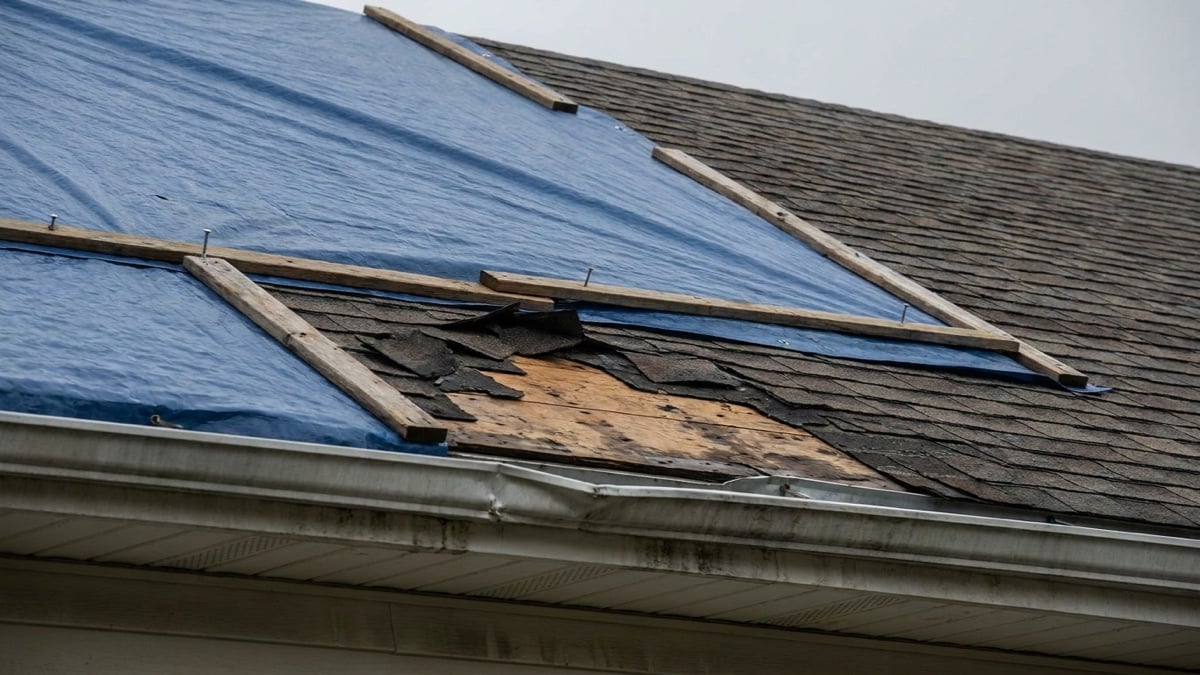
Featured image: AI-generated editorial illustration of a residential shingle roof with a blue emergency tarp battened over storm damage, torn shingles and exposed plywood decking at the eave. Not a particular property.