

Starting December 28, 2026, a USDA-guaranteed loan can finance a home that contains a rentable accessory dwelling unit. A final rule published October 29 strikes the restriction that has kept income-producing units out of the program, and it extends the same relief to houses with design features built for a home-based business. The rent from that unit still cannot help you qualify. Rural Housing Service said so twice in its answers to public comments, on the ground that potential unit income is not verifiable, stable or likely to continue. Two older tests decide whether the program is open to you at all, and neither one changed: the address has to fall outside USDA’s mapped ineligible areas, and the household’s adjusted annual income has to land under the limit for its metro area.
What the December rule actually changes
The rule is a final rule from Rural Housing Service, published at 91 FR 68025 on October 29, 2026 under docket RHS-26-SFH-0100, effective December 28, 2026. It adopts the proposal published on March 31, 2026 without modification, after 28 respondents commented.
Today, 7 CFR 3555.102(b) bars loan funds from the purchase or improvement of land or buildings typically used principally for income-producing purposes, and 7 CFR 3555.201(b)(2) says the site must not include income-producing land or buildings to be used principally for income-producing purposes. A house with a garage apartment rented to a tenant runs into both. On December 28 each of those sentences picks up a carve-out: the limitation “shall not apply when an otherwise qualifying property contains, or will contain, a single or multiple accessory dwelling units.”
A companion change to 7 CFR 3555.102(c) covers the house built to accommodate work instead of a tenant. Its restriction on buildings designed for a business stops applying to design features that support “a home-based business or businesses; such as childcare, product sales, or craft production; which do not require specific commercial real estate features.” A converted front room used for childcare now reads differently from a storefront.
Two definitions enter 7 CFR 3555.10 alongside those changes. An accessory dwelling unit is a habitable living unit inside or detached from a single family dwelling, subordinate in size, with separate ingress and egress, which together with the main house constitutes a single interest in real estate. A living unit has to carry potable water, sanitary facilities and safe sewage disposal, heating, hot water, adequate electricity, kitchen facilities with a sink and a stove hookup, and at least one bathroom with a water closet, lavatory and bathtub or shower. A finished bonus room over the garage with no kitchen and no bathroom falls outside that definition, and it never needed this rule.
Rent from the unit will not help you qualify
Four respondents asked Rural Housing Service to let applicants count unit income, and one asked specifically about room rent. The agency declined both times, citing 7 CFR 3555.152(a)(3), which bars a lender from using income in an applicant’s ratios when the source cannot be verified, the income is not stable, or it is unlikely to continue. Potential income from an accessory dwelling unit, by the agency’s determination, falls into that category.
That answer matters because the program runs three separate income figures and they do different jobs. Repayment income under 7 CFR 3555.152(a) is the stable income of the people signing the note, and it sets your ratios. Annual income under 7 CFR 3555.152(b) is the income of every household member, whether or not they sign. Adjusted annual income under 7 CFR 3555.152(c) takes annual income and subtracts the verified deductions the household qualifies for, and that is the number tested against the limit.
Under 7 CFR 3555.151(h)(1)(i), repayment is considered adequate when principal, interest, taxes, insurance, association dues, the monthly share of the annual fee and other real estate assessments stay within 29 percent of repayment income, and when that figure plus recurring monthly debts stays within 41 percent. Unit rent sits outside both calculations.
Whether the address qualifies, and what the map does not settle
Rural Development guarantees loans only in areas it has designated rural, under 7 CFR 3555.201(a). That designation traces to section 520 of the Housing Act of 1949, codified at 42 U.S.C. 1490, which reaches open country and any place outside an urban area with a population under 2,500, or under 10,000 if rural in character. A separate clause in the same section holds existing classifications in place until data arrives from the 2030 census, for areas that run between 10,000 and 35,000 people, remain rural in character and still show a serious lack of mortgage credit. Eligibility in a growing town carries a date on it.
USDA publishes the boundaries on its Rural Development Eligibility Lookup Tool, which shades ineligible areas in orange and states at the top of the map that highlighted areas are ineligible. On November 8, 2026 we queried USDA’s own single family ineligible-area layer at the geocoded center point of each community below. Every ineligible polygon returned for those points carries an effective date of July 25, 2023.
| County | Center point outside the ineligible area | Center point inside the ineligible area |
|---|---|---|
| Lake | Groveland, Mascotte, Minneola, Montverde | Clermont, Mount Dora |
| Orange | Oakland | Apopka, Ocoee, Windermere, Winter Garden |
| Osceola | None of the points checked | Celebration, Kissimmee, St. Cloud |
| Polk | Davenport, Haines City, Polk City | Lakeland, Winter Haven |
| Seminole | None of the points checked | Altamonte Springs, Lake Mary, Longwood, Sanford |
| Volusia | None of the points checked | Deltona |
Read that table as a map reading at one coordinate, never as a verdict on a city. Minneola’s center point sits outside the shaded area while neighboring Clermont’s sits inside it, and Oakland’s sits outside while neighboring Winter Garden’s sits inside. Boundaries like those run through neighborhoods, so two houses a few streets apart can land on opposite sides. USDA attaches its own warning to the map: final determination of property eligibility must be made by Rural Development upon receipt of a complete application, and viewing the eligibility maps does not constitute a final determination.
The income limit is measured on the household
Under 7 CFR 3555.151(a), the household’s adjusted income must not exceed the applicable moderate income limit at the time of loan approval. USDA publishes those limits in Appendix 5 of Handbook HB-1-3555. The Florida page in the current table, dated July 13, 2026 under procedure notice PN 657, carries the FY 2026 figures below for the guaranteed loan.
| Metro area | Counties we serve | 1 to 4 people | 5 to 8 people |
|---|---|---|---|
| Orlando-Kissimmee-Sanford, FL MSA | Lake, Orange, Osceola, Seminole | $132,100 | $174,400 |
| Lakeland-Winter Haven, FL MSA | Polk | $122,800 | $162,100 |
| Deltona-Daytona Beach-Ormond Beach, FL | Volusia | $122,800 | $162,100 |
Those ceilings apply to adjusted annual income, so the gross figure on your pay stubs is the wrong number to compare them against. The household first adds the income of every member under 7 CFR 3555.152(b), including members who will not sign the note, then subtracts the deductions it qualifies for under 7 CFR 3555.152(c): an allowance for each family member other than the head of household or spouse who is under 18, disabled or a full-time student, child care costs for a child aged 12 or under that let a family member work or study, and disability-related care expenses above 3 percent of annual income. An adult child living at home pushes the household figure up; a young child can pull it back down.
What the guarantee costs
USDA set the fees for fiscal year 2027 in a notice to lenders dated September 16, 2026: an upfront guarantee fee of 1.00 percent and an annual fee of 0.35 percent, identical for purchases and refinances. Fiscal year 2027 runs from October 1, 2026 through September 30, 2027. Both figures sit well under the regulatory ceilings of 3.5 percent upfront and 0.5 percent annually in 7 CFR 3555.107(g) and (h), so they can move when a new fiscal year opens.
Take a $350,000 purchase price with nothing down. The upfront fee comes to $3,500. Financed into the loan it brings the amount borrowed to $353,500, which is exactly the ceiling 7 CFR 3555.103 allows when the appraisal matches the contract price, because that section caps the loan at market value plus the upfront guarantee fee. The annual fee runs on the average scheduled unpaid principal balance, so a first year measured on the opening balance works out to $1,237.25, roughly $103.10 a month, and the amount declines as the loan amortizes. Separately, 7 CFR 3555.104 requires a fixed rate over a term no longer than 30 years and makes adjustable rate, balloon and prepayment-penalty structures ineligible.
What to confirm before you write the offer
- Run the exact street address through USDA’s eligibility map rather than the city name, and save the result with the date you checked it.
- Ask your lender to price the deal on adjusted annual income for every household member, not on the income of the people signing the note.
- Establish whether the extra space is a living unit under the new definition, which turns on a kitchen with a sink and stove hookup, a full bathroom and separate access.
- Check whether the unit is permitted and whether local zoning allows it to be occupied, because the federal rule governs the loan guarantee and says nothing about local approval.
- Confirm the closing date against December 28, 2026 if the property has a tenant in the accessory unit, since the carve-out does not exist before that date.
- Price the annual fee into your monthly budget, because 7 CFR 3555.151(h)(1)(i) counts it inside the 29 percent ratio.
Frequently Asked Questions
Can I use rent from the accessory unit to qualify for the loan?
No. Rural Housing Service addressed this twice in the final rule and declined both requests, applying 7 CFR 3555.152(a)(3), which bars income that cannot be verified, is not stable or is unlikely to continue. Potential income from an accessory dwelling unit falls into that category by the agency’s determination and will not be included in income calculations. That unit can change what you are allowed to buy without changing what you are approved to borrow.
My town shows as ineligible on the USDA map. Is that the final word?
Not for a specific property. The map draws areas, and those boundaries ignore city limits, so a point check at one coordinate says nothing about an address a mile away. USDA states that final determination of property eligibility must be made by Rural Development upon receipt of a complete application, and that viewing the maps does not constitute a final determination. Designations also change, and 7 CFR 3555.201(a) protects applications where the purchase contract was complete before a change to nonrural.
Does the new rule mean I can buy a duplex with a USDA loan?
No. The carve-out is written for an accessory dwelling unit, which the rule defines as subordinate in size to the single family dwelling and part of a single interest in real estate. A separate prohibition in 7 CFR 3555.102(b) on financing property used principally for income-producing purposes stays in force, and 7 CFR 3555.151(c) still requires you to occupy the home as your principal residence. Vacant land, property used primarily for agriculture or farming, and property used primarily for commercial enterprise also stay outside the program under the revised 7 CFR 3555.201(b)(2).
Buying with a zero-down loan in Central Florida
The address test is the one that ends most of these conversations, and it takes minutes to run before anyone writes an offer. We can check a specific property against the current USDA map, tell you whether the extra space on the listing meets the new living unit definition, and work through how the household income figure will be built. If the address falls inside an ineligible area, Florida Hometown Heroes may still reach it. Our guide to the real monthly cost of a Florida home covers what the annual fee sits alongside, and buyers comparing programs often weigh what an FHA loan asks of the seller. To work through a specific property, book a strategy session at mvphomegroup.com/nelsoncruz. This is general information about a federal loan program and published USDA figures, not legal advice, not lending advice, and not a determination about any particular property or applicant.
Nelson Cruz, P.A.
Founder & CEO
MVP Home Group, Real Broker LLC
Nelson brings nearly two decades in law enforcement to his work in real estate. View Nelson’s profile or contact our team at 407-901-9939 or [email protected].
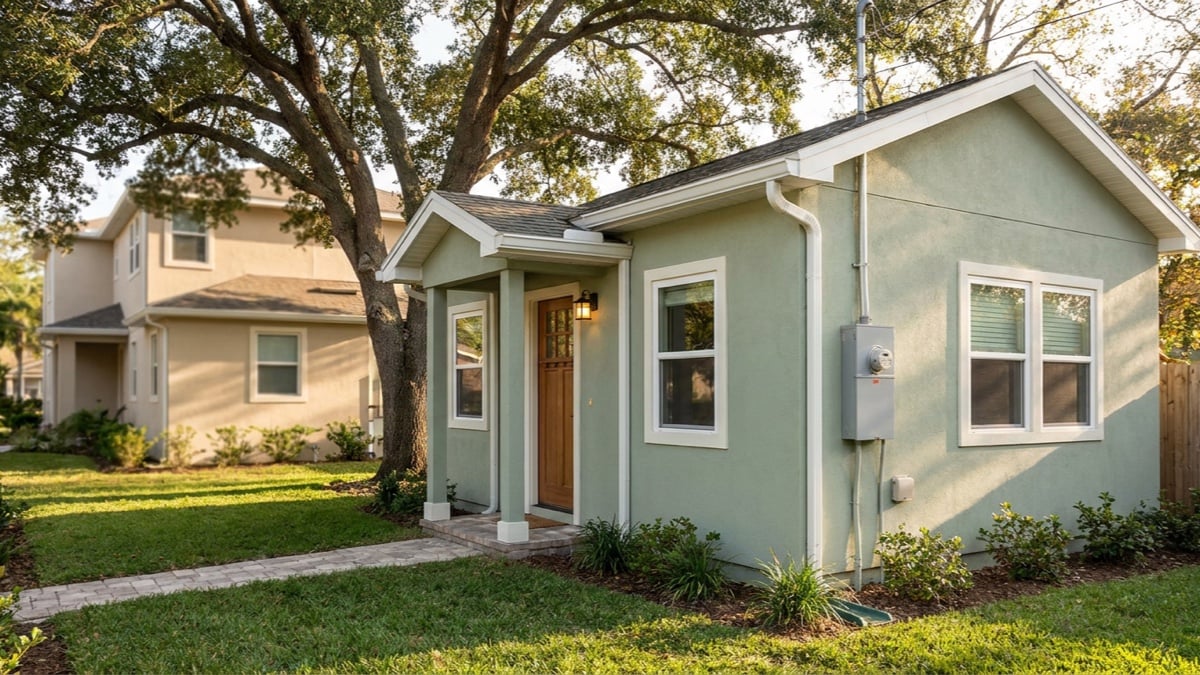
Featured image: AI-generated editorial illustration of a detached single-story backyard cottage with its own entry door and exterior electric meter, standing behind a larger residential house in afternoon light. Illustrative only. No readable text or markings. Not a particular property and not an example of a unit that meets the USDA definition.