

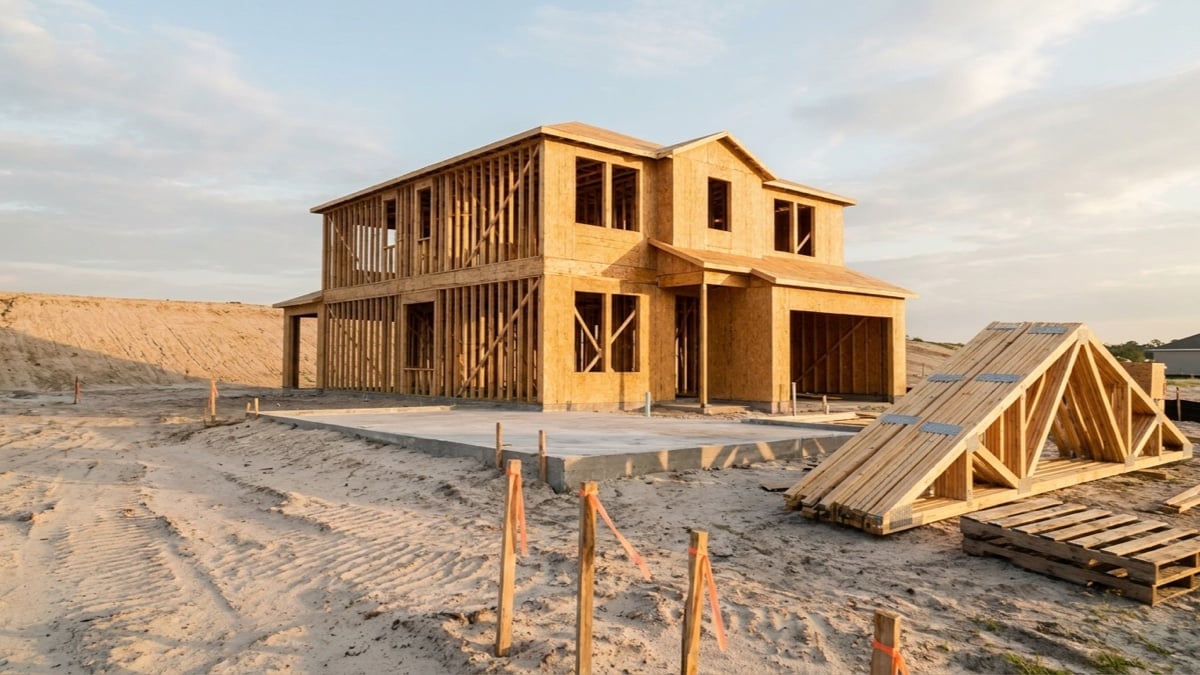
If your house was not finished on January 1, Florida law puts no value on it for that whole tax year. Fla. Stat. 192.042(1) assesses real property as of January 1 and states that improvements not substantially completed on that date “shall have no value placed thereon.” The Polk County tax figure that appears on a to-be-built closing statement is therefore the bare lot’s tax. The first bill that carries the finished house lands the November after the first January 1 the house is standing, and in the worked example below it runs about five times the land-only figure.
When does Polk County first put a value on your house?
On the first January 1 that the house is substantially complete. Fla. Stat. 192.042(1) defines “substantially completed” as the point where the improvement, or some self-sufficient unit within it, “can be used for the purpose for which it was constructed.”
Run a typical to-be-built timeline through that rule. You sign a builder contract in October 2026 on a graded, empty lot. On January 1, 2027, there is framing and no certificate of occupancy, so the 2027 tax roll carries the lot alone. You close in April 2027 and move in. The house is standing on January 1, 2028, so the 2028 roll is the first one that values it, and that bill reaches you in late 2028.
The back end is fixed by statute. Under Fla. Stat. 197.322, the tax collector publishes notice that the roll is open on November 1 and sends tax notices within 20 working days of receiving the certified rolls. Fla. Stat. 197.162 then runs the early payment discount from 4 percent in November down to zero in March.
The tax number at your closing is the lot’s tax
Taxes get prorated at closing from the most recent bill. On a to-be-built home that bill is the land-only bill, which means the credit you see on the settlement statement is calculated from a number that will not exist again.
The Polk County Property Appraiser flags the same gap in its own tax estimator disclosures, which warn that a pre-construction sales price “may need to be adjusted to reflect the increase in value from the date of the contract to the January 1st appraisal date.” That page also notes millage is adopted by ordinance “usually by October 8th,” so the rate behind your second bill is set months after you sign.
It carries a second warning worth acting on: new subdivisions or parcels not yet in the appraiser’s file “may be subject to non-ad valorem assessments that are not reflected in this estimate,” and it tells you to contact the developer. Those are the community development district lines. We break down what a CDD adds to a payment in this post on CDD bond and operating assessments, with a lot-by-lot example in our write-up on Tohoqua in Kissimmee.
A Polk County worked example
Highland Homes lists its VillaMar community in southeast Winter Haven from $259,900 for 1,358 to 2,227 square feet, checked October 29, 2026. Use that as the completed just value.
The rates come from the Polk County Property Appraiser’s 2026 Final Millage Rates, printed October 6, 2026. Unincorporated tax code 90 totals 12.8971 mills. A City of Winter Haven parcel on millage code 90410 totals 18.6659 mills, which is the city’s 6.5900 added to 12.0759. Confirm which code your parcel carries before you rely on either one, because the difference on this price is about $1,500 a year.
| Tax year | Unincorporated Polk, 12.8971 mills | Winter Haven city, 18.6659 mills |
|---|---|---|
| Land only, illustrated at a $50,000 January 1 land value | $644.86 | $933.29 |
| First year the finished house is on the roll, no homestead | $3,351.96 | $4,851.27 |
| Same year with homestead granted | $2,838.55 | $4,049.42 |
The $50,000 land value in the first row is an illustration, not a figure from any parcel. Pull the actual January 1 land value from the parcel page on the appraiser’s site. Every other number is computed from the published millage.
The homestead rows follow Fla. Stat. 196.031: the first $25,000 comes off for all levies, and the second $25,000, which applies to assessed value above $50,000, comes off for every levy other than school district levies. Polk’s school total is 5.2580 mills, so the second $25,000 works against 7.6391 mills in the unincorporated example and 13.4079 mills inside Winter Haven.
The escrow shortage is the part that catches people
Your servicer sets up the escrow account using the tax figure available at closing. Under 12 CFR 1024.17(f)(1)(i), it runs an escrow account analysis when the account is established and again at the end of each computation year. The year the real bill arrives, that analysis finds a shortage.
Carry the unincorporated numbers forward. Escrowing the land-only $644.86 costs about $53.74 a month. Escrowing $3,351.96 costs about $279.33 a month. The ongoing increase is roughly $225.59. Separately, the account is short by about $2,707.10 for the year that already ran.
12 CFR 1024.17(f)(3)(ii) gives the servicer two choices on a shortage of one month’s escrow payment or more: leave it alone, or collect it in equal monthly payments over at least a 12 month period. Spread over 12 months, that catch-up adds another $225.59. For one year the escrow portion of your payment can rise by roughly twice the amount it eventually settles at. Our walkthrough of the real monthly cost of a Florida home stacks tax, insurance and association costs into the figure to plan against from the start.
Homestead starts on January 1, and a builder contract is not ownership
Fla. Stat. 196.031(1) grants the exemption to a person who, on January 1, holds legal or equitable title and in good faith makes the property a permanent residence. Fla. Stat. 196.011(1)(a) requires the application on or before March 1 and treats a missed deadline as a waiver for that year.
Polk County is explicit about what does not count. Its exemptions page states that a Contract for Sale or Purchase, Purchase Contract, Sales Contract or similar document “will not be considered by this office as it does not convey equitable title and is merely a contract to purchase the property at a future date.” A recorded agreement for deed can qualify. A signed builder contract cannot.
The office also tells buyers who closed after January 1 to pre-file for the next tax year, and its important dates page opened 2027 pre-filing on March 2, 2026. If you close this winter and occupy the home before January 1, 2027, you are filing for 2027 and the statutory deadline is March 1, 2027. If you close after January 1, 2027, pre-file for 2028 now rather than waiting.
The Save Our Homes cap arrives a year behind the exemption. Fla. Stat. 193.155(1) reassesses homestead property annually beginning the year following the year it first receives the exemption, capped at the lesser of 3 percent or the change in the Consumer Price Index. The first year your homestead is granted is assessed at market value, and the cap starts the year after that.
Five things to confirm before you sign the builder contract
- Ask the builder in writing whether the lot is expected to be substantially complete before January 1, and get the target certificate of occupancy date. That one date sets which year carries your first full bill.
- Look up the parcel on the Polk County Property Appraiser site and record the January 1 land value and the millage code. Unincorporated and city codes are different numbers on the same street map.
- Ask your lender to run the initial escrow on the completed value at the published millage rather than on the land-only bill, and get the monthly figure both ways.
- Ask the developer, in writing, for every non-ad valorem assessment that will appear on the parcel, including any CDD debt and operating lines, since the appraiser’s estimator will not show them on a new parcel.
- Put the homestead filing on your calendar for the January after you own and occupy, and pre-file if your closing falls after January 1.
Have us price the tax line before you sign the builder contract
We can pull the parcel’s land value and millage code, get the builder’s completion target in writing, ask the developer for the full assessment schedule and hand your lender the completed-value tax figure so the escrow is funded correctly the first time. Set up a strategy session, or see how we work with buyers across Polk County and Central Florida. If you are moving an existing exemption, our post on the Save Our Homes portability window covers the filing deadline that sits alongside this one.
Frequently Asked Questions
Who pays the property tax while my house is being built?
Whoever owns the lot on January 1 is the one assessed for that year, and the parcel is billed on its land value alone if the house was not substantially complete on that date under Fla. Stat. 192.042(1). At closing, that year’s taxes are prorated between the parties. The amount is small because the structure is not on the roll yet.
My Polk County home finishes in December. Do I get homestead for that year?
Only if you hold title and occupy it as your permanent residence on January 1 of the year you are claiming, per Fla. Stat. 196.031(1). Closing in December 2026 and moving in before January 1, 2027 puts you in line for the 2027 exemption, filed by March 1, 2027. Closing on January 5 moves that to 2028.
Will my first full tax bill match the price I paid the builder?
Not necessarily. The bill is calculated on the appraiser’s just value as of January 1, which can differ from a contract price signed months earlier. The Polk County Property Appraiser’s own estimator disclosures say a pre-construction sales price may need adjusting to reflect the change in value between the contract date and the January 1 appraisal date.
Nelson Cruz, P.A.
Founder & CEO
MVP Home Group, Real Broker LLC
Nelson brings nearly two decades in law enforcement to his work in real estate. View the profile or contact our team at 407-901-9939 or [email protected].