

Winning a Florida clerk’s foreclosure auction buys you the court’s certificate of title, not a closing. You post 5 percent of your bid on the spot, fund the rest within the period the judgment sets, and wait 10 days for the title to issue. Unpaid association dues and property taxes can follow the property to you.
There is no inspection, no financing contingency, no title commitment and no walk-through. A clerk’s sale under section 45.031 of the Florida Statutes is a cash purchase, and the price on the auction calendar is not the price you pay. Here is what the sale transfers, what the statutes add to your bid, and which liabilities survive it.
The sale is a court procedure on a fixed clock
Under section 45.031(1)(a), the final judgment directs the clerk to sell on a specified day not less than 20 and not more than 35 days after the judgment, unless the plaintiff consents to a later date. Section 45.031(10) lets the clerk sell electronically, and Lake and Orange counties both do. Orange County’s clerk routes its “Online Foreclosure Sales” link to its auction site on realforeclose.com, and Lake County runs its own site on the same platform. The statute lets the clerk require bidders to advance funds before bidding, so registration and a deposit come first.
Three documents follow, in order. The clerk files a certificate of sale promptly after the auction. If no objections are filed within 10 days, the clerk files a certificate of title. On that filing, section 45.031(6) says the sale stands confirmed and title passes without further proceedings or instruments. No deed from a seller, no closing table.
What you pay on top of the bid
Section 45.031(3) requires the high bidder to post 5 percent of the final bid at the time of the sale, applied to the price when you pay. The deadline for the balance comes from the judgment and the clerk’s published terms, so read both for your county before registering.
Two statutory charges then ride on top of the bid, and neither shows on the auction calendar:
- The clerk’s registry charge. Section 45.035(3) subjects the winning bidder’s deposit to the service charge in section 28.24(11) for receiving money into the registry of the court: 3 percent of the first $500 and 1.5 percent of each subsequent $100. Section 28.24 sets these as maximums the clerk may not exceed.
- Documentary stamp tax. Section 201.02(1)(a) taxes conveyances at 70 cents per $100 of consideration. Rule 12B-4.013(3)(a) of the Florida Administrative Code applies it to a clerk’s conveyance of realty sold under foreclosure, computed on the highest and best bid, and makes the clerk collect it from the high bidder when the certificate of title is recorded.
On a $310,000 winning bid, that arithmetic runs as follows:
| Item | Authority | Amount |
|---|---|---|
| Winning bid | Your bid | $310,000.00 |
| Deposit posted at the sale | s. 45.031(3), 5 percent | $15,500.00 |
| Balance to fund by the deadline | s. 45.031(3) | $294,500.00 |
| Clerk’s registry charge | s. 28.24(11)(a) | $4,657.50 |
| Documentary stamp tax on the bid | s. 201.02(1)(a); Rule 12B-4.013(3)(a) | $2,170.00 |
| Cash required to take title | $316,827.50 |
The two charges add $6,827.50, or 2.20 percent over the bid. The $70 judicial sale charge in section 45.035(1) and the electronic sale charge of up to $70 in section 45.035(3) are advanced by the plaintiff, so they are not bidder money. Budget from the all-in figure, because a bid that works at $310,000 and fails at $316,827.50 costs you the deposit.
The liabilities that survive the sale
A first mortgage foreclosure wipes out junior interests properly brought into the suit. It does not clear everything, and two survivors regularly surprise third-party bidders.
Property taxes. Section 197.122(1) makes taxes imposed under the State Constitution and Florida law a first lien, superior to all other liens, continuing from January 1 of the year levied until discharged by payment. The same subsection holds every owner responsible for finding out and paying current and delinquent amounts. Pull the tax account before you bid.
Association assessments. This is the sharpest trap, because the well-known safe harbor is not yours. Section 718.116(1)(a) makes a unit owner, regardless of how title was acquired, including by purchase at a foreclosure sale, jointly and severally liable with the previous owner for all unpaid assessments that came due up to the transfer of title, and section 720.3085(2)(b) says the same for a homeowners’ association parcel. The cap in sections 718.116(1)(b) and 720.3085(2)(c), the lesser of 12 months of unpaid assessments or 1 percent of the original mortgage debt, runs only to a first mortgagee or a subsequent holder of that mortgage. A third-party bidder gets none of it, and section 718.116(1)(c) gives you 30 days after transfer of title to pay in full.
Take $6,400 of assessments unpaid through transfer of title, dues of $320 a month, on an original mortgage debt of $248,000:
| Who takes title | How the cap is measured | Owed to the association |
|---|---|---|
| The foreclosing first mortgagee | Lesser of 12 months ($3,840.00) or 1 percent of $248,000 ($2,480.00) | $2,480.00 |
| You, a third-party bidder | No cap; joint and several for all arrears | $6,400.00 |
Same house, same debt, $3,920.00 of difference, driven entirely by who holds the certificate of title. Ask for the estoppel figure. We covered how that liability attaches on an ordinary purchase in what happens when your seller owes the HOA, and recorded code enforcement liens deserve the same search, covered in whether a code violation follows a Florida home to you.
Occupants do not leave because you won
If a bona fide tenant lives there, the federal Protecting Tenants at Foreclosure Act governs. Section 702 of that act, enacted in Public Law 111-22, makes any immediate successor in interest take the property subject to giving a bona fide tenant a notice to vacate at least 90 days before its effective date, and subject to the tenant’s right to finish the remaining term of a bona fide lease entered into before the notice of foreclosure. A successor selling to a purchaser who will occupy the unit as a primary residence may end the lease on the date of that sale, still subject to the 90-day notice.
That act had a sunset, and section 304 of Public Law 115-174 repealed the sunset and restored the provisions, so the 90-day rule is live law. Florida keeps a mirror copy at section 83.5615, but its note states it was created effective upon repeal of the federal act, so the federal version binds a buyer today. A tenancy counts as bona fide only if the tenant is not the mortgagor or the mortgagor’s child, spouse or parent, the tenancy was arms-length, and the rent is not substantially less than fair market rent unless subsidized. A former owner who stayed is not a tenant, and removing an occupant is a separate proceeding with its own cost.
Two protections that work in a bidder’s favor
Section 45.031(8) makes the amount bid conclusively presumed to be sufficient consideration, and provides that service of an objection to the bid amount does not affect or cloud the purchaser’s title in any manner. Section 702.036 goes further: if someone later seeks to set aside a final judgment of foreclosure, the court must treat the request solely as a claim for monetary damages and may not grant relief affecting the quality or character of the title, provided four conditions hold. The party seeking relief was properly served, the judgment was entered as to the property, all appeal periods have run and any appeal is finally resolved, and the property was acquired for value by someone unaffiliated with the foreclosing lender or the foreclosed owner while no lis pendens challenging the foreclosure appeared in the official records.
Before any of that, the borrower can still stop the sale. Section 45.0315 lets the mortgagor or the holder of any subordinate interest cure at any time before the later of the clerk filing the certificate of sale or the time specified in the judgment. After that, the statute says there is no right of redemption. Cases do get cancelled on the morning of the auction, and your preparation is not refundable.
What to check before you register to bid
- Read the final judgment and the docket, not the auction listing. The judgment sets the sale date, the payment deadline and the legal description, and names the lien foreclosed, which determines what got wiped out.
- Confirm it is a mortgage foreclosure sale. A tax deed sale under chapter 197 is a different proceeding. Section 197.552 provides that no right, interest, restriction or covenant survives a tax deed except an unsatisfied lien of record held by a municipal or county governmental unit, special district or community development district.
- Pull the tax account and the association estoppel. Both can attach to you, and the association figure runs on a 30-day clock after title transfers.
- Search the official records for liens that were not in the suit. A lien never joined was never foreclosed. Our survey and title exceptions checklist covers the categories worth reading.
- Price the add-ons into your maximum bid, then add the cost of clearing occupants and whatever the interior turns out to be.
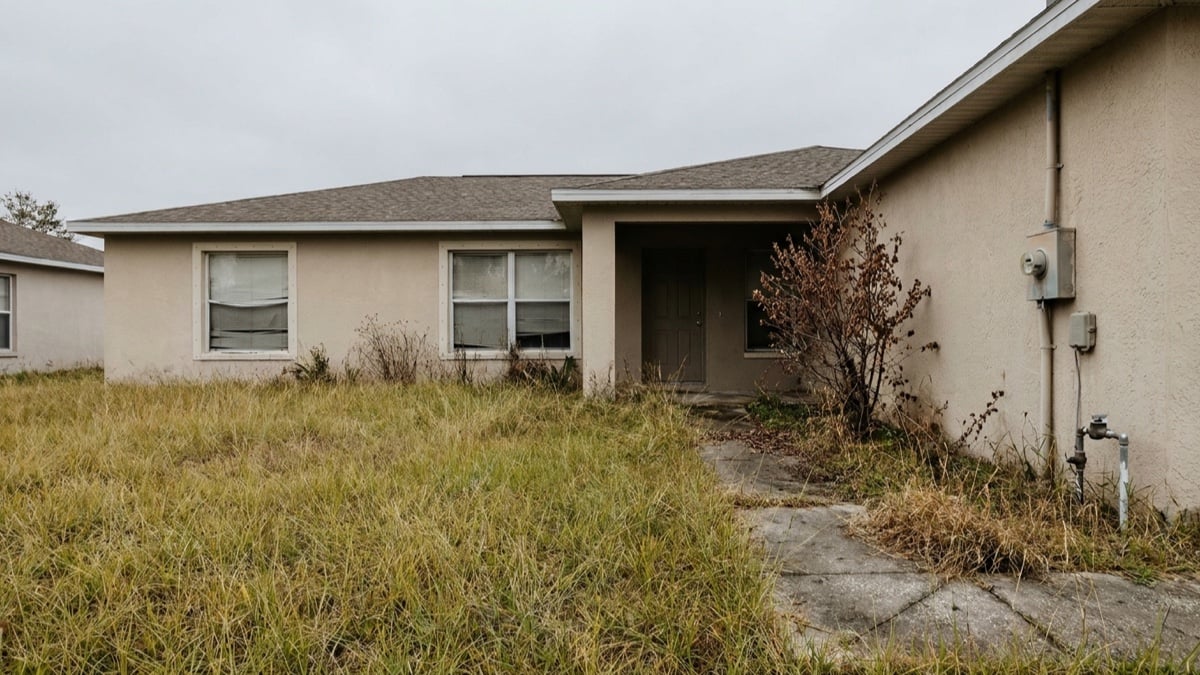
- Assume you will not see inside. You are bidding on an exterior and a records trail.
Common questions
Can I get a mortgage to buy at a foreclosure auction?
Not in the ordinary sense. Section 45.031(3) requires 5 percent at the sale and the balance within the period the judgment prescribes, far shorter than loan underwriting, and the sale gives no appraisal access, inspection period or title commitment to satisfy a lender. Bidders fund in cash and finance afterward against the property they now own. For how an ordinary purchase compares, see what Florida closing taxes a mortgage adds.
Do I get title insurance from the clerk?
No. The clerk issues and records a certificate of title under sections 45.031(5) and (6). That is a conveyance, not an insured title. A title insurer runs its own search and decides what it will cover, and the survivors above are what it looks for. The 10-day objection window exists so parties to the case can object, not so a buyer can perform due diligence.
What happens to my deposit if I cannot fund the balance?
Section 45.031(3) is direct. The clerk readvertises the sale and pays all costs of the sale from your deposit, applying any remainder toward the judgment. On a $310,000 bid that is $15,500 at risk on a deadline you accepted when you bid.
The auction is a legitimate way to buy, and the title protections above are stronger than most buyers expect. What it is not is a discounted version of a normal purchase: the discount is the price of taking a property without inspection, without title work and with the surviving liabilities attached. If you want the judgment, the tax account and the association position read before you register, book a strategy session with our team at mvphomegroup.com/nelsoncruz.
This is general information about Florida statutes and published court procedure, and it is not legal advice, a title opinion or a bidding recommendation for any particular case or property.
Nelson Cruz, P.A.
Founder & Team Leader | MVP Home Group, Real Broker LLC
Nelson brings nearly two decades in law enforcement to his work in real estate. View Nelson’s profile or contact our team at 407-901-9939 or [email protected].