

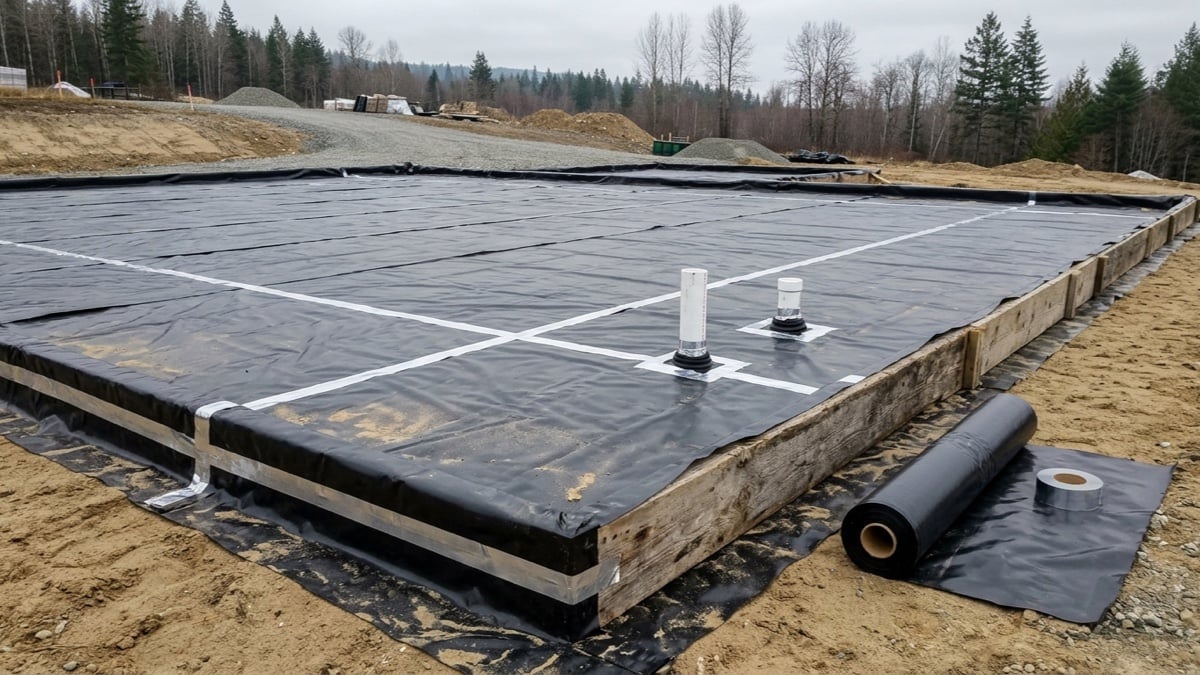
Polk County appears on Florida’s radon protection map with all three zone types for houses and duplexes, including areas where the state recommends active radon control. The construction standard that answers that recommendation is voluntary across Florida, so no Polk builder has to follow it. If you want a radon-resistant slab, it has to be in the contract before the concrete goes down.
That gives this decision a hard deadline. The work sits under the slab, so the window closes on pour day and does not reopen.
What the state’s radon map says about Polk County
The Florida Department of Health publishes the Florida Radon Protection Maps, developed by the Division of Codes and Standards at the Department of Business and Professional Regulation and published in 1995 out of the Florida Radon Research Project. They sort the state into three zone types: red, where active radon control is recommended; yellow, where passive control is recommended; and green, where control is generally considered unnecessary. The state publishes a map only for a county that has areas where added radon-resistant features are recommended.
On the single-family and duplex table, Polk is marked in all three columns, so it holds active-control zones, passive-control zones and no-control zones. Neither Lake nor Orange County is marked in any column at all. That is the distinction worth carrying into a builder conversation in Davenport, Haines City, Winter Haven or Lakeland.
The same state page adds two caveats that matter on a construction site. The maps say nothing about how common radon problems are or the odds that one building has one. They model radon source potential for a house on native soil with minimal ground disturbance, and the department warns that construction digging can unearth higher-radium soil and that imported fill can introduce higher radium. A graded and filled homesite is not the condition the map was drawn for.
Why no Polk builder has to build a radon-resistant slab
Florida has a written standard. Section 553.98(2) of the 2026 Florida Statutes records that the Legislature approved the department’s rules for radon-resistant passive construction standards for residential buildings. The standard is dated July 1, 1995, is incorporated by reference at Rule 9B-52.004 of the Florida Administrative Code, and is carried in the Florida Building Code, Residential as Appendix F.
What the statute does not do is make it mandatory. Section 553.98(3) allows a local radon-resistant construction ordinance by one route only: a county governing authority plus the governing bodies of municipalities representing at least a majority of the county’s municipal population have to enter an interlocal agreement adopting the department’s standard, which then applies uniformly across the adopting jurisdictions. The same subsection bars any other local radon construction requirement. Polk County includes 17 municipalities by the county’s own count, which makes that a seventeen-city conversation plus the Board of County Commissioners. Florida’s radon program states that the standards are currently voluntary and that it would take a majority of a county’s building permit issuing agencies to turn them into required code there.
So the inspector signing off on your foundation is checking the code that applies to your permit, and Appendix F is an appendix. Confirm the current requirement with the office issuing the permit. The Polk County Building Division takes plans questions at its Bartow office at 863-534-6080 and also runs an office in Lake Alfred.
What the Florida standard actually requires
Asking for “radon-resistant construction” invites an argument about definitions. Naming the standard ends it, because the standard is specific.
| Element | What the Florida passive standard specifies | When it happens |
|---|---|---|
| Sub-slab membrane | Minimum 0.006 inch (6 mil) single-layer polyethylene covering all soil below the floor, or another nondeteriorating nonporous material with equal resistance to air flow, puncture and tearing and a permeance under 0.3 perm | Before the pour |
| Seams | Lapped at least 12 inches and secured with a continuous band of tape or mastic centered over the top sheet’s edge. Paper and cloth tape are not allowed | Before the pour |
| Penetrations | Membrane fitted to within 1/2 inch of every pipe, conduit, stake or reinforcing bar and sealed to it. Work spaces formed into the slab, such as under a tub drain, sealed gas tight | Before the pour |
| Slab edge | Three permitted details only: thickened-edge monolithic with the membrane past the slab edge; slab poured into a stem wall forming a solid cap at least 8 inches thick; or slab capping a stem wall topped with solid masonry at least 4 inches thick | Foundation design |
| Concrete mix | Minimum design strength 3,000 psi at 28 days and design slump no more than 4 inches, with on-site slump capped at 5 inches | At the pour |
| Joints and cracks | Contraction joints sealed. Cracks wider than 1/32 inch, cracks with vertical displacement and cracks connecting weakened zones sealed with a flexible field-molded elastomeric sealant before flooring goes down | After cure |
| Ducts and air handler | No supply or return ducts below the slab. Return air separated from soil-contact floors by a sealed plenum or duct. Condensate drain joints sealed gas tight, terminating outside at least 6 inches above grade | Mechanical rough-in |
Florida’s passive standard works by sealing the slab and keeping the air system from pulling soil gas through it. It runs from section F101 through F307 and stops there, which leaves a gap worth pricing. The state’s own home buyer and seller guide describes a fuller package: a gas-permeable layer beneath the slab, plastic sheeting over it, sealing of below-grade openings, a 3-inch or 4-inch PVC vent pipe from that layer through the house to the roof, and an attic junction box so the wiring for a vent fan is already in place. The vent pipe and junction box are what let a passive system become an active one later for the cost of a fan, they sit outside the Florida standard, and they are cheap while the house is open.
What to put in the contract, and when
- Get the zone for your parcel. Call DBPR Codes and Standards at 800-543-8279. The published table is county-level and does not tell you which side of a zone line your lot sits on.
- Ask which specification the plans carry. A moisture vapor retarder and the radon detail are different specifications. The thickness, the seam lap and the penetration treatment are the three answers that separate them.
- Name the standard in the addendum. Reference the Florida Standard for Passive Radon-Resistant New Residential Building Construction dated July 1, 1995, Rule 9B-52.004, Appendix F of the Florida Building Code, Residential. A builder can price a named standard. Nobody can price an adjective.
- Add the rough-in as its own line. If you want the option of an active system, ask separately for the gas-permeable layer, the vent pipe to the roof and the attic junction box.
- Put a pre-pour look on the schedule. The day before the pour is the only day anyone can see whether the membrane, the seams and the penetration seals were built as specified.
- Test after the certificate of occupancy anyway. The state is direct: every new home should be tested as soon as possible after occupancy even when built to be radon-resistant, and radon levels cannot be predicted from state, local or neighborhood measurements.
- Use a test the state recognizes. In a real estate transaction the health department accepts two short-term passive tests placed together in the same location for at least 48 hours, with the home fixed if the average is at or above 4 pCi/L, or one continuous monitor run for at least 48 hours. Anyone charging a fee for radon measurement or mitigation in Florida must be certified by the department under section 404.056(2)(b).
The Florida Department of Health in Polk County mails a free radon test kit for a Florida residential building. Call 863-519-8330 or send the kit form to 2090 E. Clower St., Bartow, FL 33830. Separately, section 404.056(5) requires a radon notice on at least one document executed at or before the contract for sale of any building, in language the statute sets out word for word. That notice is statewide boilerplate and says nothing about your lot or your slab.
Frequently asked questions
Does Polk County require builders to use the radon-resistant standard?
No. Under section 553.98(3) of the Florida Statutes, a radon-resistant construction ordinance can only come from an interlocal agreement between the county governing authority and municipalities representing at least a majority of the county’s municipal population, and Florida’s radon program states that the standards are currently voluntary. Polk has 17 municipalities, which makes that a heavy lift. Confirm the current requirement with the building department issuing your permit; the Polk County Building Division answers at 863-534-6080.
My lot is in a green zone on the state map. Can I skip the whole thing?
Treat a green marking as a reason to expect less rather than a clearance. The maps model radon source potential for a building on native soil with minimal ground disturbance, and the health department warns on the same page that construction digging can unearth higher-radium soil and that imported fill can introduce higher radium. The department’s position is that the only way to know whether a building has a radon problem is to test it after it is finished.
Is it cheaper to deal with radon after I move in?
The state’s buyer guide says building radon-resistant features in during construction is easier and cheaper than fixing a radon problem from scratch later, and the standard shows why. The membrane, the seam laps and the penetration seals all live under the slab, so once the concrete is down a mitigation contractor is solving the same problem from above with a more invasive set of tools.
Where to go from here
This belongs with the other Polk decisions made before the slab. Your first Polk property tax bill covers the lot only, which changes the first year of escrow, and what Florida’s right-to-farm law protects next door is worth knowing before you pick a homesite. If something gets built wrong, Florida’s construction defect deadlines decide how long you have to act.
To go through a builder’s plans and addendum before you sign, book a strategy session with our team at mvphomegroup.com/nelsoncruz. We read the foundation specification and the contract together, because the specification decides what gets built and the contract decides whether you can insist on it. This is general information drawn from Florida statutes, the Florida Administrative Code, the Florida Building Code and state health department guidance, not legal, engineering or health advice; zone designations and published guidance change, so verify current terms for your address.
Nelson Cruz, P.A.
Founder & Team Leader
MVP Home Group, Real Broker LLC
Nelson brings nearly two decades in law enforcement to his work in real estate. View Nelson’s profile or contact our team at 407-901-9939 or [email protected].
Featured image: AI-generated editorial illustration of a residential foundation before the concrete pour, with black polyethylene sheeting spread over graded soil, taped overlapping seams, sealed plumbing stub-ups, a timber form board along the slab edge and a spare roll of sheeting. Not a particular property, builder or job site.